Lai Zhangqi, Lee Seullee, Hu Xiaoyue, Wang Lin
Key Laboratory of Exercise and Health Science of the Ministry of Education, Shanghai University of Sport, China.
J Musculoskelet Neuronal Interact. 2019 Sep 1;19(3):333-341.
This study aims to investigate the effects of adding whole-body vibration (WBV) exercise to squat training (ST) on the physical function and muscle strength of patients with knee osteoarthritis (KOA).
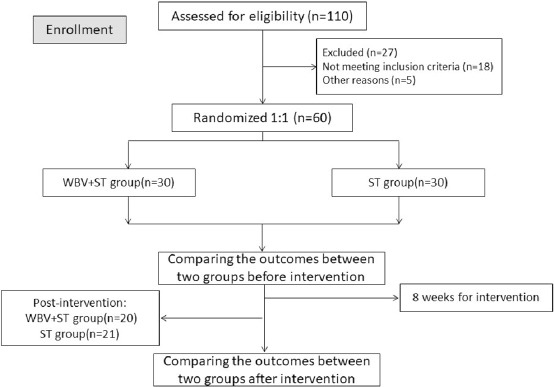
41 participants completed the intervention and measurements (ST group; n=21, age=65.00±4.39 years, BMI=23.01±2.95 kg/m; WBV+ST group; n=20, age=64.10±4.95 years, BMI=24.79±3.12 kg/m). The supervised eight-week intervention was performed three times per week with the intensity and duration increased gradually. Visual analog scale, Timed Up and Go test (TUG), 6-min Walk Distance test, and isokinetic measurements were performed at baseline and post-intervention.
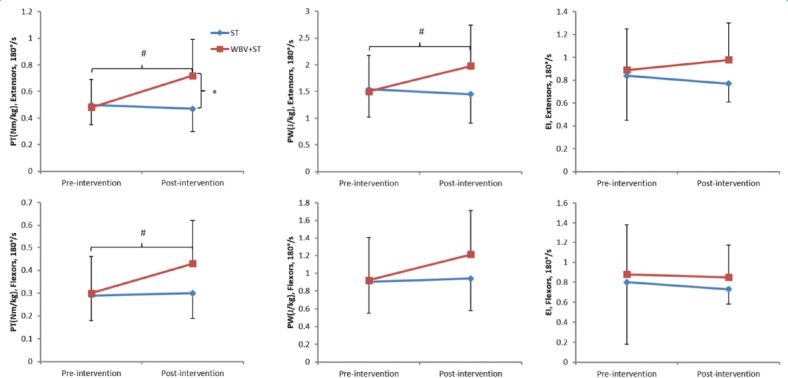
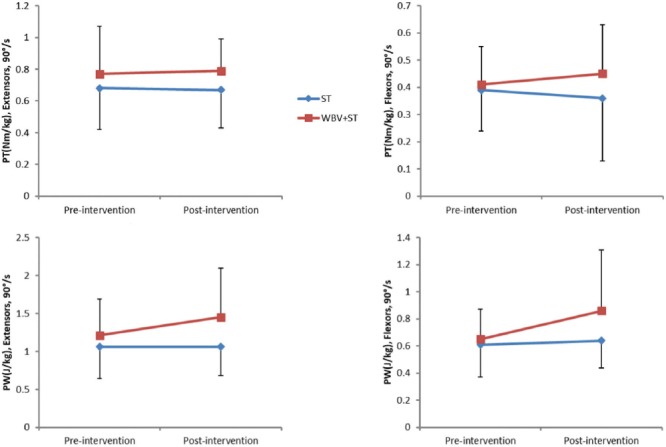
The peak torque (PT) of the extensors at 180°/s increased significantly in the WBV+ST group compared with the ST group (p = 0.046). The peak work of the extensors and the PT of the flexors at 180°/s improved only in the WBV+ST group (p<0.0125). However, no significant changes in these variables were found between groups (p>0.05).
Adding 8 weeks of WBV training to ST can more effectively improve the muscular strength of knee extensors compared with ST in patients with KOA.
本研究旨在探讨在深蹲训练(ST)中加入全身振动(WBV)运动对膝关节骨关节炎(KOA)患者身体功能和肌肉力量的影响。
41名参与者完成了干预和测量(ST组;n = 21,年龄= 65.00±4.39岁,BMI = 23.01±2.95 kg/m;WBV + ST组;n = 20,年龄= 64.10±4.95岁,BMI = 24.79±3.12 kg/m)。为期八周的监督干预每周进行三次,强度和持续时间逐渐增加。在基线和干预后进行视觉模拟量表、计时起立行走测试(TUG)、6分钟步行距离测试和等速测量。
与ST组相比,WBV + ST组在180°/s时伸肌的峰值扭矩(PT)显著增加(p = 0.046)。仅在WBV + ST组中,伸肌的峰值功和180°/s时屈肌的PT有所改善(p < 0.0125)。然而,两组之间这些变量没有显著变化(p > 0.05)。
与单纯ST相比,在KOA患者的ST中加入8周的WBV训练能更有效地提高膝关节伸肌的肌肉力量。