Esna Ashari Zhila, Brayton Kelly A, Broschat Shira L
School of Electrical Engineering and Computer Science, Washington State University, Pullman, WA, United States.
Department of Veterinary Microbiology and Pathology, Washington State University, Pullman, WA, United States.
Front Microbiol. 2019 Jun 21;10:1391. doi: 10.3389/fmicb.2019.01391. eCollection 2019.
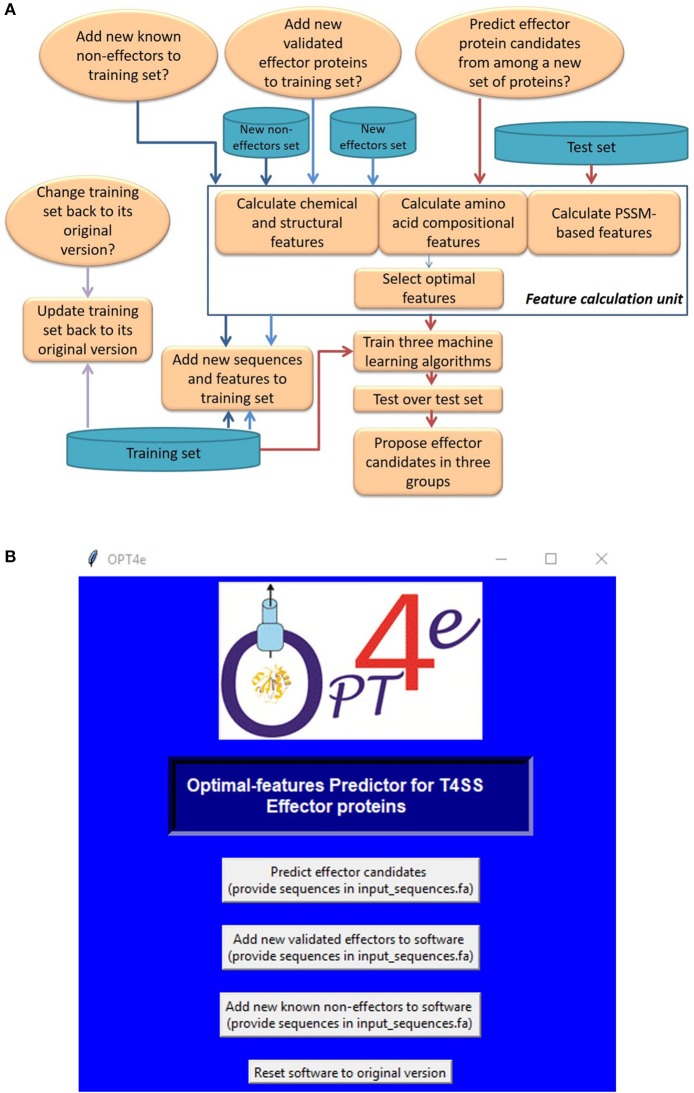
Type IV secretion systems (T4SS) are used by a number of bacterial pathogens to attack the host cell. The complex protein structure of the T4SS is used to directly translocate effector proteins into host cells, often causing fatal diseases in humans and animals. Identification of effector proteins is the first step in understanding how they function to cause virulence and pathogenicity. Accurate prediction of effector proteins via a machine learning approach can assist in the process of their identification. The main goal of this study is to predict a set of candidate effectors for the tick-borne pathogen , the causative agent of anaplasmosis in humans. To our knowledge, we present the first computational study for effector prediction with a focus on . In a previous study, we systematically selected a set of optimal features from more than 1,000 possible protein characteristics for predicting T4SS effector candidates. This was followed by a study of the features using the proteome of strain Philadelphia deduced from its complete genome. In this manuscript we introduce the OPT4e software package for Optimal-features Predictor for T4SS Effector proteins. An earlier version of OPT4e was verified using cross-validation tests, accuracy tests, and comparison with previous results for . We use OPT4e to predict candidate effectors from the proteomes of strains HZ and HGE-1 and predict 48 and 46 candidates, respectively, with 16 and 18 deemed most probable as effectors. These latter include the three known validated effectors for .
IV型分泌系统(T4SS)被多种细菌病原体用于攻击宿主细胞。T4SS复杂的蛋白质结构用于将效应蛋白直接转运到宿主细胞中,常常在人类和动物中引发致命疾病。鉴定效应蛋白是了解它们如何发挥作用导致毒力和致病性的第一步。通过机器学习方法准确预测效应蛋白有助于其鉴定过程。本研究的主要目标是预测一组蜱传病原体(人类无形体病的病原体)的候选效应蛋白。据我们所知,我们首次开展了一项以……为重点的效应蛋白预测计算研究。在之前的一项研究中,我们从1000多种可能的蛋白质特征中系统地选择了一组最佳特征,用于预测T4SS效应蛋白候选物。随后,我们利用从其完整基因组推导出来的费城菌株的蛋白质组对这些特征进行了研究。在本论文中,我们介绍了用于T4SS效应蛋白的最佳特征预测器的OPT4e软件包。OPT4e的早期版本通过交叉验证测试、准确性测试以及与之前……的结果进行比较得到了验证。我们使用OPT4e从HZ和HGE-1菌株的蛋白质组中预测候选效应蛋白,分别预测出48个和46个候选物,其中16个和18个被认为最有可能是效应蛋白。后者包括三种已知的经证实的……效应蛋白。