Khan Haris A, Margulies Carla E
Physiological Chemistry, Biomedical Center, Ludwig-Maximilians-Universität, Munich, Germany.
Front Genet. 2019 Jun 21;10:591. doi: 10.3389/fgene.2019.00591. eCollection 2019.
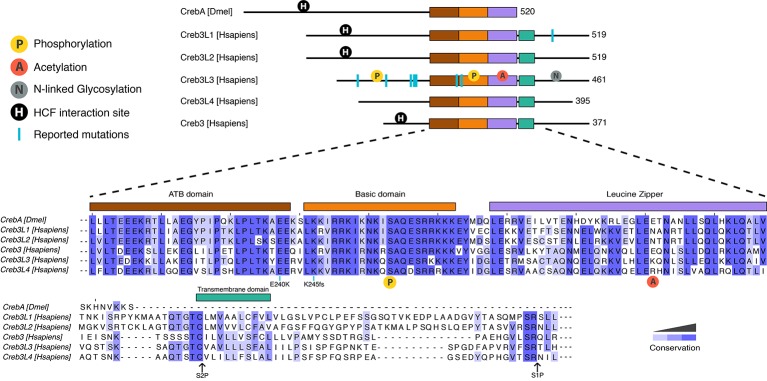
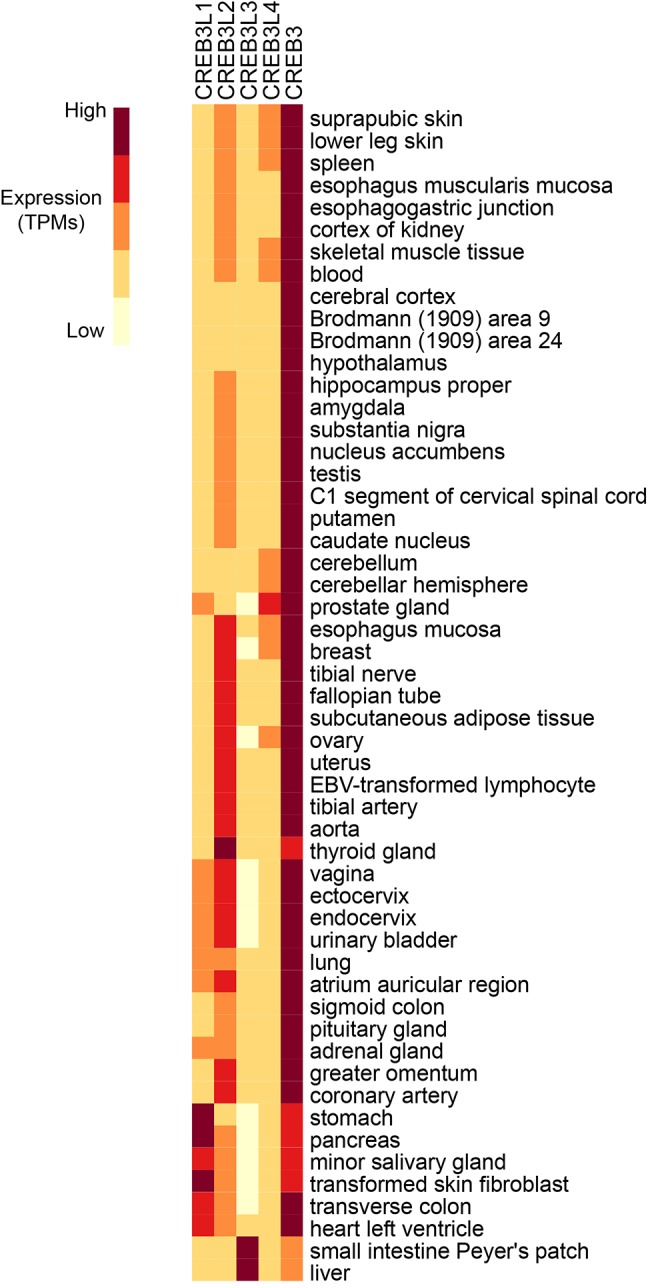
Our ability to overcome the challenges behind metabolic disorders will require a detailed understanding of the regulation of responses to nutrition. The Creb3 transcription factor family appears to have a unique regulatory role that links cellular secretory capacity with development, nutritional state, infection, and other stresses. This role in regulating individual secretory capacity genes could place this family of transcription factors at an important regulatory intersection mediating an animal's responses to nutrients and other environmental challenges. Interestingly, in both humans and mice, individuals with mutations in Creb3L3/CrebH, one of the Creb3 family members, exhibit hypertriglyceridemia (HTG) thus linking this transcription factor to lipid metabolism. We are beginning to understand how Creb3L3 and related family members are regulated and to dissect the potential redundancy and cross talk between distinct family members, thereby mediating both healthy and pathological responses to the environment. Here, we review the current knowledge on the regulation of Creb3 family transcription factor activity, their target genes, and their role in metabolic disease.
我们若要克服代谢紊乱背后的挑战,就需要详细了解对营养反应的调节机制。Creb3转录因子家族似乎具有独特的调节作用,它将细胞分泌能力与发育、营养状态、感染及其他应激联系起来。该家族在调节单个分泌能力基因方面的这一作用,可能使其处于一个重要的调节交叉点,介导动物对营养物质及其他环境挑战的反应。有趣的是,在人类和小鼠中,Creb3家族成员之一Creb3L3/CrebH发生突变的个体均表现出高甘油三酯血症(HTG),从而将这种转录因子与脂质代谢联系起来。我们开始了解Creb3L3及相关家族成员是如何被调节的,并剖析不同家族成员之间潜在的冗余和相互作用,从而介导对环境的健康和病理反应。在此,我们综述了关于Creb3家族转录因子活性调节、其靶基因及其在代谢疾病中作用的现有知识。