Lee Richard M H, Bouremel Yann, Eames Ian, Brocchini Steve, Khaw Peng Tee
Chelsea and Westminster Hospital NHS Foundation Trust, London, UK.
National Institute for Health Research Biomedical Research Centre at Moorfields Eye Hospital NHS Foundation Trust and University College London (UCL) Institute of Ophthalmology, London, UK.
Transl Vis Sci Technol. 2019 Jun 28;8(3):58. doi: 10.1167/tvst.8.3.58. eCollection 2019 May.
Minimally invasive glaucoma surgery (MIGS) devices that drain into the subconjunctival space can be inserted via an ab externo or ab interno approach. Limited experimental data exists as to the impact of either technique on intraocular pressure (IOP) control. We performed microfluidic studies by using ex vivo rabbit eyes to assess the effect of each approach on outflow resistance of a subconjunctival drainage device for IOP control.
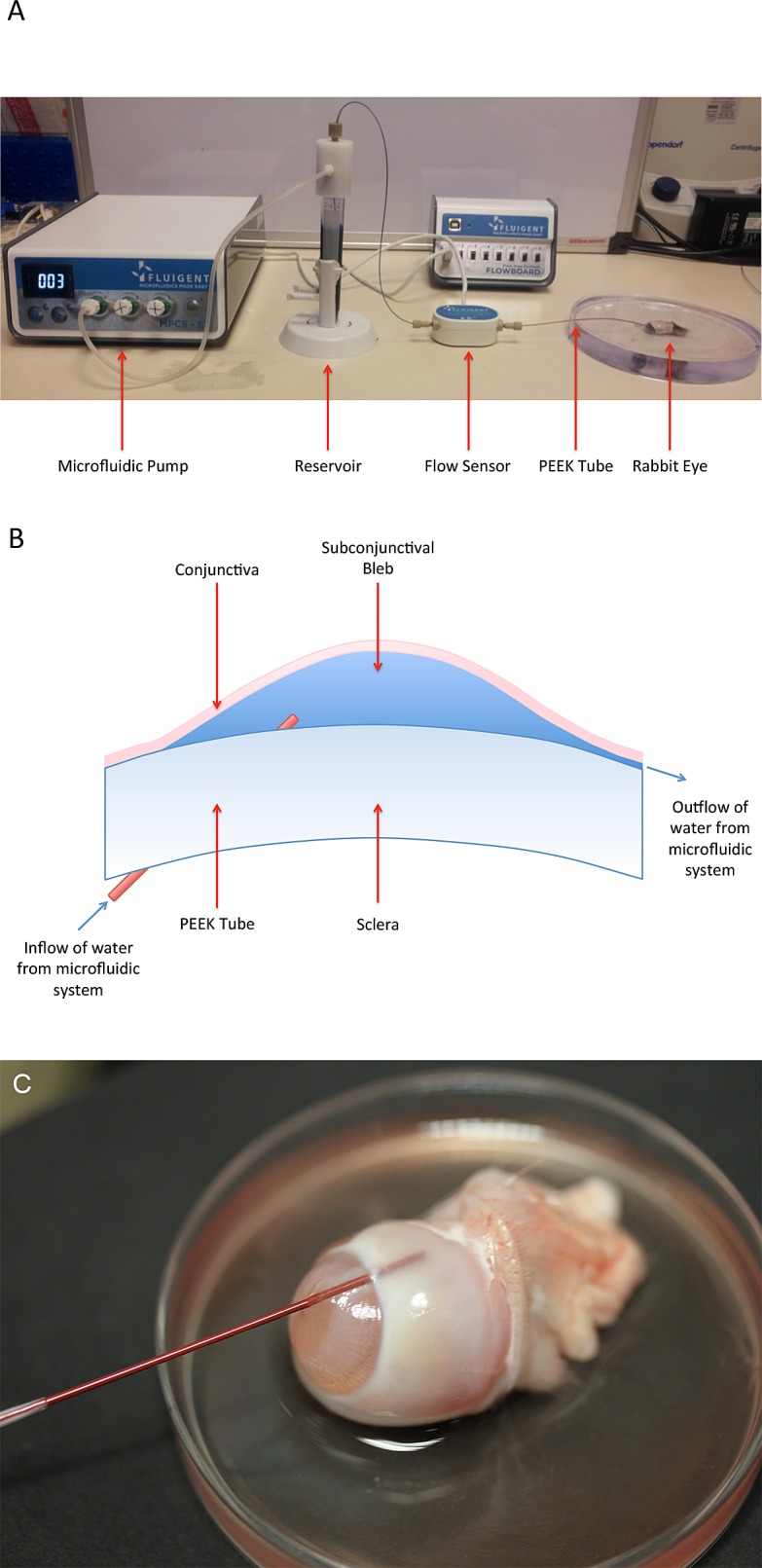
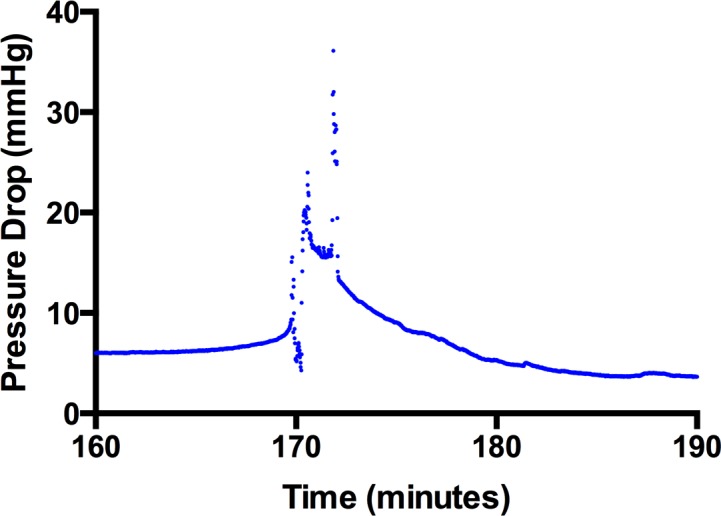
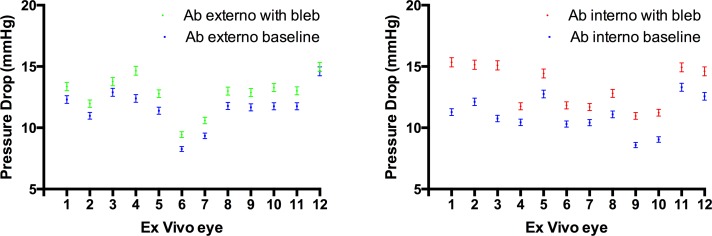
A microfluidic experiment system was designed, consisting of a controlled reservoir of water connected to a pressure pump/flow sensor. The flow rate of water was fixed at 2 μl/min to simulate aqueous humor production. The pressure readings for each approach were recorded at a frequency of 1 Hz. A baseline reading was made before tube insertion into the eye (PEEK tube length set to aim for an initial outflow resistance of 5 to 10 mm Hg/μL/min) followed by measurements for a cumulative 2-ml volume entering the subconjunctival space. Results were adjusted for water viscosity at 37°C and reported as outflow resistance (mm Hg/μL/min ± standard error of mean).
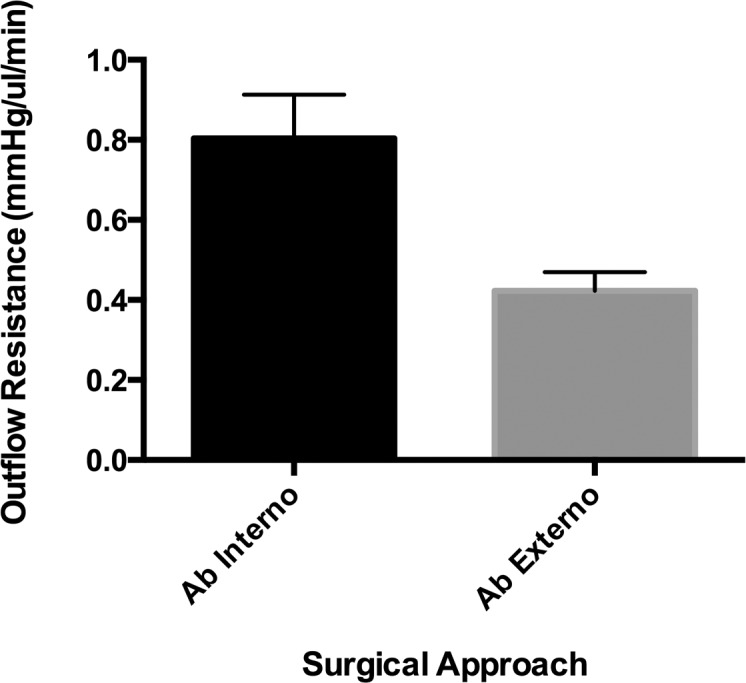
Outflow resistance via the ab interno approach was 90.4% higher than with the ab externo approach being measured at 0.80 ± 0.11 mm Hg/μL/min and 0.42 ± 0.05 mm Hg/μL/min, respectively. Bleb formation was observed to be less predictable with the ab interno approach.
The ab interno approach demonstrated greater outflow resistance and less predictable bleb formation than the ab externo approach. These results have implications for long-term IOP control and success depending on the approach to device insertion and could be an important consideration for future MIGS devices.
The effect of the ab interno versus ab externo approach of a MIGS device inserted into the subconjunctival space was assessed. The ab interno approach demonstrated greater outflow resistance and less predictable bleb formation that may have implications for the development of future MIGS devices.
可通过外路或内路方法插入引流至结膜下间隙的微创青光眼手术(MIGS)装置。关于这两种技术对眼压(IOP)控制的影响,现有实验数据有限。我们通过使用离体兔眼进行微流控研究,以评估每种方法对用于眼压控制的结膜下引流装置流出阻力的影响。
设计了一个微流控实验系统,由连接到压力泵/流量传感器的受控水箱组成。水流速固定为2 μl/分钟,以模拟房水生成。每种方法的压力读数以1 Hz的频率记录。在将管子插入眼内之前进行基线读数(聚醚醚酮管长度设置为目标初始流出阻力为5至10 mmHg/μL/分钟),然后测量累计2毫升体积进入结膜下间隙的情况。结果针对37°C时的水粘度进行了调整,并报告为流出阻力(mmHg/μL/分钟±平均标准误差)。
内路方法的流出阻力比外路方法高90.4%,分别测量为0.80±0.11 mmHg/μL/分钟和0.42±0.05 mmHg/μL/分钟。观察到内路方法的滤过泡形成较难预测。
与外路方法相比,内路方法显示出更大的流出阻力和更难预测的滤过泡形成。这些结果对于取决于装置插入方法的长期眼压控制和成功率具有影响,并且可能是未来MIGS装置的一个重要考虑因素。
评估了插入结膜下间隙的MIGS装置内路与外路方法的效果。内路方法显示出更大的流出阻力和更难预测的滤过泡形成,这可能对未来MIGS装置的开发有影响。