Lim Audrey J R, Indran Inthrani R, Kramer Michael S, Yong Eu-Leong
Department of Obstetrics & Gynaecology Yong Loo Lin School of Medicine, National University of Singapore Singapore Singapore.
Department of Pharmacology, Yong Loo Lin School of Medicine National University of Singapore Singapore Singapore.
Endocrinol Diabetes Metab. 2019 Mar 22;2(3):e00047. doi: 10.1002/edm2.47. eCollection 2019 Jul.
Firstly, to investigate whether polycystic ovary syndrome (PCOS) shows a continuum of severity with increasing number of phenotypic features comprising the Rotterdam criteria for PCOS and secondly, to explore relationships of these phenotypes to the circadian biomarkers, cortisol and melatonin.
Studies characterizing the spectrum of PCOS subphenotypes give little emphasis to the distinction among women who manifest zero, one or two of the three phenotypic features comprising the Rotterdam criteria. The relationship of circadian biomarkers to PCOS phenotypes is unclear.
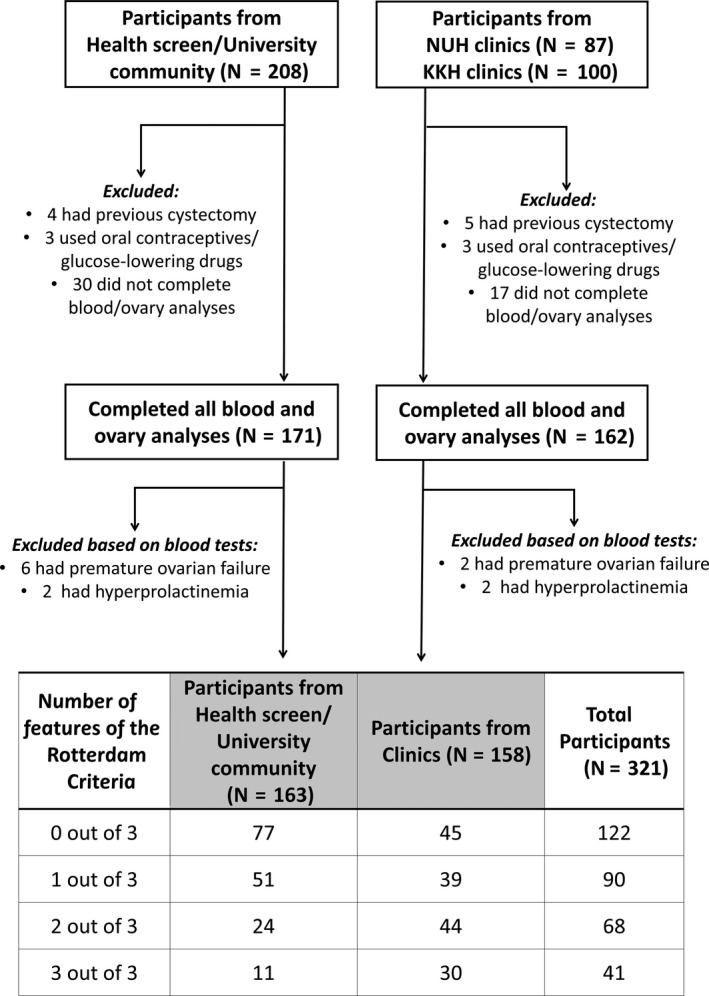
Cross-sectional study of 321 participants from 2011 to 2016 conducted at the National University Hospital (NUH), Singapore.
Participants included women who attended a health screen for NUH staff, volunteers from the university community, and women referred for possible PCOS from gynaecological clinics at NUH and KK Women's and Children's Hospital (Singapore).
All participants underwent a physical examination, ovarian ultrasound scan and follicular-phase blood testing, and completed a health and lifestyle questionnaire.
A significant positive linear trend in all clinical and biochemical characteristics of PCOS with increasing number of phenotypic features comprising the Rotterdam criteria. We observed a similar trend in serum cortisol and melatonin, two biomarkers of the circadian rhythm.
PCOS may not be an "all-or-none" condition, but rather a continuous spectrum. The positive relationship between number of PCOS criteria with melatonin and cortisol merits further investigation on the role of circadian biorhythms in the pathogenesis of PCOS.
首先,研究多囊卵巢综合征(PCOS)是否随着符合鹿特丹PCOS诊断标准的表型特征数量增加而呈现严重程度的连续性变化;其次,探究这些表型与昼夜节律生物标志物皮质醇和褪黑素之间的关系。
对PCOS亚表型谱进行特征描述的研究很少强调在符合鹿特丹标准的三个表型特征中表现出零个、一个或两个特征的女性之间的区别。昼夜节律生物标志物与PCOS表型之间的关系尚不清楚。
2011年至2016年在新加坡国立大学医院(NUH)对321名参与者进行的横断面研究。
参与者包括参加NUH员工健康筛查的女性、大学社区的志愿者,以及从NUH和新加坡KK妇女儿童医院的妇科诊所转诊来的疑似PCOS女性。
所有参与者均接受了体格检查、卵巢超声扫描和卵泡期血液检测,并完成了一份健康和生活方式问卷。
PCOS的所有临床和生化特征均随着符合鹿特丹标准的表型特征数量增加而呈现显著的正线性趋势。我们在血清皮质醇和褪黑素这两种昼夜节律生物标志物中也观察到了类似趋势。
PCOS可能不是一种“全或无”的疾病,而是一个连续谱。PCOS标准数量与褪黑素和皮质醇之间的正相关关系值得进一步研究昼夜节律在PCOS发病机制中的作用。