Moayyedi Paul, Marsiglio Megan, Andrews Christopher N, Graff Lesley A, Korownyk Christina, Kvern Brent, Lazarescu Adriana, Liu Louis, MacQueen Glenda, Paterson William G, Sidani Sacha, Vanner Stephen J, Sinclair Paul, Marshall Lesley, Fernandes Aida
Farncombe Family Digestive Health Research Institute, McMaster University, Hamilton, Ontario, Canada.
IMAGINE Network Patient Research Partner, Hamilton, Ontario, Canada.
J Can Assoc Gastroenterol. 2019 Apr;2(1):30-36. doi: 10.1093/jcag/gwy072. Epub 2019 Jan 17.
The value of a multidisciplinary group and patient engagement in guideline groups is uncertain. We compared the recommendations of two guidelines that used the same data during the same time frame but with different participants to obtain a "real world" perspective on influence of the composition of guideline groups.
The Canadian Association of Gastroenterology (CAG) and the American College of Gastroenterology (ACG) recently updated their clinical practice guidelines for the management of Irritable Bowel Syndrome (IBS). Both the CAG and ACG used the same methodology and methodologist and were presented with the same data for interpretation. The ACG group consisted of predominantly academic gastroenterologists, while the CAG group also included general practitioners, a psychiatrist, a psychologist and a patient representative. The CAG group were also asked what components of the group were valuable.
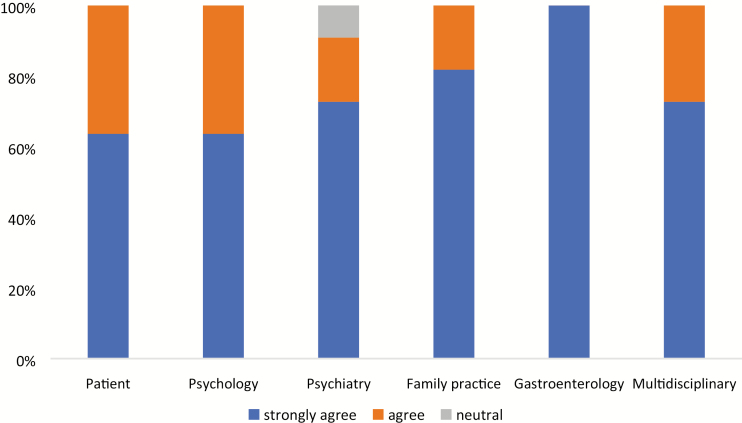
There were 14 statements with the same or similar recommendations. There were 10 statements in the CAG guideline not addressed by the ACG guideline and five recommendations where the opposite was the case. There was one statement that the two groups both addressed, but each group came to different conclusions. CAG members were in 100% agreement that involving a patient and having a multidisciplinary team was valuable and may have played a role in these differing interpretations of the same data in an IBS guideline.
There has been little uptake of patient involvement and multidisciplinary teams in guideline groups. However, this study provides a unique example of added benefit through broader group representation.
多学科团队及患者参与指南制定小组的价值尚不确定。我们比较了两份指南的建议,这两份指南在同一时间段使用相同的数据,但参与者不同,以获得关于指南制定小组组成影响的“真实世界”观点。
加拿大胃肠病学协会(CAG)和美国胃肠病学学院(ACG)最近更新了肠易激综合征(IBS)管理的临床实践指南。CAG和ACG都使用相同的方法和方法学家,并获得相同的数据进行解读。ACG小组主要由学术胃肠病学家组成,而CAG小组还包括全科医生、一名精神科医生、一名心理学家和一名患者代表。CAG小组还被问及小组的哪些组成部分有价值。
有14条陈述具有相同或相似的建议。CAG指南中有10条陈述未被ACG指南涉及,有5条建议情况相反。有一条陈述两组都涉及,但每组得出了不同的结论。CAG成员一致认为患者参与和多学科团队很有价值,并可能在IBS指南中对相同数据的这些不同解读中发挥了作用。
指南制定小组中很少有患者参与和多学科团队的情况。然而,本研究提供了一个通过更广泛的小组代表性带来额外益处的独特例子。