Monash Centre for Health Research and Implementation, Monash University and Monash Health, Melbourne, Victoria, Australia.
National Health and Medical Research Council Centre for Research Excellence in Women's Health in Reproductive Life, Melbourne, Victoria, Australia.
J Clin Endocrinol Metab. 2023 Sep 18;108(10):2447-2469. doi: 10.1210/clinem/dgad463.
What is the recommended assessment and management of those with polycystic ovary syndrome (PCOS), based on the best available evidence, clinical expertise, and consumer preference?
International evidence-based guidelines address prioritized questions and outcomes and include 254 recommendations and practice points, to promote consistent, evidence-based care and improve the experience and health outcomes in PCOS.
The 2018 International PCOS Guideline was independently evaluated as high quality and integrated multidisciplinary and consumer perspectives from six continents; it is now used in 196 countries and is widely cited. It was based on best available, but generally very low to low quality, evidence. It applied robust methodological processes and addressed shared priorities. The guideline transitioned from consensus based to evidence-based diagnostic criteria and enhanced accuracy of diagnosis, whilst promoting consistency of care. However, diagnosis is still delayed, the needs of those with PCOS are not being adequately met, evidence quality was low and evidence-practice gaps persist.
STUDY DESIGN, SIZE, DURATION: The 2023 International Evidence-based Guideline update reengaged the 2018 network across professional societies and consumer organizations with multidisciplinary experts and women with PCOS directly involved at all stages. Extensive evidence synthesis was completed. Appraisal of Guidelines for Research and Evaluation-II (AGREEII)-compliant processes were followed. The Grading of Recommendations, Assessment, Development, and Evaluation (GRADE) framework was applied across evidence quality, feasibility, acceptability, cost, implementation and ultimately recommendation strength and diversity and inclusion were considered throughout.
PARTICIPANTS/MATERIALS, SETTING, METHODS: This summary should be read in conjunction with the full Guideline for detailed participants and methods. Governance included a six-continent international advisory and management committee, five guideline development groups, and paediatric, consumer, and translation committees. Extensive consumer engagement and guideline experts informed the update scope and priorities. Engaged international society-nominated panels included paediatrics, endocrinology, gynaecology, primary care, reproductive endocrinology, obstetrics, psychiatry, psychology, dietetics, exercise physiology, obesity care, public health and other experts, alongside consumers, project management, evidence synthesis, statisticians and translation experts. Thirty-nine professional and consumer organizations covering 71 countries engaged in the process. Twenty meetings and five face-to-face forums over 12 months addressed 58 prioritized clinical questions involving 52 systematic and 3 narrative reviews. Evidence-based recommendations were developed and approved via consensus across five guideline panels, modified based on international feedback and peer review, independently reviewed for methodological rigour, and approved by the Australian Government National Health and Medical Research Council (NHMRC).
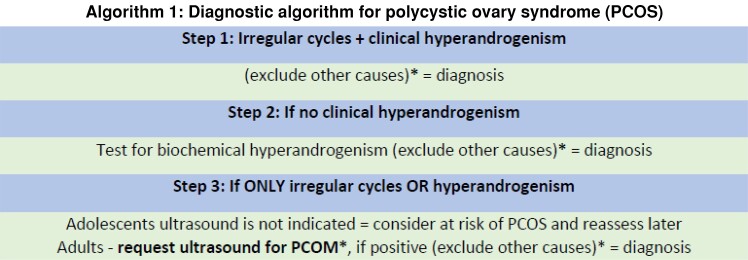
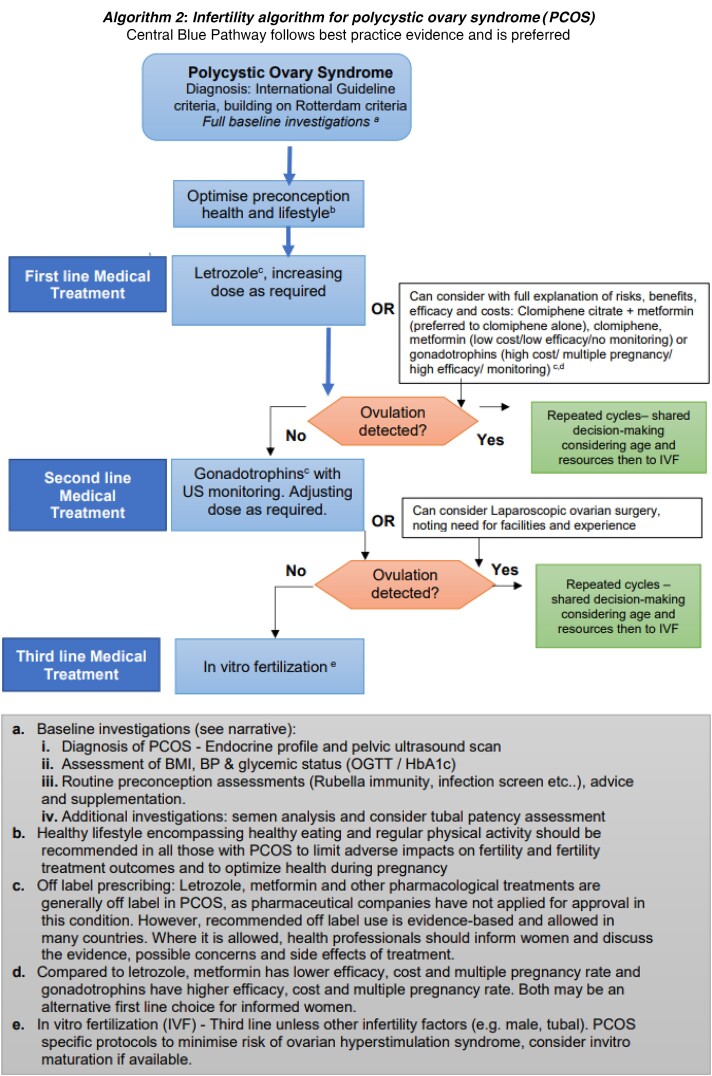
The evidence in the assessment and management of PCOS has generally improved in the past five years, but remains of low to moderate quality. The technical evidence report and analyses (∼6000 pages) underpins 77 evidence-based and 54 consensus recommendations, with 123 practice points. Key updates include: i) further refinement of individual diagnostic criteria, a simplified diagnostic algorithm and inclusion of anti-Müllerian hormone (AMH) levels as an alternative to ultrasound in adults only; ii) strengthening recognition of broader features of PCOS including metabolic risk factors, cardiovascular disease, sleep apnea, very high prevalence of psychological features, and high risk status for adverse outcomes during pregnancy; iii) emphasizing the poorly recognized, diverse burden of disease and the need for greater healthcare professional education, evidence-based patient information, improved models of care and shared decision making to improve patient experience, alongside greater research; iv) maintained emphasis on healthy lifestyle, emotional wellbeing and quality of life, with awareness and consideration of weight stigma; and v) emphasizing evidence-based medical therapy and cheaper and safer fertility management.
LIMITATIONS, REASONS FOR CAUTION: Overall, recommendations are strengthened and evidence is improved, but remain generally low to moderate quality. Significantly greater research is now needed in this neglected, yet common condition. Regional health system variation was considered and acknowledged, with a further process for guideline and translation resource adaptation provided.
The 2023 International Guideline for the Assessment and Management of PCOS provides clinicians and patients with clear advice on best practice, based on the best available evidence, expert multidisciplinary input and consumer preferences. Research recommendations have been generated and a comprehensive multifaceted dissemination and translation programme supports the Guideline with an integrated evaluation program.
STUDY FUNDING/COMPETING INTEREST(S): This effort was primarily funded by the Australian Government via the National Health Medical Research Council (NHMRC) (APP1171592), supported by a partnership with American Society for Reproductive Medicine, Endocrine Society, European Society for Human Reproduction and Embryology, and the European Society for Endocrinology. The Commonwealth Government of Australia also supported Guideline translation through the Medical Research Future Fund (MRFCRI000266). HJT and AM are funded by NHMRC fellowships. JT is funded by a Royal Australasian College of Physicians (RACP) fellowship. Guideline development group members were volunteers. Travel expenses were covered by the sponsoring organizations. Disclosures of interest were strictly managed according to NHMRC policy and are available with the full guideline, technical evidence report, peer review and responses (www.monash.edu/medicine/mchri/pcos). Of named authors HJT, CTT, AD, LM, LR, JBoyle, AM have no conflicts of interest to declare. JL declares grant from Ferring and Merck; consulting fees from Ferring and Titus Health Care; speaker's fees from Ferring; unpaid consultancy for Ferring, Roche Diagnostics and Ansh Labs; and sits on advisory boards for Ferring, Roche Diagnostics, Ansh Labs, and Gedeon Richter. TP declares a grant from Roche; consulting fees from Gedeon Richter and Organon; speaker's fees from Gedeon Richter and Exeltis; travel support from Gedeon Richter and Exeltis; unpaid consultancy for Roche Diagnostics; and sits on advisory boards for Roche Diagnostics. MC declares travels support from Merck; and sits on an advisory board for Merck. JBoivin declares grants from Merck Serono Ltd.; consulting fees from Ferring B.V; speaker's fees from Ferring Arzneimittell GmbH; travel support from Organon; and sits on an advisory board for the Office of Health Economics. RJN has received speaker's fees from Merck and sits on an advisory board for Ferring. AJoham has received speaker's fees from Novo Nordisk and Boehringer Ingelheim. The guideline was peer reviewed by special interest groups across our 39 partner and collaborating organizations, was independently methodologically assessed against AGREEII criteria and was approved by all members of the guideline development groups and by the NHMRC.
基于最佳现有证据、临床专业知识和消费者偏好,对于多囊卵巢综合征(PCOS)患者,应如何进行评估和管理?
国际循证指南解决了优先问题和结果,并包含 254 条建议和实践要点,以促进一致、基于证据的护理,并改善 PCOS 患者的体验和健康结果。
2018 年国际 PCOS 指南是独立评估为高质量的,并整合了来自六大洲的多学科和消费者观点;它现在已在 196 个国家使用,并被广泛引用。它基于最佳但通常质量较低或较低的证据。它应用了稳健的方法学流程,并解决了共同的优先事项。该指南从基于共识的诊断标准转变为基于证据的诊断标准,提高了诊断的准确性,同时促进了护理的一致性。然而,诊断仍然滞后,PCOS 患者的需求未得到充分满足,证据质量较低,证据实践差距仍然存在。
研究设计、规模、持续时间:2023 年国际循证指南更新重新邀请了 2018 年网络中的专业协会和消费者组织,以及多学科专家和 PCOS 患者直接参与各个阶段。完成了广泛的证据综合。遵循了适用研究和评估指南 II(AGREEII)的过程。应用了分级评估、制定、发展和评估(GRADE)框架,以评估证据质量、可行性、可接受性、成本、实施以及最终推荐强度和多样性,并在整个过程中考虑包容性。
参与者/材料、设置、方法:应结合全文指南阅读本摘要,以了解详细的参与者和方法。治理包括一个由来自六大洲的国际咨询和管理委员会、五个指南制定小组以及儿科、消费者和翻译委员会组成的六大陆国际咨询和管理委员会。广泛的消费者参与和指南专家为更新范围和优先事项提供了信息。参与的国际社会提名小组包括儿科、内分泌学、妇科、初级保健、生殖内分泌学、产科、精神病学、心理学、饮食学、运动生理学、肥胖护理、公共卫生和其他专家,以及消费者、项目管理、证据综合、统计学家和翻译专家。涵盖 71 个国家的 39 个专业和消费者组织参与了该过程。在 12 个月内进行了 20 次会议和 5 次面对面论坛,以解决涉及 52 项系统评价和 3 项叙述性评价的 58 个优先临床问题。通过五个指南小组达成共识制定和批准了基于证据的建议,并根据国际反馈和同行评审进行了修改,经过方法学严格性的独立审查,并得到澳大利亚政府国家健康和医学研究委员会(NHMRC)的批准。
过去五年中,PCOS 评估和管理方面的证据质量总体有所提高,但仍处于低至中等水平。技术证据报告和分析(约 6000 页)为 77 条基于证据的和 54 条共识建议以及 123 条实践要点提供了依据。主要更新包括:i)进一步细化了个体诊断标准、简化的诊断算法和仅在成人中纳入抗苗勒氏管激素(AMH)水平以替代超声;ii)更加强调 PCOS 的广泛特征,包括代谢风险因素、心血管疾病、睡眠呼吸暂停、非常高的心理特征患病率以及妊娠期间不良结局的高风险状态;iii)强调了未被充分认识到的、多样化的疾病负担以及对更多医疗保健专业人员教育、基于证据的患者信息、改进的护理模式和共同决策以改善患者体验以及更多研究的需求;iv)保持对健康生活方式、情绪健康和生活质量的重视,并考虑体重耻辱感;v)强调基于证据的医疗治疗和更便宜、更安全的生育管理。
局限性、谨慎的原因:总体而言,建议得到了加强,证据也得到了改善,但仍处于低至中等质量。现在更需要针对这种被忽视但又常见的疾病进行更多的研究。考虑到区域卫生系统的差异,并提供了指南和翻译资源适应的进一步流程。
2023 年国际 PCOS 评估和管理指南为临床医生和患者提供了基于最佳现有证据、多学科专家意见和消费者偏好的最佳实践建议。已经提出了研究建议,并通过综合评估计划为指南和翻译资源提供了全面的多方面传播和翻译计划。
研究资金/利益冲突:这项工作主要由澳大利亚政府通过国家健康和医学研究委员会(NHMRC)(APP1171592)提供资金,得到美国生殖医学学会、内分泌学会、欧洲人类生殖与胚胎学会和欧洲内分泌学会的合作支持。英联邦政府还通过医学研究未来基金(MRFCRI000266)支持指南翻译。HJT 和 AM 获得 NHMRC 奖学金。JT 获得皇家澳大利亚内科医师学院(RACP)奖学金。指南制定小组成员是志愿者。旅行费用由赞助组织承担。利益冲突的披露严格按照 NHMRC 政策管理,并可在全文指南、技术证据报告、同行评审和回复中查阅(www.monash.edu/medicine/mchri/pcos)。在提到的作者中,HJT、CTT、AD、LM、LR、JBoyle 和 AM 没有利益冲突需要披露。JL 报告说他从 Ferring 和默克获得了资助;担任 Ferring 和 Titus Health Care 的顾问;担任 Ferring 的演讲嘉宾;未领取 Roche Diagnostics 和 Ansh Labs 的咨询费;并担任 Ferring、Roche Diagnostics、Ansh Labs 和 Gedeon Richter 的顾问委员会成员。TP 报告说他从 Roche 获得了赠款;担任 Gedeon Richter 和 Organon 的顾问;担任 Roche Diagnostics 和 Exeltis 的演讲嘉宾;从 Roche Diagnostics 和 Exeltis 获得旅行支持;担任 Gedeon Richter 和 Exeltis 的未领薪顾问;并担任 Roche Diagnostics 的顾问委员会成员。MC 报告说他从 Merck Serono Ltd. 获得了旅行支持;并担任 Merck 的顾问委员会成员。JBoivin 报告说他从 Merck Serono Ltd. 获得了资助;担任 Ferring B.V 的顾问;担任 Ferring Arzneimittell GmbH 的演讲嘉宾;从 Organon 获得旅行支持;并担任 Office of Health Economics 的顾问委员会成员。RJN 已获得 Merck 的演讲嘉宾费,并担任 Ferring 的顾问委员会成员。AJoham 获得 Novo Nordisk 和 Boehringer Ingelheim 的演讲嘉宾费。该指南由我们的 39 个合作伙伴和合作组织的特别利益集团进行了同行评审,根据 AGREEII 标准进行了独立的方法学评估,并由指南制定小组的所有成员以及 NHMRC 批准。