Centre for Organismal Studies Heidelberg, Department of Biodiversity and Plant Systematics, Heidelberg University, Im Neuenheimer Feld, Heidelberg.
Deep Sequencing Core Facility, CellNetworks Excellence Cluster, Heidelberg University, Im Neuenheimer Feld, Heidelberg.
J Exp Bot. 2019 Oct 24;70(20):5643-5657. doi: 10.1093/jxb/erz323.
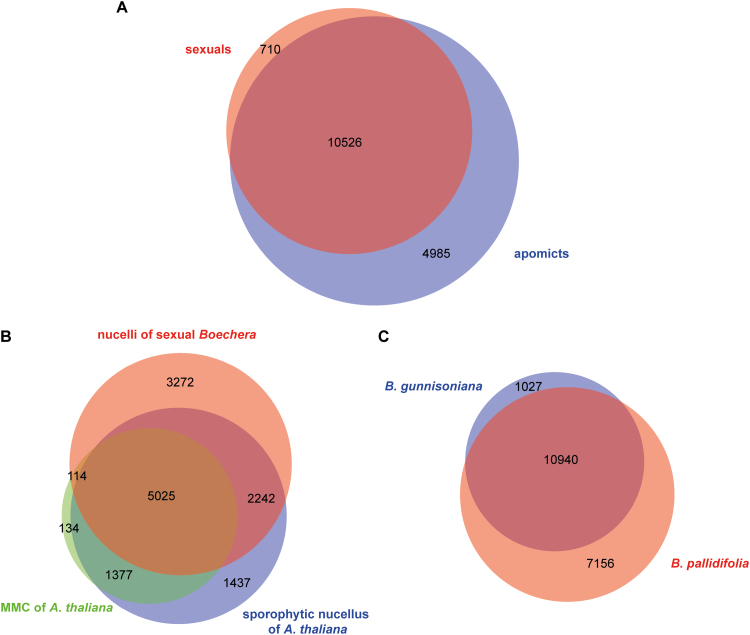
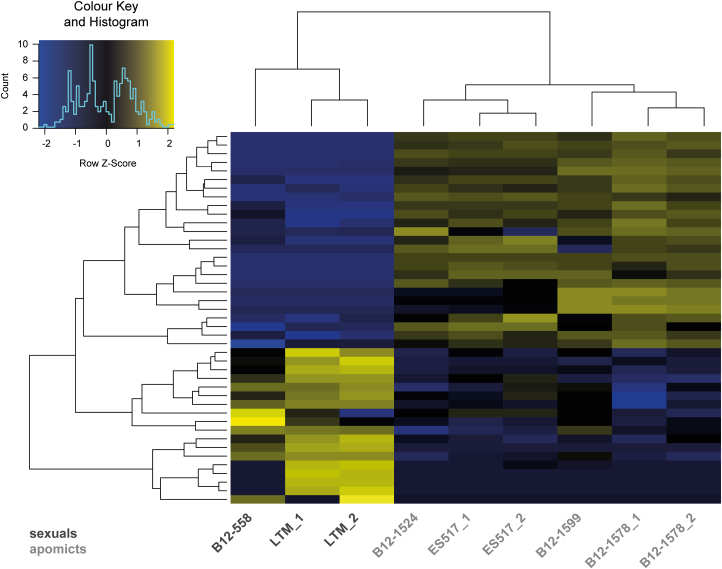
Germline specification is the first step during sexual and apomictic plant reproduction, and takes place in the nucellus of the ovule, a specialized domain of the reproductive flower tissues. In each case, a sporophytic cell is determined to form the sexual megaspore mother cell (MMC) or an apomictic initial cell (AIC). These differ in their developmental fates: while the MMC undergoes meiosis, the AIC modifies or omits meiosis to form the female gametophyte. Despite great interest in these distinct developmental processes, little is known about their gene regulatory basis. To elucidate the gene regulatory networks underlying germline specification, we conducted tissue-specific transcriptional profiling using laser-assisted microdissection and RNA sequencing to compare the transcriptomes of nucellar tissues between different sexual and apomictic Boechera accessions representing four species and two ploidy levels. This allowed us to distinguish between expression differences caused by genetic background or reproductive mode. Statistical data analysis revealed 45 genes that were significantly differentially expressed, and which potentially play a role for determination of the reproductive mode. Based on annotations, these included F-box genes and E3 ligases that most likely relate to genes previously described as regulators important for germline development. Our findings provide novel insights into the transcriptional basis of sexual and apomictic reproduction.
生殖细胞的特化是有性和无融合生殖植物繁殖的第一步,发生在胚珠的珠心,这是生殖花组织的一个特化区域。在每种情况下,一个孢子体细胞被决定形成有性大孢子母细胞(MMC)或无融合生殖初始细胞(AIC)。这些细胞在其发育命运上有所不同:MMC 经历减数分裂,而 AIC 则修饰或省略减数分裂以形成雌性配子体。尽管人们对这些不同的发育过程非常感兴趣,但对它们的基因调控基础知之甚少。为了阐明生殖细胞特化的基因调控网络,我们使用激光辅助微切割和 RNA 测序进行了组织特异性转录谱分析,比较了来自四个物种和两个倍性水平的不同有性和无融合生殖 Boechera 品系的珠心组织的转录组。这使我们能够区分由遗传背景或生殖方式引起的表达差异。统计数据分析揭示了 45 个显著差异表达的基因,这些基因可能在决定生殖方式方面发挥作用。根据注释,这些基因包括 F-box 基因和 E3 连接酶,它们很可能与先前描述为对生殖细胞发育重要的基因调节剂有关。我们的研究结果为有性和无融合生殖的转录基础提供了新的见解。