Bruni Alessandro, Serra Francesca Giulia, Deregibus Andrea, Castroflorio Tommaso
Department of Surgical Sciences, CIR Dental School, Università degli Studi di Torino, Via Nizza, 230, 10126 Turin, Italy.
Department of Mechanical and Aerospatial Engineering (DIMEAS), Politecnico di Torino, C.so Duca degli Abruzzi, 24, 10129 Turin, Italy.
Materials (Basel). 2019 Jul 10;12(14):2216. doi: 10.3390/ma12142216.
To perform a systematic review (SR) of existing literature and a patent landscape report (PLR) regarding the potential applications of shape-memory polymers (SMPs) in dentistry.
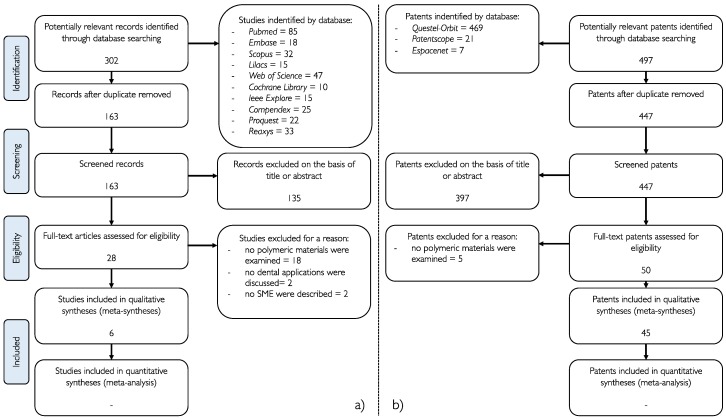
Clinical and Biomedical online databases (Pubmed, Medline via Embase, Scopus, LILACS, Web of Science, Cochrane Library), Materials Science and Engineering databases (IEEE Explore, Compendex, Proquest), Material Science and Chemical database (Reaxys) so as Patents databases (Questel-Orbit, Espacenet, Patentscope) were consulted as recently as January 2019 to identify all papers and patents potentially relevant to the review. The reference lists of all eligible studies were hand searched for additional published work.
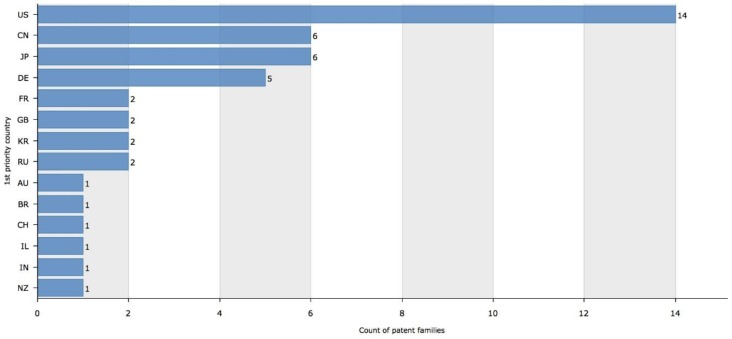
After duplicate selection and extraction procedures, 6 relevant full-text articles from the initial 302 and 45 relevant patents from 497 were selected. A modified Consolidated Standards of Reporting Trials (CONSORT) checklist of 14 items for reporting pre-clinical in-vitro studies was used to rate the methodological quality of the selected papers. The overall quality was judged low.
Despite the great potential and versatility of SMPs, it was not possible to draw evidence-based conclusions supporting their immediate employment in clinical dentistry. This was due to the weak design and a limited number of studies included within this review and reflects the fact that additional research is mandatory to determine whether or not the use of SMPs in dentistry could be effective. Nevertheless, the qualitative analysis of selected papers and patents indicate that SMPs are promising materials in dentistry because of their programmable physical properties. These findings suggest the importance of furtherly pursuing this line of research.
对现有文献进行系统综述(SR),并就形状记忆聚合物(SMP)在牙科领域的潜在应用开展专利态势报告(PLR)。
检索了临床与生物医学在线数据库(PubMed、通过Embase的Medline、Scopus、LILACS、科学网、Cochrane图书馆)、材料科学与工程数据库(IEEE Xplore、Compendex、ProQuest)、材料科学与化学数据库(Reaxys)以及专利数据库(Questel-Orbit、Espacenet、Patentscope),检索时间截至2019年1月,以识别所有可能与该综述相关的论文和专利。对所有符合条件研究的参考文献列表进行人工检索,以查找其他已发表的作品。
经过重复筛选和提取程序后,从最初的302篇文章中选出6篇相关全文文章,从497项专利中选出45项相关专利。使用一份经过修改的包含14项内容的报告临床前体外研究的统一报告标准(CONSORT)清单,对所选论文的方法学质量进行评分。总体质量判定为较低。
尽管SMP具有巨大潜力和多功能性,但无法得出支持其立即应用于临床牙科的循证结论。这是由于本综述中研究设计薄弱且数量有限,这也反映出必须开展更多研究以确定SMP在牙科领域的使用是否有效。然而,对所选论文和专利的定性分析表明,由于其可编程的物理特性,SMP在牙科领域是有前景的材料。这些发现表明进一步开展这一研究方向的重要性。