Mechelli Filippo, Arendt-Nielsen Lars, Stokes Maria, Agyapong-Badu Sandra
Centre of Sensory Motor Interaction, Department of Health Science and Technology, School of Medicine, University of Aalborg, 9220 Aalborg, Denmark.
PT, MSc, Private Practice, 61029 Urbino, Italy.
Methods Protoc. 2019 Jul 10;2(3):58. doi: 10.3390/mps2030058.
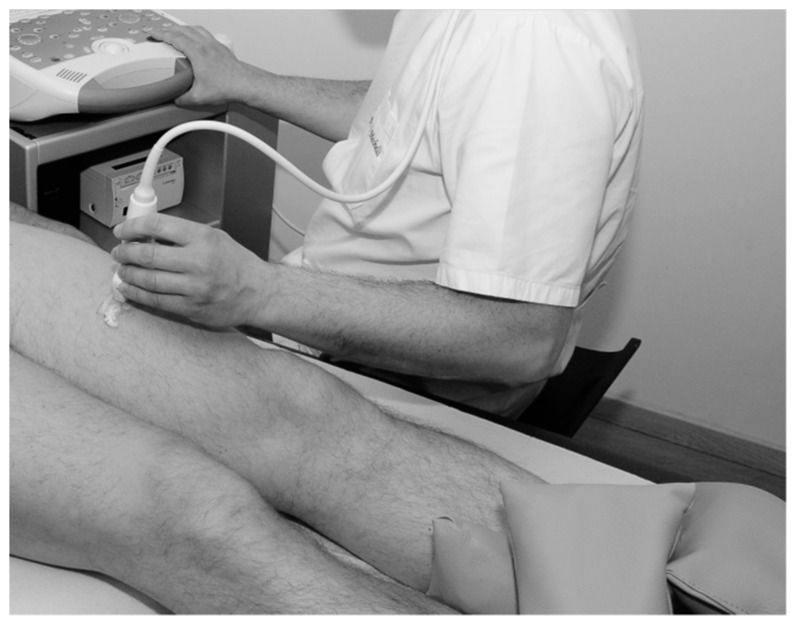
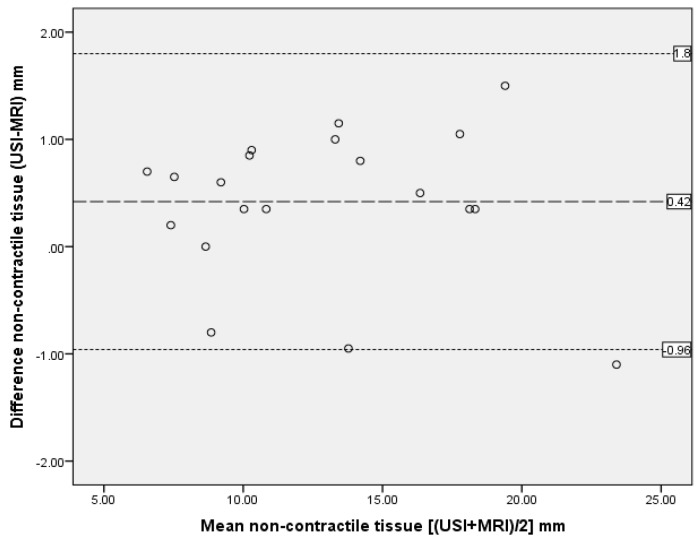
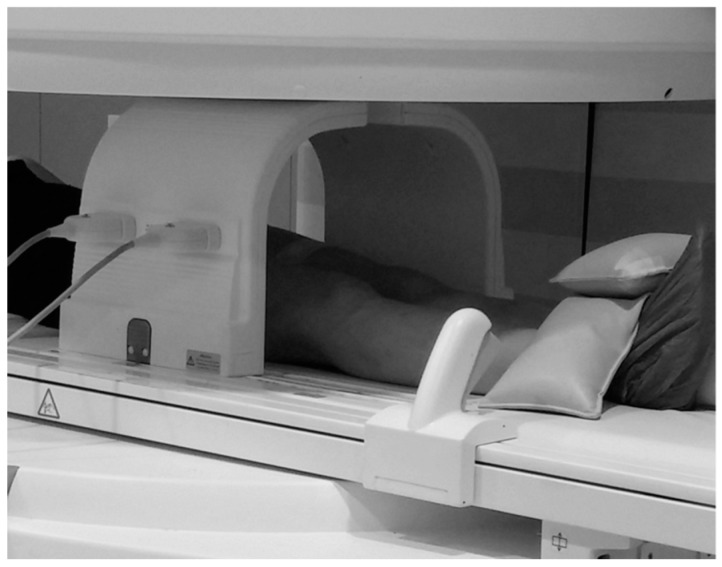
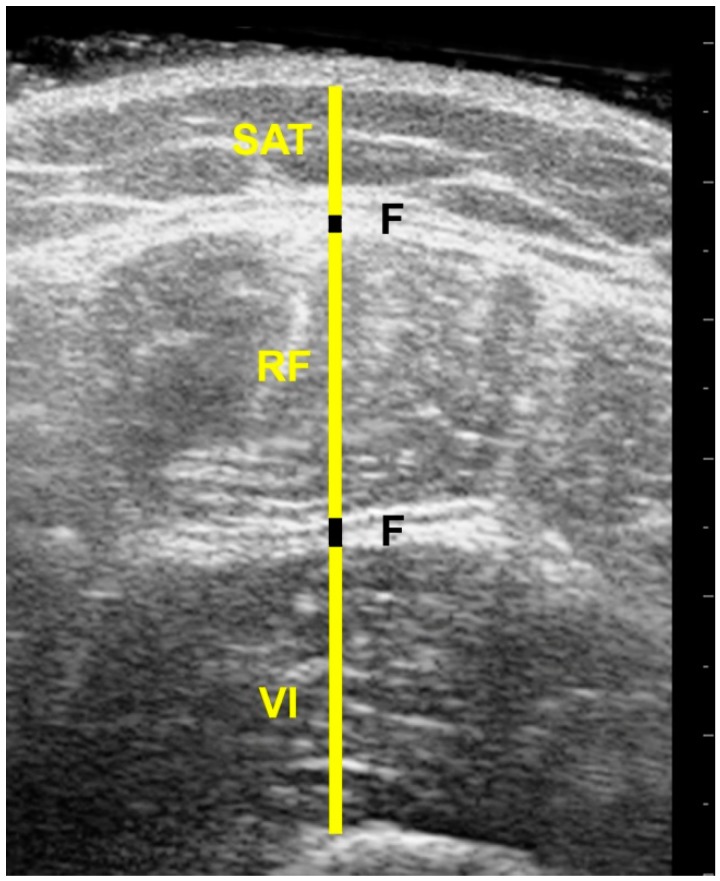
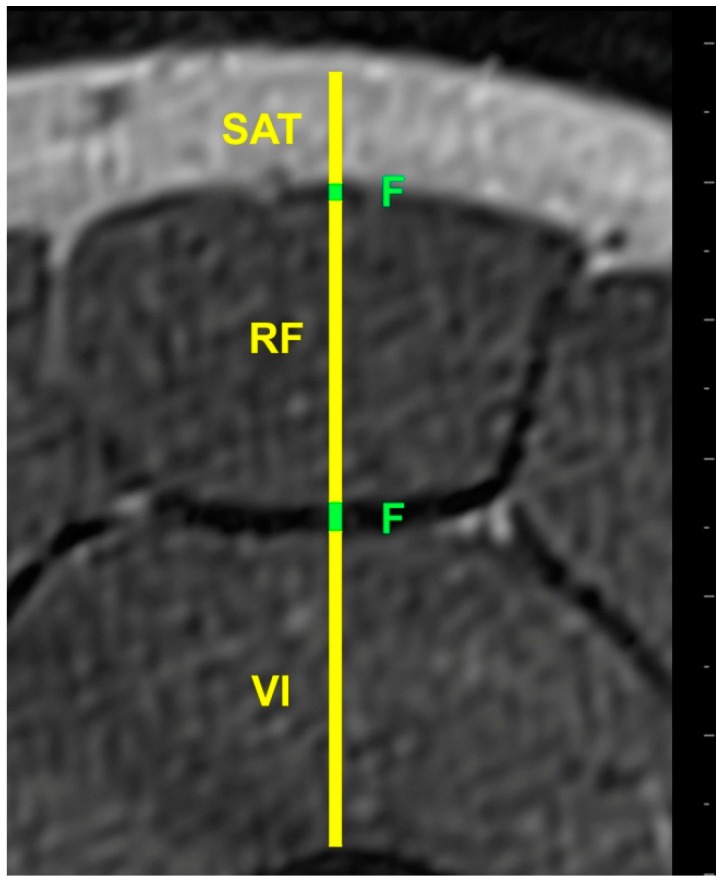
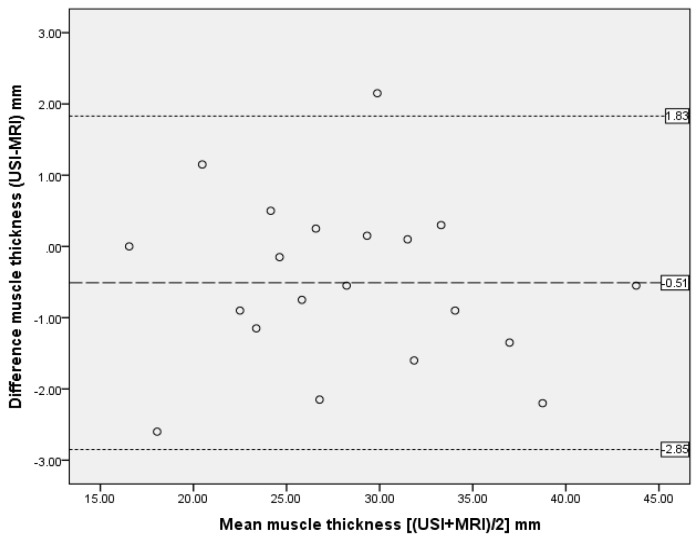
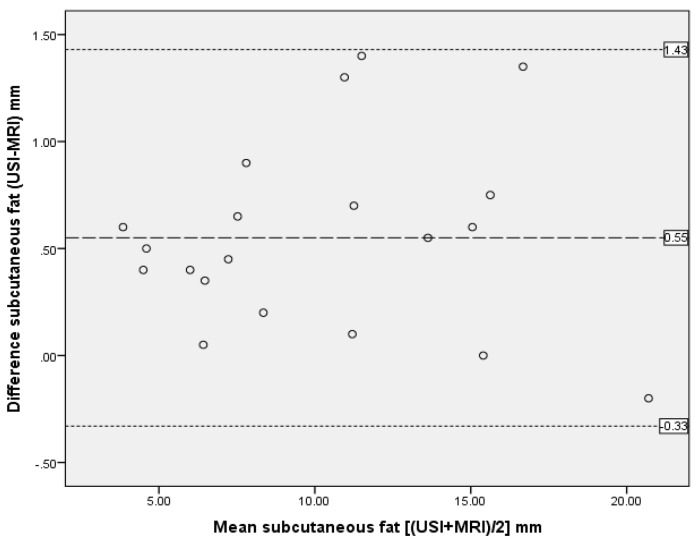
The aim of the present study was to determine the validity of ultrasound (US) imaging versus magnetic resonance imaging (MRI) for measuring anterior thigh muscle, subcutaneous adipose tissue (SAT), and fascia thickness. Twenty healthy, moderately active participants (aged 49.1 ± 9.74 [36-64] years), underwent imaging of the anterior thigh, using ultrasound and MRI modalities on the same day. Images were analyzed offline to assess the level of agreement between US and MRI measurements. Pearson's correlation coefficient showed an excellent relationship between US imaging and MRI for measuring muscle (r = 0.99, < 0.01), SAT (r = 0.99, < 0.01), and non-contractile tissue (SAT combined with perimuscular fascia) thickness (r = 0.99, < 0.01). Perimuscular fascia thickness measurement showed a poor correlation between modalities (r = 0.39, < 0.01). Intra-class correlation coefficients (ICC3,1) also showed excellent correlation of the measurements with ICC = 0.99 for muscle thickness, SAT, and non-contractile tissue, but not for perimuscular fascia, which showed poor agreement ICC = 0.36. Bland and Altman plots demonstrated excellent agreement between US imaging and MRI measurements. Criterion validity was demonstrated for US imaging against MRI, for measuring thickness of muscle and SAT, but not perimuscular fascia alone on the anterior thigh. The US imaging technique is therefore applicable for research and clinical purposes for muscle and SAT.
本研究的目的是确定超声(US)成像与磁共振成像(MRI)在测量大腿前侧肌肉、皮下脂肪组织(SAT)和筋膜厚度方面的有效性。20名健康、活动适度的参与者(年龄49.1±9.74[36 - 64]岁)于同一天接受了大腿前侧的超声和MRI成像检查。对图像进行离线分析,以评估US和MRI测量之间的一致性水平。Pearson相关系数显示,US成像与MRI在测量肌肉(r = 0.99,<0.01)、SAT(r = 0.99,<0.01)以及非收缩组织(SAT与肌周筋膜组合)厚度方面具有极佳的相关性(r = 0.99,<0.01)。肌周筋膜厚度测量显示两种检查方法之间的相关性较差(r = 0.39,<0.01)。组内相关系数(ICC3,1)也显示,对于肌肉厚度、SAT和非收缩组织,测量值具有极佳的相关性,ICC = 0.99,但对于肌周筋膜,一致性较差,ICC = 0.36。Bland和Altman图显示US成像与MRI测量之间具有极佳的一致性。已证明US成像相对于MRI在测量大腿前侧肌肉和SAT厚度方面具有标准效度,但单独测量肌周筋膜时不具有标准效度。因此,US成像技术适用于肌肉和SAT的研究及临床应用。