Icahn Institute for Genomics & Multiscale Biology, Department of Genetics and Genomic Sciences, and Precision Immunology Institute, Icahn School of Medicine at Mount Sinai, New York, New York.
Endocrinology and Nutrition Department, Parc Taulí Hospital Universitari, Institut d'Investigació i Innovació Parc Taulí (I3 PT)-UAB, Sabadell, Spain.
Surg Obes Relat Dis. 2019 Aug;15(8):1367-1373. doi: 10.1016/j.soard.2019.05.038. Epub 2019 Jun 10.
Some of the metabolic effects of bariatric surgery may be mediated by the gut microbiome.
To study the effect of bariatric surgery on changes to gut microbiota composition and bacterial pathways, and their relation to metabolic parameters after bariatric surgery.
University hospitals in the United States and Spain.
Microbial diversity and composition by 16 S rRNA sequencing, putative bacterial pathways, and targeted circulating metabolites were studied in 26 individuals with severe obesity, with and without type 2 diabetes, before and at 3, 6, and 12 months after either gastric bypass or sleeve gastrectomy.
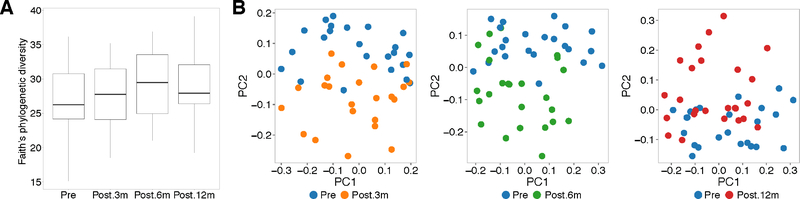
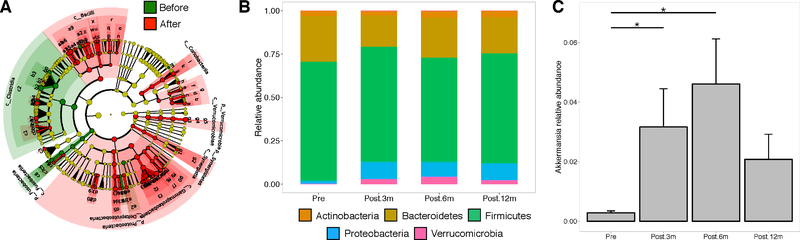
Bariatric surgery tended to increase alpha diversity, and significantly altered beta diversity, microbiota composition, and function up to 6 months after surgery, but these changes tend to regress to presurgery levels by 12 months. Twelve of 15 bacterial pathways enriched after surgery also regressed to presurgery levels at 12 months. Network analysis identified groups of bacteria significantly correlated with levels of circulating metabolites over time. There were no differences between study sites, surgery type, or diabetes status in terms of microbial diversity and composition at baseline and after surgery.
The association among changes in microbiome with decreased circulating biomarkers of inflammation, increased bile acids, and products of choline metabolism and other bacterial pathways suggest that the microbiome partially mediates improvement of metabolism during the first year after bariatric surgery.
减重手术的一些代谢效应可能是由肠道微生物组介导的。
研究减重手术对肠道微生物群落组成和细菌途径的变化及其与减重手术后代谢参数的关系。
美国和西班牙的大学医院。
通过 16S rRNA 测序研究微生物多样性和组成、可能的细菌途径以及靶向循环代谢物,纳入 26 例严重肥胖患者(伴或不伴 2 型糖尿病),分别在术前和术后 3、6 和 12 个月进行研究。
减重手术倾向于增加 alpha 多样性,并在术后 6 个月内显著改变 beta 多样性、微生物群落组成和功能,但这些变化在 12 个月时趋于恢复到术前水平。手术后富集的 15 条细菌途径中有 12 条在 12 个月时也恢复到术前水平。网络分析确定了与循环代谢物水平随时间变化相关的细菌群。在微生物多样性和组成方面,研究地点、手术类型或糖尿病状态在基线和手术后均无差异。
微生物组与循环炎症标志物降低、胆汁酸增加以及胆碱代谢产物和其他细菌途径产物的变化之间的关联表明,微生物组部分介导了减重手术后第一年代谢的改善。