Institute for Research in Biomedicine (IRB Barcelona), The Barcelona Institute of Science and Technology, 08028, Barcelona, Spain.
ICREA, Pg. Lluís Companys 23, 08010, Barcelona, Spain.
Nat Commun. 2019 Jul 11;10(1):3071. doi: 10.1038/s41467-019-10946-y.
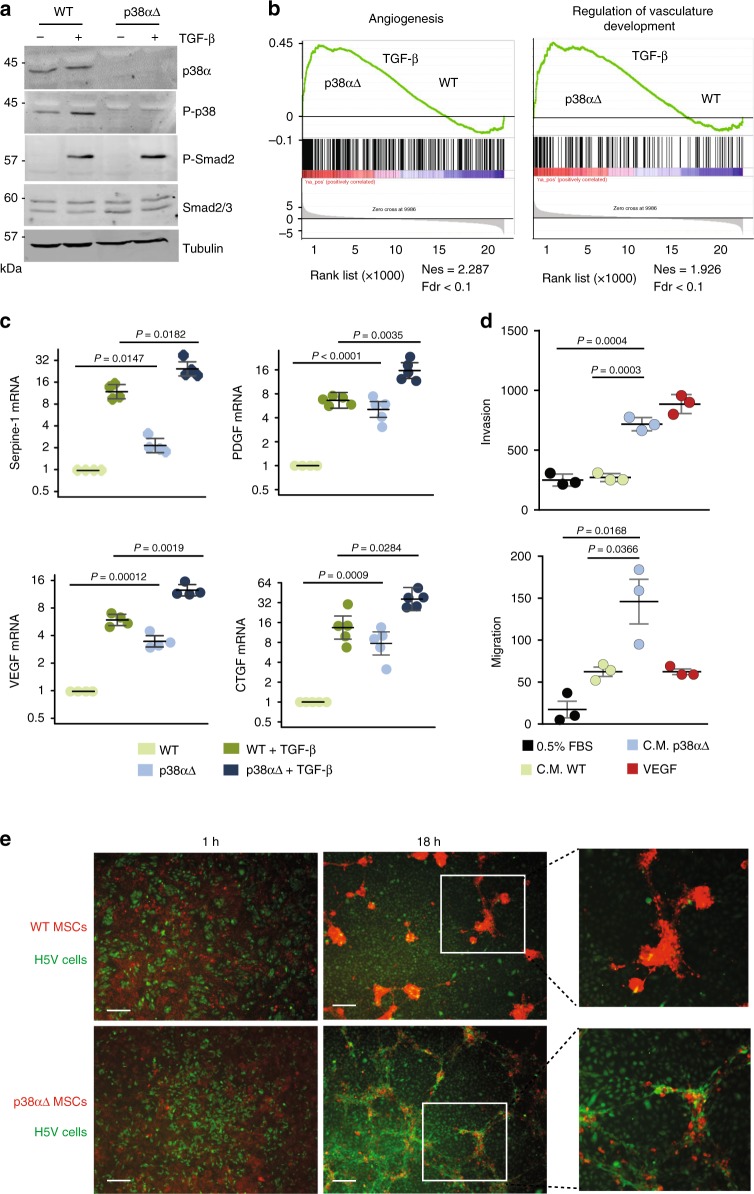
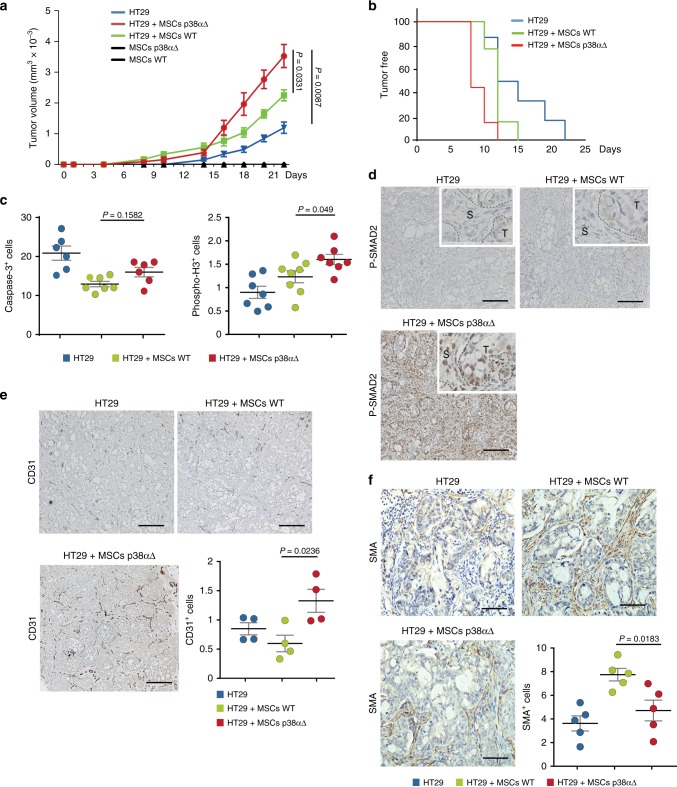
The formation of new blood vessels is essential for normal development, tissue repair and tumor growth. Here we show that inhibition of the kinase p38α enhances angiogenesis in human and mouse colon tumors. Mesenchymal cells can contribute to tumor angiogenesis by regulating proliferation and migration of endothelial cells. We show that p38α negatively regulates an angiogenic program in mesenchymal stem/stromal cells (MSCs), multipotent progenitors found in perivascular locations. This program includes the acquisition of an endothelial phenotype by MSCs mediated by both TGF-β and JNK, and negatively regulated by p38α. Abrogation of p38α in mesenchymal cells increases tumorigenesis, which correlates with enhanced angiogenesis. Using genetic models, we show that p38α regulates the acquisition of an endothelial-like phenotype by mesenchymal cells in colon tumors and damage tissue. Taken together, our results indicate that p38α in mesenchymal cells restrains a TGF-β-induced angiogenesis program including their ability to transdifferentiate into endothelial cells.
新血管的形成对于正常发育、组织修复和肿瘤生长至关重要。在这里,我们表明抑制激酶 p38α 可增强人和小鼠结肠肿瘤中的血管生成。间充质细胞可以通过调节内皮细胞的增殖和迁移来促进肿瘤血管生成。我们表明 p38α 负调控血管生成程序在间充质干细胞(MSC)中,多能祖细胞在血管周围位置发现。这个程序包括 MSC 通过 TGF-β和 JNK 介导的获得内皮表型,并且受到 p38α 的负调控。在间充质细胞中阻断 p38α 会增加肿瘤发生,这与增强的血管生成相关。使用遗传模型,我们表明 p38α 调节结肠肿瘤和损伤组织中间充质细胞获得类似内皮的表型。总之,我们的结果表明,间充质细胞中的 p38α 抑制 TGF-β诱导的血管生成程序,包括它们转分化为内皮细胞的能力。