Key Lab of Applied Chemistry of Zhejiang Province, Zhejiang University, 310028, Hangzhou, China.
College of Chemical and Biological Engineering, Zhejiang University, 310027, Hangzhou, China.
Nat Commun. 2019 Jul 11;10(1):3059. doi: 10.1038/s41467-019-11080-5.
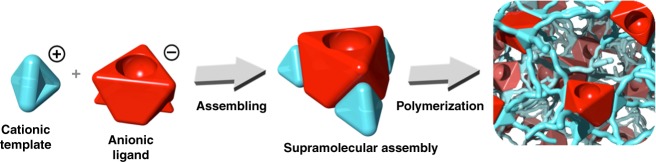
Precise control of the outer-sphere environment around the active sites of heterogeneous catalysts to modulate the catalytic outcomes has long been a challenge. Here, we demonstrate how this can be fulfilled by encapsulating catalytic components into supramolecular capsules, used as building blocks for materials synthesis, whereby the microenvironment of each active site is tuned by the assembled wall. Specifically, using a cationic template equipped with a polymerizable functionality, anionic ligands can be encapsulated by ion pair-directed supramolecular assembly, followed by construction into porous frameworks. The hydrophilic ionic wall enables reactions to be achieved in water that usually requires organic solvents and also facilitates the enrichment of the substrate into the hydrophobic pocket, leading to superior catalytic performances as demonstrated by the industrially relevant hydroformylation. Remarkably, the formation of the supramolecular assembly and catalyst encapsulation further engenders reaction selectivity, which reaches an even greater extent after construction of the porous framework.
精确控制多相催化剂活性位周围的外部环境以调节催化结果一直是一个挑战。在这里,我们展示了如何通过将催化组件封装在超分子胶囊中来实现这一点,这些胶囊可作为材料合成的构建块,从而通过组装壁来调节每个活性位的微环境。具体而言,使用带有可聚合官能团的阳离子模板,可以通过离子对导向的超分子组装来封装阴离子配体,然后构建成多孔骨架。亲水离子壁可使通常需要有机溶剂的反应在水中进行,并且还可以促进底物富集到疏水性口袋中,从而在工业相关的加氢甲酰化反应中表现出优异的催化性能。值得注意的是,超分子组装的形成和催化剂的封装进一步产生了反应选择性,在构建多孔骨架后,这种选择性达到了更高的程度。