Burtea D, Dimitriu A, Maloș A, Cherciu I, Săftoiu A
Research Centre of Gastroenterology and Hepatology, University of Medicine and Pharmacy of Craiova, Romania.
Gastro Center Craiova, Romania.
Curr Health Sci J. 2019 Jan-Mar;45(1):52-58. doi: 10.12865/CHSJ.45.01.07. Epub 2019 Mar 31.
Endoscopic procedures represent an important part of daily practice, both for gastroenterologists and nurses, enabling diagnosis and treatment of digestive diseases. An optimal level of quality needs to be obtained for endoscopic procedures to be efficient, which is reflected directly by patient satisfaction. The Gastrointestinal Endoscopy Satisfaction Questionnaire (GESQ) has already been validated in a multicenter trial as an efficient method for measuring patient satisfaction. Aim The aim of our study was to evaluate the quality of endoscopic procedures and patient satisfaction by applying a modified version of the GESQ in an outpatient facility, with or without deep sedation performed under the supervision of an anesthesiologist.
Our study included 552 patients undergoing diagnostic and therapeutic upper and lower GI endoscopies, including endoscopic ultrasound procedures (EUS) performed under propofol sedation, from September 2015 to February 2016. Consecutive patients examined during these 6 months received the questionnaire which was handed by the endoscopy nurse two hours after procedure. The GESQ was modified to include different sections for: 1) communication skills with questions regarding the quantity and clarity of the information delivered to the patient before and after the procedures; 2) pain and discomfort related to the examination with an added question about the specific procedure the patient had undergone; 3) staff manners; 4) physician's technical skills; 5) facility organization (waiting time, comfort in the recovery room, good facilities and equipment) and 6) overall satisfaction. The questionnaire did not include personal data, while answers were analyzed in a confidential manner.
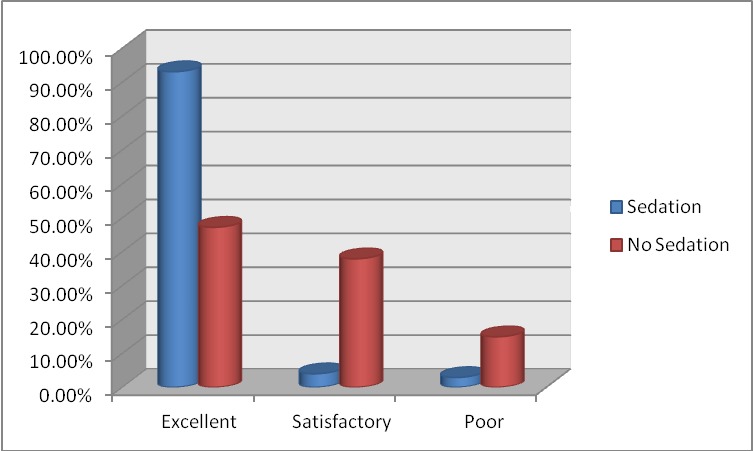
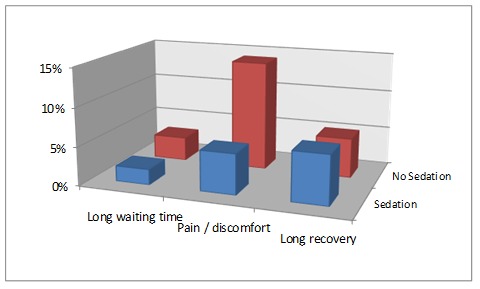
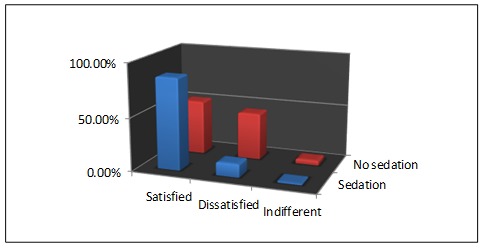
A total number of 552 patients agreed to answer our questionnaire, 192 (34,7%) underwent gastroscopies, 288 (52,1%) colonoscopies and 72 (13,2%) EUS examinations. Regarding the overall level of satisfaction (assessed on a five-point scale), 476 (86,2%) were very satisfied or satisfied, 69 (12,5%) dissatisfied and the remainder 7 (1,3%) were indifferently. For the communication section 16 (3%) patients were not satisfied with the explanations received before the procedure or with the answers to their questions. Pain and discomfort were mentioned by 29 (5,2%) of the patients, usually related to colonoscopies or EUS examinations. 13 (2,3%) of the patients considered the comfort or intimacy of the recovery room to be poor, and 11 (2%) patients were not satisfied with the waiting time before the procedure.
Our modified questionnaire showed good overall patient satisfaction with our endoscopy unit, while also suggesting some areas in need of improvement, such as staff communication skills, better time management and reorganization of the recovery area. Our study demonstrates the importance of such questionnaires in providing feedback information meant to improve standards in endoscopy, including staff skills and organization.
内镜检查程序是胃肠病学家和护士日常工作的重要组成部分,可用于诊断和治疗消化系统疾病。为使内镜检查程序高效进行,需要达到最佳质量水平,而这直接体现在患者满意度上。《胃肠道内镜检查满意度问卷》(GESQ)已在一项多中心试验中得到验证,是测量患者满意度的有效方法。目的 我们研究的目的是通过在门诊机构应用修改版的GESQ来评估内镜检查程序的质量和患者满意度,该检查在麻醉医生监督下进行或不进行深度镇静。
我们的研究纳入了2015年9月至2016年2月期间接受诊断性和治疗性上、下消化道内镜检查的552例患者,包括在丙泊酚镇静下进行的内镜超声检查(EUS)。在这6个月期间接受检查的连续患者在检查后两小时由内镜护士发放问卷。GESQ进行了修改,包括不同部分:1)沟通技巧,涉及术前和术后向患者提供信息的数量和清晰度方面的问题;2)与检查相关的疼痛和不适,并增加了关于患者所接受具体检查程序的问题;3)工作人员态度;4)医生的技术技能;5)设施组织(等待时间、恢复室舒适度、良好的设施和设备);6)总体满意度。问卷不包括个人数据,答案以保密方式进行分析。
共有552例患者同意回答我们的问卷,其中192例(34.7%)接受了胃镜检查,288例(52.1%)接受了结肠镜检查,72例(13.2%)接受了EUS检查。关于总体满意度水平(采用五点量表评估),476例(86.2%)非常满意或满意,69例(12.5%)不满意,其余7例(1.3%)无明显态度。在沟通部分,16例(3%)患者对术前收到的解释或对其问题的回答不满意。29例(5.2%)患者提到了疼痛和不适,通常与结肠镜检查或EUS检查有关。13例(2.3%)患者认为恢复室的舒适度或私密性较差,11例(2%)患者对检查前的等待时间不满意。
我们修改后的问卷显示患者对我们的内镜检查科室总体满意度良好,同时也指出了一些需要改进的方面,如工作人员的沟通技巧、更好的时间管理和恢复区域的重新组织。我们的研究证明了此类问卷在提供反馈信息以提高内镜检查标准(包括工作人员技能和组织)方面的重要性。