Department of Applied Physics, University of Eastern Finland, Kuopio, Finland.
Department of Clinical Neurophysiology, Diagnostic Imaging Center, Kuopio University Hospital, Kuopio, Finland.
Sleep Breath. 2020 Mar;24(1):379-386. doi: 10.1007/s11325-019-01885-5. Epub 2019 Jul 11.
Diagnostics of obstructive sleep apnea (OSA) is based on apnea-hypopnea index (AHI) determined as full-night average of occurred events. We investigate our hypothesis that intra-night variation in the frequency of obstructive events affects diagnostics and prognostics of OSA and should therefore be considered in clinical practice.
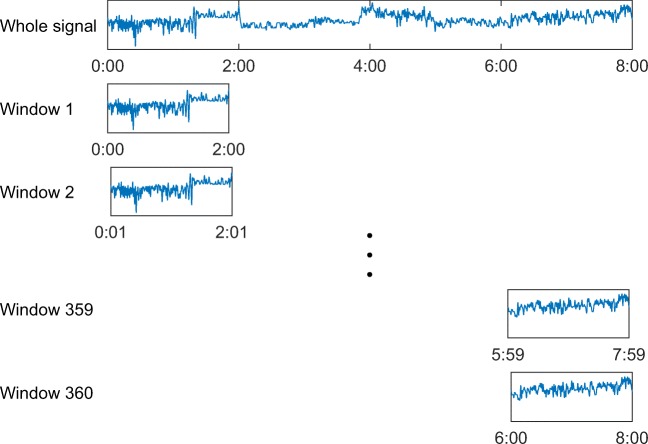
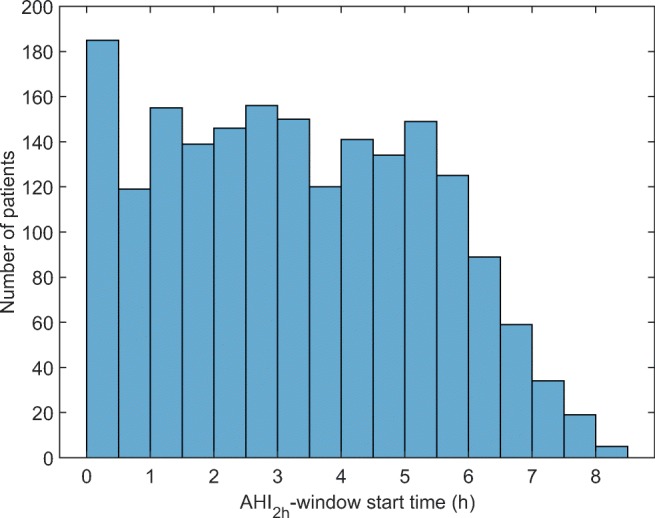
Polygraphic recordings of 1989 patients (mean follow-up 18.3 years) with suspected OSA were analyzed. Number and severity of individual obstructive events were calculated hourly for the first 6 h of sleep. OSA severity was determined based on the full-night AHI and AHI for the 2 h when the obstructive event frequency was highest (AHI). Hazard ratios for all-cause, cardiovascular, and non-cardiovascular mortalities were calculated for different OSA severity categories based on the full-night AHI and AHI.
Frequency and duration of obstructive events varied hour-by-hour increasing towards morning. Using AHI led to a statistically significant rearrangement of patients between the OSA severity categories. The use of AHI for severity classification showed clearer relationship between the OSA severity and mortality than the full-night AHI.
Currently, the intra-night variation in frequency and severity of obstructive events is completely ignored by conventional, full-night AHI and considering this information could improve the diagnostics of OSA.
阻塞性睡眠呼吸暂停(OSA)的诊断基于作为发生事件的全夜平均值的呼吸暂停-低通气指数(AHI)确定。我们调查了我们的假设,即阻塞性事件频率的夜间内变化会影响 OSA 的诊断和预后,因此应在临床实践中考虑。
分析了 1989 名疑似 OSA 患者的多导睡眠图记录(平均随访 18.3 年)。计算了睡眠前 6 小时内每小时单个阻塞性事件的数量和严重程度。根据全夜 AHI 和阻塞性事件频率最高时的 2 小时 AHI(AHI)确定 OSA 严重程度。根据全夜 AHI 和 AHI,基于不同的 OSA 严重程度类别计算了全因、心血管和非心血管死亡率的风险比。
阻塞性事件的频率和持续时间逐小时变化,逐渐增加直至早晨。使用 AHI 导致患者在 OSA 严重程度类别之间进行了统计学上的重新排列。使用 AHI 进行严重程度分类与全夜 AHI 相比,更清楚地显示了 OSA 严重程度与死亡率之间的关系。
目前,常规的全夜 AHI 完全忽略了夜间频率和严重程度的变化,考虑这些信息可以改善 OSA 的诊断。