School of Social Sciences and Psychology, Western Sydney University, AU.
School of Public Health and Community Medicine, University of New South Wales, AU.
Ann Glob Health. 2019 Jul 12;85(1):106. doi: 10.5334/aogh.2348.
Sub-Saharan Africa (SSA) has one of the highest levels of perinatal mortality globally. However, there are sub-regional and country-specific disparities in its distribution.
The aim of this study was to undertake a meta-analysis of demographic and health surveys to quantify perinatal mortality rate within sub-Saharan Africa and to depict sub-regional and country-specific differences.
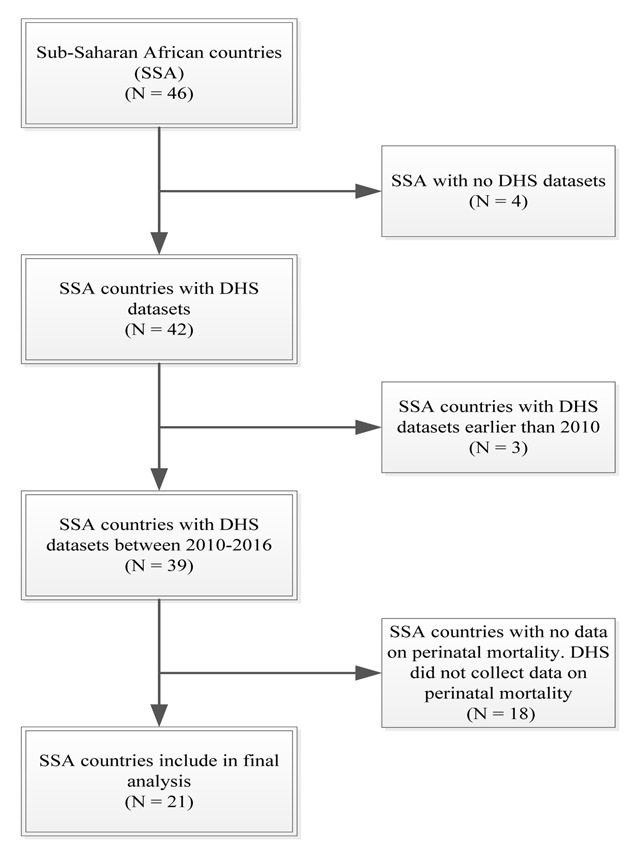
This study used cross-sectional data from the most recent demographic and health surveys (2010-2016) conducted in 21 sub-Saharan African countries. The countries were grouped into four sub-regions (Eastern Africa, Western Africa, Southern Africa and Central Africa), and a meta-analysis was conducted to estimate perinatal mortality rate within each of the sub-regions. Significant heterogeneity was detected among the various surveys (I2 > 50%), hence a random effect model was used. Sensitivity analysis was also performed to examine the effects of outliers. Perinatal mortality was defined as pregnancy losses occurring after seven completed months of gestation (stillbirths) and deaths to live births within the first seven days of life (early neonatal deaths).
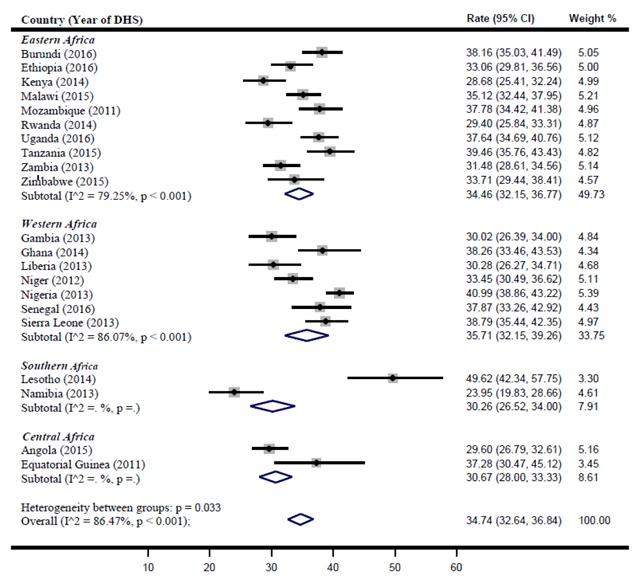
The pooled estimate for perinatal mortality rate per 1000 births across 21 countries in the four sub-regions of SSA was 34.7 (95% CI: 32.6, 36.8). Eastern Africa reported 34.5 (95% CI: 32.2, 36.8), with the highest rate observed in Tanzania [39.5 (95% CI: 35.8, 43.4)]. Western Africa reported 35.7 (95% CI: 32.2, 39.3), with the highest rate observed in Nigeria [40.9 (95% CI: 38.3, 43.2)]. Southern Africa reported 30.3 (95% CI: 26.5, 34.0), with the highest rate observed in Lesotho [49.6 (95% CI: 42.3, 57.8)]. Central Africa reported 30.7 (95% CI: 28.0, 33.3), with the highest rate observed in Equatorial Guinea [37.3 (95% CI: 30.5, 45.1)].
To reduce mortality in the perinatal period, interventions should focus on improving access to high quality antenatal and postnatal care, as well as strengthening health care systems within countries in sub-Saharan Africa.
撒哈拉以南非洲(SSA)的围产期死亡率居全球最高之列。然而,其分布情况在次区域和国家之间存在差异。
本研究旨在通过对人口与健康调查进行荟萃分析,量化撒哈拉以南非洲的围产期死亡率,并描述次区域和国家间的差异。
本研究使用了 21 个撒哈拉以南非洲国家最近的人口与健康调查(2010-2016 年)的横断面数据。这些国家被分为四个次区域(东非、西非、南非和中非),并对每个次区域的围产期死亡率进行了荟萃分析。由于各调查之间存在显著的异质性(I2>50%),因此采用了随机效应模型。还进行了敏感性分析以检查离群值的影响。围产期死亡定义为妊娠 7 个月后(死产)和出生后 7 天内(早期新生儿死亡)的妊娠损失。
在 SSA 的四个次区域的 21 个国家中,每 1000 例活产的围产期死亡率总和为 34.7(95%CI:32.6,36.8)。东非报告的围产期死亡率为 34.5(95%CI:32.2,36.8),其中坦桑尼亚的死亡率最高[39.5(95%CI:35.8,43.4)]。西非报告的围产期死亡率为 35.7(95%CI:32.2,39.3),其中尼日利亚的死亡率最高[40.9(95%CI:38.3,43.2)]。南非报告的围产期死亡率为 30.3(95%CI:26.5,34.0),其中莱索托的死亡率最高[49.6(95%CI:42.3,57.8)]。中非报告的围产期死亡率为 30.7(95%CI:28.0,33.3),其中赤道几内亚的死亡率最高[37.3(95%CI:30.5,45.1)]。
为降低围产期死亡率,应重点关注改善获得高质量产前和产后护理的机会,并加强撒哈拉以南非洲国家的卫生保健系统。