University of Southern California/University Kidney Research Organization, Kidney Research Center, Division of Nephrology and Hypertension, Department of Medicine, Keck School of Medicine of University of Southern California, Los Angeles, CA.
Division of Nephrology, Department of Medicine, Stanford University School of Medicine, Stanford, CA.
Semin Nephrol. 2019 Jul;39(4):353-367. doi: 10.1016/j.semnephrol.2019.04.005.
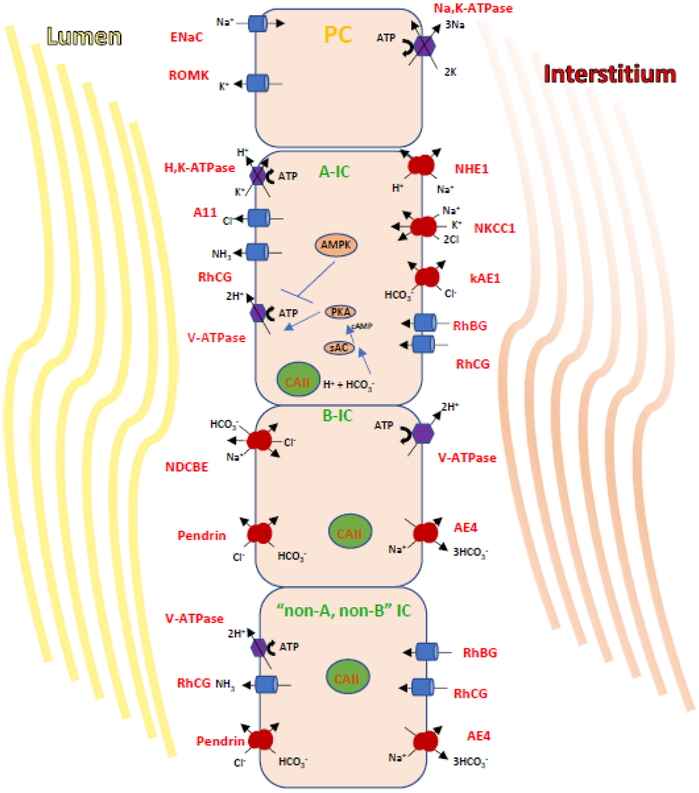
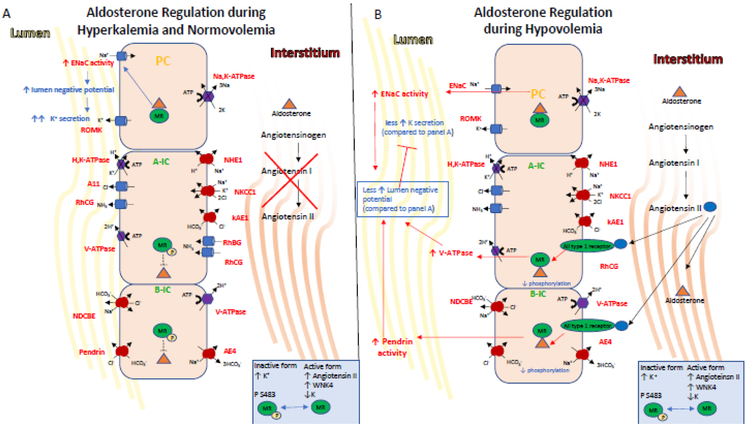
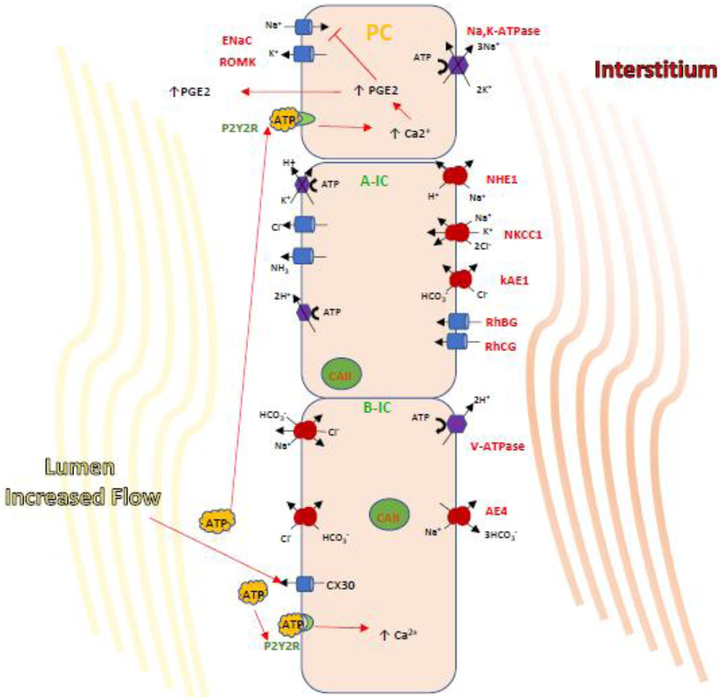
The epithelium of the kidney collecting duct (CD) is composed mainly of two different types of cells with distinct and complementary functions. CD principal cells traditionally have been considered to have a major role in Na and water regulation, while intercalated cells (ICs) were thought to largely modulate acid-base homeostasis. In recent years, our understanding of IC function has improved significantly owing to new research findings. Thus, we now have a new model for CD transport that integrates mechanisms of salt and water reabsorption, K homeostasis, and acid-base status between principal cells and ICs. There are three main types of ICs (type A, type B, and non-A, non-B), which first appear in the late distal convoluted tubule or in the connecting segment in a species-dependent manner. ICs can be detected in CD from cortex to the initial part of the inner medulla, although some transport proteins that are key components of ICs also are present in medullary CD, cells considered inner medullary. Of the three types of ICs, each has a distinct morphology and expresses different complements of membrane transport proteins that translate into very different functions in homeostasis and contributions to CD luminal pro-urine composition. This review includes recent discoveries in IC intracellular and paracrine signaling that contributes to acid-base regulation as well as Na, Cl, K, and Ca homeostasis. Thus, these new findings highlight the potential role of ICs as targets for potential hypertension treatments.
肾脏集合管(CD)的上皮细胞主要由两种具有不同且互补功能的细胞类型组成。传统上认为 CD 主细胞在调节 Na 和水方面具有主要作用,而间充质细胞(IC)被认为在很大程度上调节酸碱平衡。近年来,由于新的研究发现,我们对 IC 功能的理解有了显著提高。因此,我们现在有了一个新的 CD 转运模型,该模型整合了主细胞和 IC 之间的盐和水重吸收、K 稳态和酸碱状态的机制。有三种主要类型的 IC(A 型、B 型和非 A、非 B 型),它们首先以物种依赖的方式出现在远曲小管的晚期或连接段。IC 可以在从皮质到内髓初始部分的 CD 中检测到,尽管一些作为 IC 关键组成部分的转运蛋白也存在于 CD 的髓质中,这些细胞被认为是内髓质细胞。在这三种类型的 IC 中,每种都有独特的形态,表达不同的膜转运蛋白,这些蛋白在体内平衡和对 CD 腔尿组成的贡献方面转化为非常不同的功能。本综述包括 IC 细胞内和旁分泌信号转导的最新发现,这些发现有助于酸碱调节以及 Na、Cl、K 和 Ca 稳态。因此,这些新发现强调了 IC 作为潜在高血压治疗靶点的潜力。