School of Medical Sciences, Division of Dentistry, The University of Manchester, Manchester, Greater Manchester, UK.
Functional Area Speech and Language Pathology, Division of Speech and Language Pathology, Karolinska Institute, Stockholm, Sweden.
BMJ Open. 2019 Jul 11;9(7):e029780. doi: 10.1136/bmjopen-2019-029780.
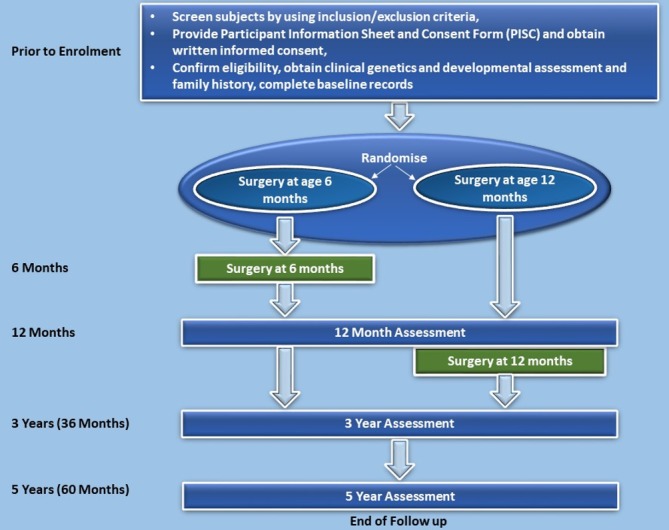
Cleft palate is among the most common birth abnormalities. The success of primary surgery in the early months of life is crucial for successful feeding, speech, hearing, dental development and facial growth. Over recent decades, age at palatal surgery in infancy has reduced. This has led to palatal closure in one-stage procedures being carried out around the age of 12 months, but in some cases as early as 6 months. The primary objective of the Timing Of Primary Surgery for Cleft Palate (TOPS)trial is to determine whether surgery for cleft palate performed at 6 or 12 months of age is most beneficial for speech outcomes.
Infants with a diagnosis of non-syndromic isolated cleft palate will be randomised to receive standardised primary surgery (Sommerlad technique) for closure of the cleft at either 6 months or 12 months, corrected for gestational age. The primary outcome will be perceived insufficient velopharyngeal function at 5 years of age. Secondary outcomes measured across 12 months, 3 years and 5 years will include growth, safety of the procedure, dentofacial development, speech, hearing level and middle ear function. Video and audio recordings of speech will be collected in a standardised age-appropriate manner and analysed independently by multiple speech and language therapists. The trial aims to recruit and follow-up 300 participants per arm. Data will be analysed according to the intention-to-treat principle using a 5% significance level. All analyses will be prespecified within a full and detailed statistical analysis plan.
Ethical approval has been sought in each participating country according to country-specific procedures. Trial results will be presented at conferences, published in peer-reviewed journals and disseminated through relevant patient support groups.
NCT00993551; Pre-results.
腭裂是最常见的出生缺陷之一。在生命早期进行初次手术的成功对成功喂养、言语、听力、牙齿发育和面部生长至关重要。近几十年来,婴儿腭裂手术的年龄有所降低。这导致在 12 个月左右进行腭裂一期手术,但在某些情况下,6 个月就可以进行。腭裂初次手术时机(TOPS)试验的主要目的是确定 6 个月或 12 个月大时进行腭裂手术对言语结果是否更有益。
将诊断为非综合征性单纯腭裂的婴儿随机分配接受标准化的初次手术(Sommerlad 技术),以在 6 个月或 12 个月时(按胎龄校正)闭合裂隙。主要结局将是 5 岁时感知到的腭咽功能不足。在 12 个月、3 年和 5 年测量的次要结局包括生长、手术安全性、牙颌面发育、言语、听力水平和中耳功能。将以标准化的适合年龄的方式收集语音的视频和音频记录,并由多名言语和语言治疗师独立进行分析。该试验旨在每臂招募和随访 300 名参与者。将根据意向治疗原则使用 5%的显著性水平进行数据分析。所有分析将在完整和详细的统计分析计划中预先规定。
根据各国的具体程序,已在每个参与国家征求伦理批准。试验结果将在会议上报告,发表在同行评议的期刊上,并通过相关的患者支持团体传播。
NCT00993551;预结果。