Innsbruck Medical University, Department of Anatomy, Histology and Embryology, Division of Neuroanatomy, 6020, Innsbruck, Austria.
VIB-KU Leuven Center for Brain & Disease Research O&N 4, Campus Gasthuisberg, 3000, Leuven, Belgium.
Sci Rep. 2019 Jul 12;9(1):10095. doi: 10.1038/s41598-019-46579-w.
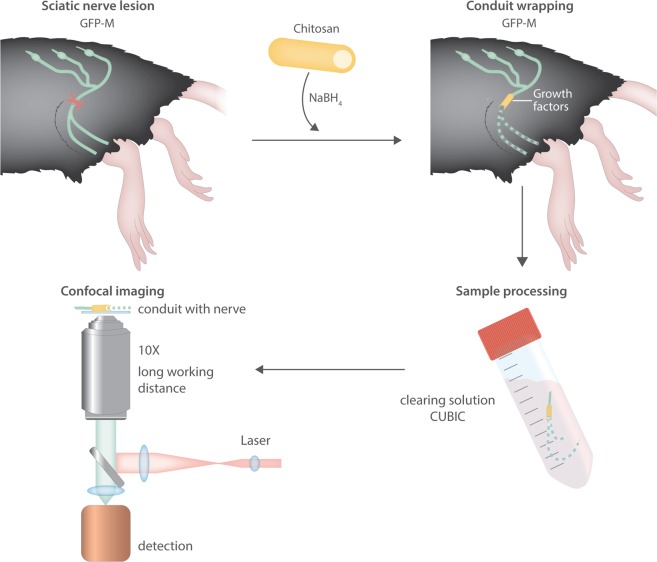
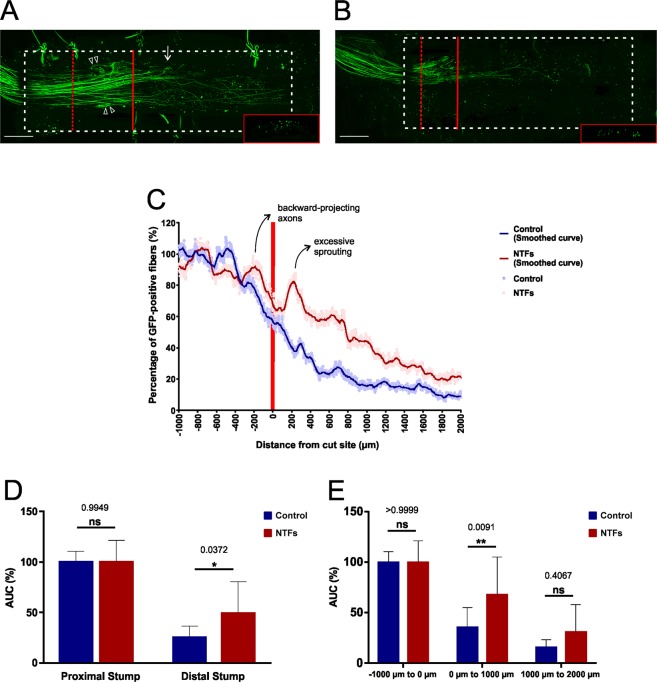
While axons within the central nervous system (CNS) do not regenerate following injury, those in the peripheral nervous system (PNS) do, although not in a clinically satisfactory manner as only a small proportion of axons exhibit long-distance regeneration. Moreover, functional recovery is hampered by excessive axonal sprouting and aberrant reinnervation of target tissue. In order to investigate the mechanisms governing the regrowth of axons following injury, previous studies have used lesion paradigms of peripheral nerves in rat or mouse models, and reagents or cells have been administered to the lesion site through nerve conduits, aiming to improve early-stage regeneration. Morphological analysis of such in vivo experiments has however been limited by the incompatibility of synthetic nerve conduits with existing tissue-clearing and imaging techniques. We present herein a novel experimental approach that allows high-resolution imaging of individual axons within nerve conduits, together with quantitative assessment of fiber growth. We used a GFP-expressing mouse strain in a lesion model of the sciatic nerve to describe a strategy that combines nerve clearing, chemical treatment of chitosan nerve conduits, and long working distance confocal microscopy with image processing and analysis. This novel experimental setup provides a means of documenting axon growth within the actual conduit during the critical initial stage of regeneration. This will greatly facilitate the development and evaluation of treatment regimens to improve axonal regeneration following nerve damage.
虽然中枢神经系统(CNS)中的轴突在受伤后不会再生,但周围神经系统(PNS)中的轴突会再生,尽管其方式在临床上并不令人满意,因为只有一小部分轴突表现出长距离再生。此外,轴突过度发芽和靶组织的异常再支配会阻碍功能恢复。为了研究损伤后轴突再生的调控机制,以前的研究使用了大鼠或小鼠模型中的周围神经损伤范例,并通过神经导管向损伤部位给予试剂或细胞,旨在改善早期再生。然而,这种体内实验的形态学分析受到合成神经导管与现有组织清除和成像技术不兼容的限制。我们在此提出了一种新的实验方法,允许在神经导管内对单个轴突进行高分辨率成像,并对纤维生长进行定量评估。我们使用了一种 GFP 表达的小鼠品系在坐骨神经损伤模型中,描述了一种结合神经清除、壳聚糖神经导管化学处理以及长工作距离共聚焦显微镜与图像处理和分析的策略。这种新的实验装置提供了一种在再生的关键初始阶段在实际导管内记录轴突生长的方法。这将极大地促进改善神经损伤后轴突再生的治疗方案的开发和评估。