Ang Ting F A, An Ning, Ding Huitong, Devine Sherral, Auerbach Sanford H, Massaro Joseph, Joshi Prajakta, Liu Xue, Liu Yulin, Mahon Elizabeth, Au Rhoda, Lin Honghuang
Department of Anatomy and Neurobiology, Boston University School of Medicine, Boston, MA, USA.
Department of Epidemiology, Boston University School of Public Health, Boston, MA, USA.
Alzheimers Dement (N Y). 2019 Jun 27;5:264-271. doi: 10.1016/j.trci.2019.05.002. eCollection 2019.
Despite the availability of age- and education-adjusted standardized scores for most neuropsychological tests, there is a lack of objective rules in how to interpret multiple concurrent neuropsychological test scores that characterize the heterogeneity of Alzheimer's disease.
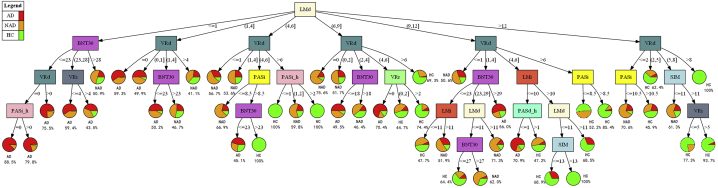
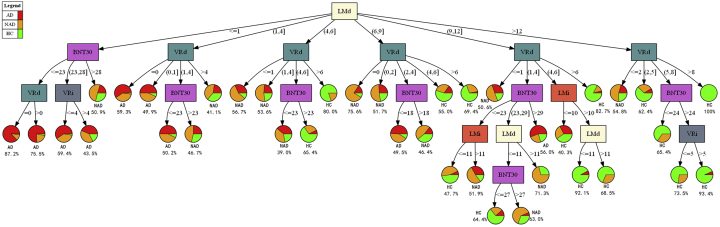
Using neuropsychological test scores of 2091 participants from the Framingham Heart Study, we devised an automated algorithm that follows general diagnostic criteria and explores the heterogeneity of Alzheimer's disease.
We developed a series of stepwise diagnosis rules that evaluate information from multiple neuropsychological tests to produce an intuitive and objective Alzheimer's disease dementia diagnosis with more than 80% accuracy.
A data-driven stepwise diagnosis system is useful for diagnosis of Alzheimer's disease from neuropsychological tests. It demonstrated better performance than the traditional dichotomization of individuals' performance into satisfactory and unsatisfactory outcomes, making it more reflective of dementia as a spectrum disorder. This algorithm can be applied to both within clinic and outside-of-clinic settings.
尽管大多数神经心理学测试都有年龄和教育程度调整后的标准化分数,但在如何解释表征阿尔茨海默病异质性的多个同时进行的神经心理学测试分数方面,缺乏客观规则。
利用弗雷明汉心脏研究中2091名参与者的神经心理学测试分数,我们设计了一种遵循一般诊断标准并探索阿尔茨海默病异质性的自动化算法。
我们制定了一系列逐步诊断规则,这些规则评估来自多个神经心理学测试的信息,以产生准确率超过80%的直观且客观的阿尔茨海默病痴呆症诊断。
一个数据驱动的逐步诊断系统对于通过神经心理学测试诊断阿尔茨海默病很有用。它表现出比将个体表现传统二分法为满意和不满意结果更好的性能,使其更能反映痴呆症作为一种谱系障碍。该算法可应用于临床环境和非临床环境。