Su Hong, Wang Lina, Li Yang, Yu Hong, Zhang Jiayuan
School of Nursing, Daqing Campus, University of Harbin Medical, Daqing District, Heilongjiang.
School of Nursing, Medical College of Huzhou University, Huzhou District, Zhejiang, China.
Medicine (Baltimore). 2019 Jul;98(28):e16149. doi: 10.1097/MD.0000000000016149.
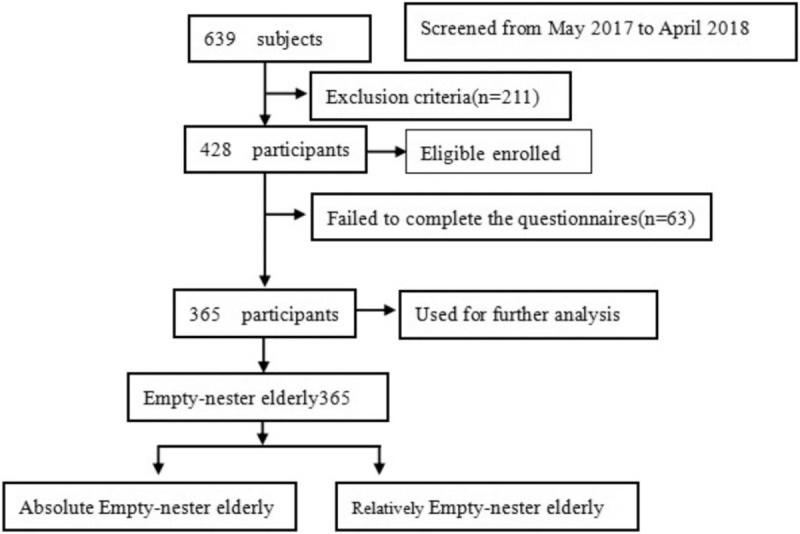
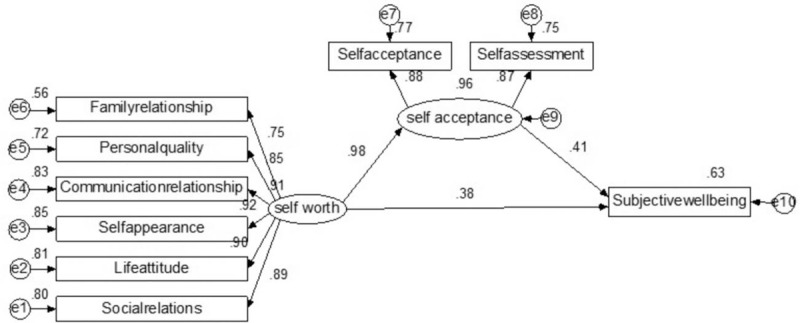
This study aims to test the moderation and mediation effects of self-acceptance and self-reported health on self-worth's impact on subjective well-being among elderly Chinese rural empty-nester elderly, and confirm whether self-report health is a moderating variable between self-worth and subjective well-being.This cross-sectional study was performed from May 2017 to April 2018; the participants were 365 empty-nest elderly adults from rural areas of Chifeng City in Inner Mongolia.Data were collected with the General information questionnaire, Self-worth questionnaire for adults, Self-acceptance Questionnaire, and Memorial University of New Found land Scale of Happiness. For the analyses, correlations, regressions, and structural equation models were used. Bootstrapping was performed to confirm the mediation effect. Multiple regression analysis was performed to confirm the moderation effect.Self-worth showed significant correlations with self-acceptance and subjective well-being (all P < .01). Bootstrapping indicated that the mediating role of self-acceptance was statistically significant. And self-reported health moderated the self-worth and subjective well-being association.Self-acceptance partially mediated the relationship between self-worth and subjective well-being of the rural empty-nest elderly and self-reported health moderated self-worth and subjective well-being association. Consequently, to improve the subjective well-being of the rural empty-nest elderly, self-acceptance and personal health should be the focus.
本研究旨在检验自我接纳和自评健康在自我价值对中国农村老年空巢老人主观幸福感影响中的调节和中介作用,并确认自评健康是否为自我价值与主观幸福感之间的调节变量。本横断面研究于2017年5月至2018年4月进行;参与者为内蒙古赤峰市农村地区的365名空巢老年人。使用一般信息问卷、成人自我价值问卷、自我接纳问卷和纽芬兰纪念大学幸福量表收集数据。分析时采用了相关性分析、回归分析和结构方程模型。进行了自抽样以确认中介效应。进行多元回归分析以确认调节效应。自我价值与自我接纳和主观幸福感显著相关(所有P <.01)。自抽样表明自我接纳的中介作用具有统计学意义。且自评健康调节了自我价值与主观幸福感的关联。自我接纳部分中介了农村空巢老人自我价值与主观幸福感之间的关系,且自评健康调节了自我价值与主观幸福感的关联。因此,为提高农村空巢老人的主观幸福感,应关注自我接纳和个人健康。