K=1 Project, Center for Nuclear Studies, Columbia University, New York, NY 10027.
Department of Physics, Columbia University, New York, NY 10027.
Proc Natl Acad Sci U S A. 2019 Jul 30;116(31):15414-15419. doi: 10.1073/pnas.1903481116. Epub 2019 Jul 15.
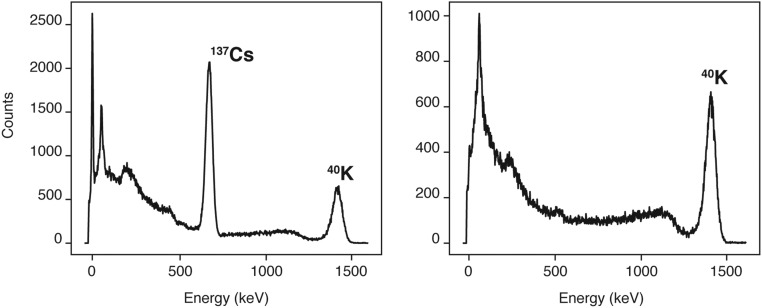
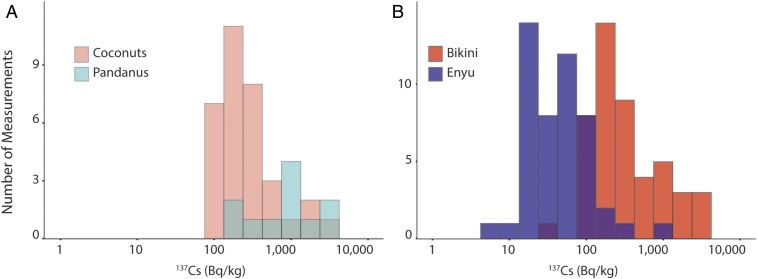
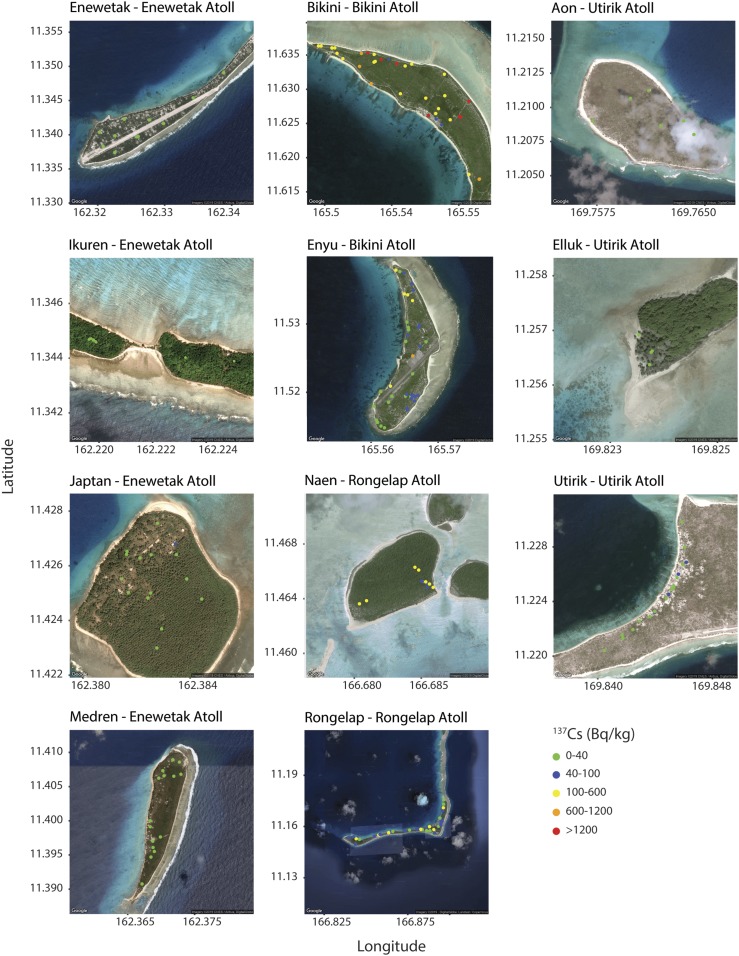
Radioactive contamination of fruits in the northern Marshall Islands, resulting from the US nuclear weapons testing program in the 1940s and 1950s, is still a human health concern, in particular pertaining to island population resettlement and the economic benefit from farming. Over 200 fruits, primarily coconuts and pandanus, were collected on 11 islands from four atolls in the northern Marshall Islands in 2017. The energy spectra from nuclear gamma decays were measured on a research vessel for each fruit in situ. From these recordings, the level of cesium-137 (Cs) contamination was determined for individual fruits. Comparisons of the results are made to past studies and international food safety standards. There is a broad distribution of values, ranging from below detectable radiation levels to relatively high levels; safety concerns are largest for Bikini Island. A noticeable fraction of fruits from Bikini have significantly higher levels of Cs contamination compared with those from all other measured islands.
北马绍尔群岛的水果受到放射性污染,这是美国在 20 世纪 40 年代和 50 年代进行核武器试验计划的结果,仍然是人们关注的健康问题,特别是与岛屿居民重新安置和农业经济利益有关。2017 年,在北马绍尔群岛的四个环礁的 11 个岛屿上收集了超过 200 种水果,主要是椰子和露兜树果。在研究船上对每个水果就地进行了核γ衰变能谱测量。根据这些记录,确定了个别水果的铯-137(Cs)污染水平。将结果与过去的研究和国际食品安全标准进行了比较。数值分布广泛,从低于可检测辐射水平到相对较高水平;比基尼岛的安全问题最大。与所有其他测量岛屿相比,比基尼岛上的水果有相当一部分的 Cs 污染水平明显更高。