Dean Adam, Kimmel Simeon
George Washington University, United States.
Boston Medical Center, United States.
SSM Popul Health. 2019 May 23;8:100409. doi: 10.1016/j.ssmph.2019.100409. eCollection 2019 Aug.
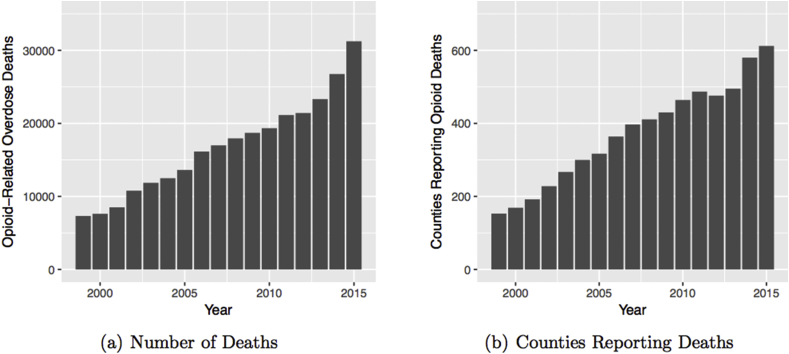
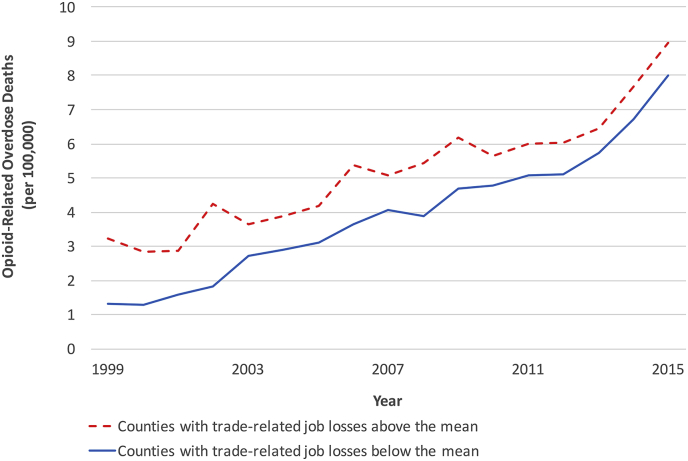
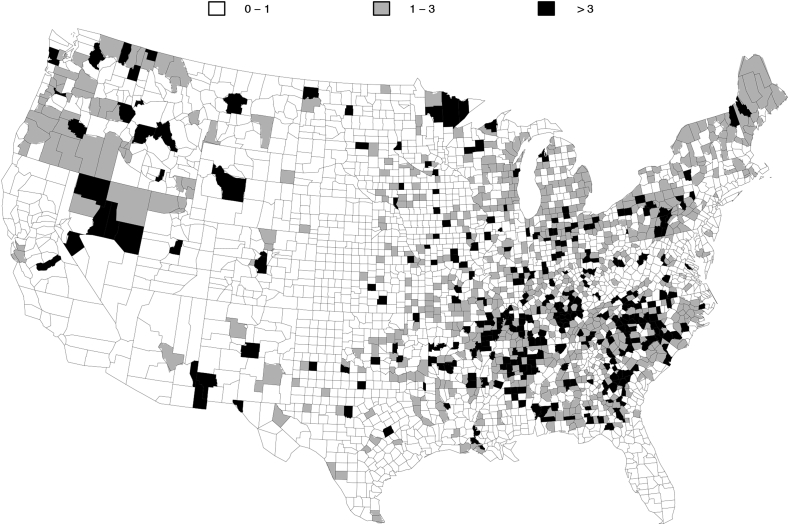
Opioid overdose deaths in the U.S. rose dramatically after 1999, but also exhibited substantial geographic variation. This has largely been explained by differential availability of prescription and non-prescription opioids, including heroin and fentanyl. Recent studies explore the underlying role of socioeconomic factors, but overlook the influence of job loss due to international trade, an economic phenomenon that disproportionately harms the same regions and demographic groups at the heart of the opioid epidemic. We used OLS regression and county-year level data from the Centers for Disease Controls and the Department of Labor to test the association between trade-related job loss and opioid-related overdose death between 1999 and 2015. We find that the loss of 1000 trade-related jobs was associated with a 2.7 percent increase in opioid-related deaths. When fentanyl was present in the heroin supply, the same number of job losses was associated with a 11.3 percent increase in opioid-related deaths.
1999年后,美国阿片类药物过量致死人数急剧上升,且存在显著的地理差异。这在很大程度上可以用处方和非处方阿片类药物(包括海洛因和芬太尼)的可得性差异来解释。近期的研究探讨了社会经济因素的潜在作用,但忽视了国际贸易导致的失业影响,而这一经济现象对阿片类药物流行核心地区的相同区域和人口群体造成了不成比例的伤害。我们使用了来自疾病控制中心和劳工部的OLS回归及县年层面数据,来检验1999年至2015年间与贸易相关的失业和与阿片类药物相关的过量死亡之间的关联。我们发现,1000个与贸易相关的工作岗位流失与阿片类药物相关死亡人数增加2.7%有关。当海洛因供应中含有芬太尼时,相同数量的岗位流失与阿片类药物相关死亡人数增加11.3%有关。