Department of Urological Surgery, Qinghai University Affiliated Hospital, Xining, Qinghai, China (mainland).
Department of Urological Surgery, Henan Province People's Hospital, Zhengzhou, Henan, China (mainland).
Med Sci Monit. 2019 Jul 16;25:5289-5298. doi: 10.12659/MSM.915682.
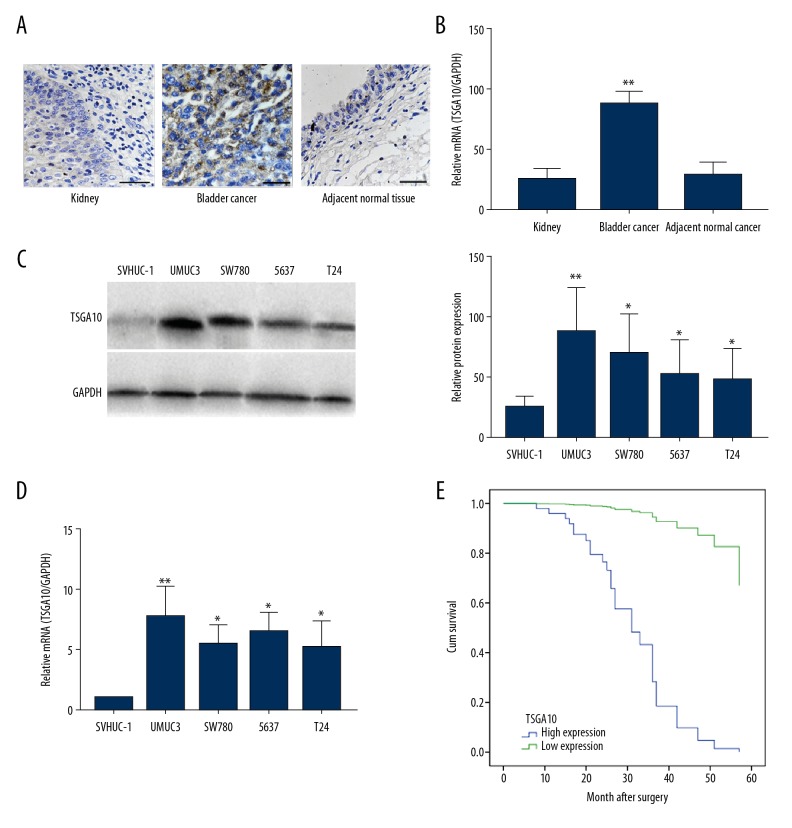
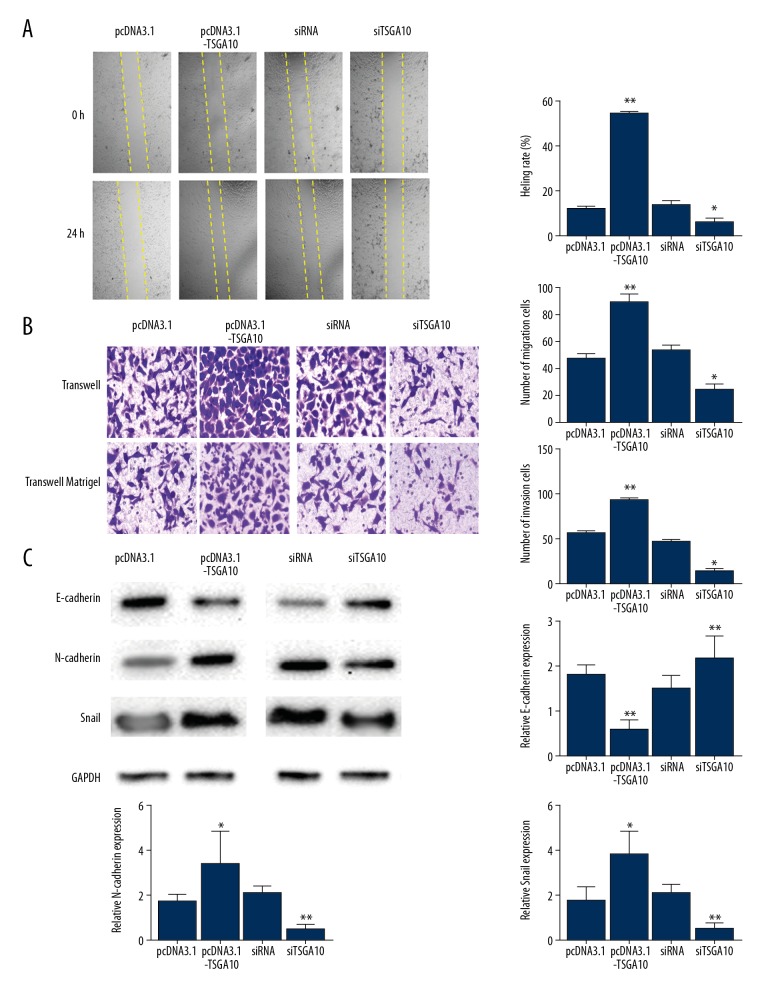
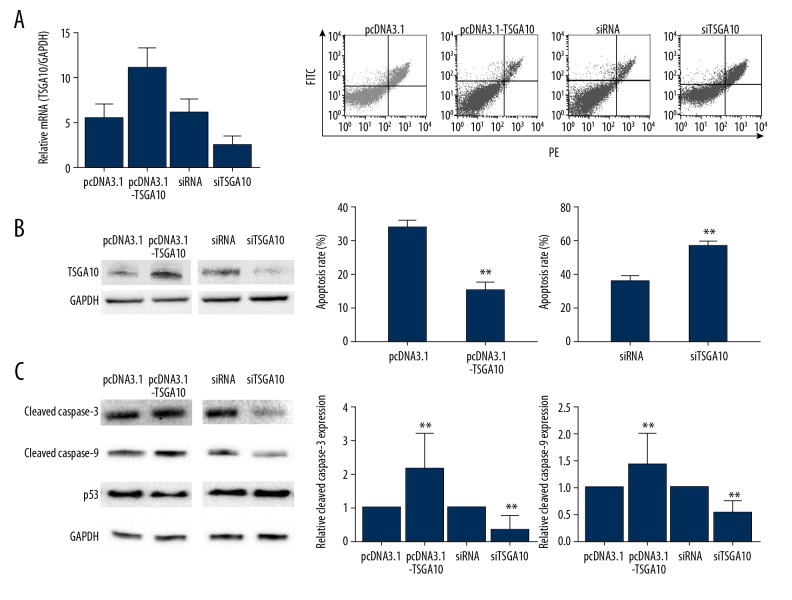
BACKGROUND Testis-specific gene antigen 10 (TSGA10) is a tumor suppressor in several types of human malignancy. However, there have been few studies that have investigated the role of TSGA10 in bladder cancer. This study aimed to investigate the expression of TSGA10 in human bladder cancer cell lines and bladder cancer tissues and its effects on patient prognosis. MATERIAL AND METHODS The expression of TSGA10 in 40 tissue samples of bladder cancer and matched normal adjacent bladder tissue, and five human bladder cancer cell lines was assessed by immunohistochemistry, Western blot, quantitative reverse transcription polymerase chain reaction (qRT-PCR), and flow cytometry. The correlation between the expression level of TSGA10 and the clinicopathological features of patients with bladder cancer was analyzed and overall survival (OS) in patients with bladder cancer was determined by Kaplan-Meier curves. RESULTS Upregulation of TSGA10 expression in tissues from patients with bladder cancer was compared with normal adjacent bladder tissue and was significantly correlated with gender, metastasis, lymphovascular invasion, and tumor stage in bladder cancer. In bladder cancer cell lines, down-regulation of TSGA10 reduced cell apoptosis and increased cell migration, and resulted in the formation of an epithelial-mesenchymal transition (EMT) phenotype. Overexpression of TSGA10 resulted in an increased apoptosis rate of tumor cells, reduced cell migration, and contributed to the reversal of the EMT phenotype. CONCLUSIONS These findings support that TSGA10 deserves further study as a potential novel prognostic biomarker in bladder cancer.
睾丸特异性基因抗原 10(TSGA10)是几种人类恶性肿瘤中的肿瘤抑制因子。然而,很少有研究调查 TSGA10 在膀胱癌中的作用。本研究旨在探讨 TSGA10 在人膀胱癌细胞系和膀胱癌组织中的表达及其对患者预后的影响。
采用免疫组织化学、Western blot、实时定量逆转录聚合酶链反应(qRT-PCR)和流式细胞术检测 40 例膀胱癌组织及其配对的正常膀胱邻近组织和 5 个人膀胱癌细胞系中 TSGA10 的表达。分析 TSGA10 表达水平与膀胱癌患者临床病理特征的相关性,并采用 Kaplan-Meier 曲线确定膀胱癌患者的总生存率(OS)。
与正常膀胱邻近组织相比,膀胱癌患者组织中 TSGA10 表达上调,且与膀胱癌患者的性别、转移、淋巴血管侵犯和肿瘤分期显著相关。在膀胱癌细胞系中,下调 TSGA10 减少了细胞凋亡,增加了细胞迁移,并导致上皮间质转化(EMT)表型的形成。TSGA10 的过表达导致肿瘤细胞凋亡率增加、细胞迁移减少,并有助于 EMT 表型的逆转。
这些发现支持 TSGA10 作为膀胱癌潜在的新型预后生物标志物值得进一步研究。