Genome Integrity and Structural Biology Laboratory, National Institute of Environmental Health Sciences, US National Institutes of Health, Department of Health and Human Services, Research Triangle Park, NC, USA.
Integrative Bioinformatics Support Group, National Institute of Environmental Health Sciences, US National Institutes of Health, Department of Health and Human Services, Research Triangle Park, NC, USA.
DNA Repair (Amst). 2019 Dec;84:102641. doi: 10.1016/j.dnarep.2019.102641. Epub 2019 Jul 3.
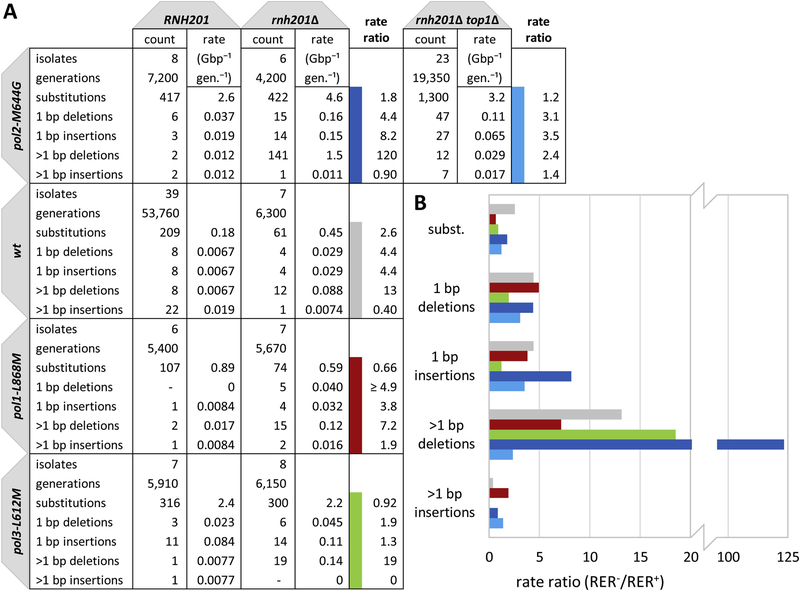
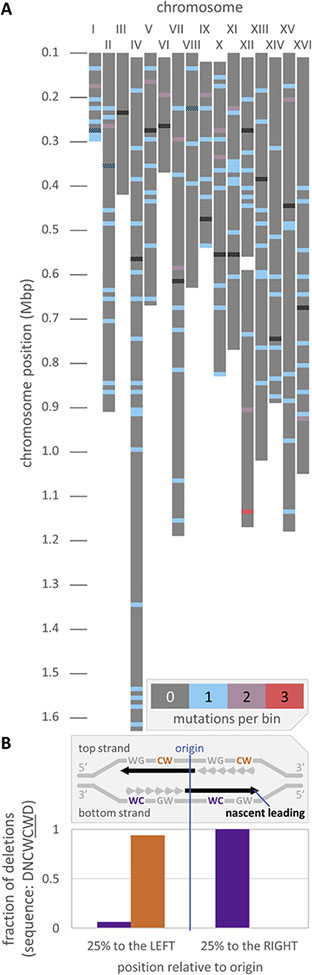
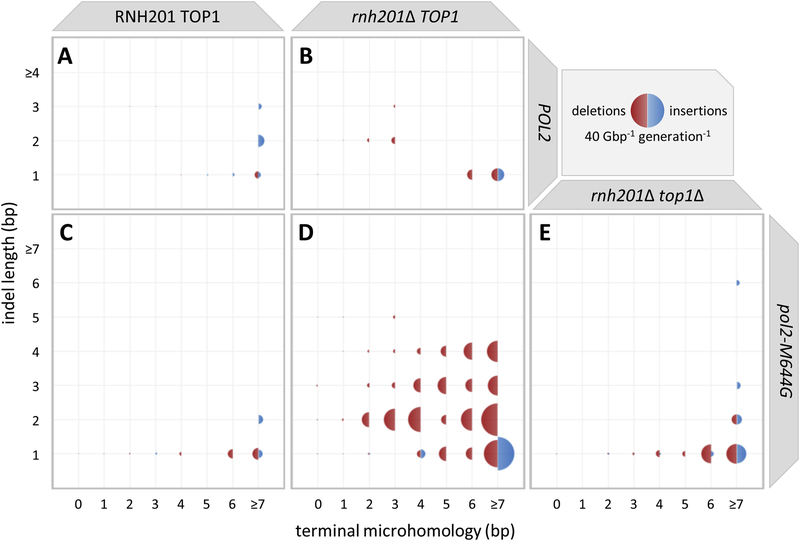
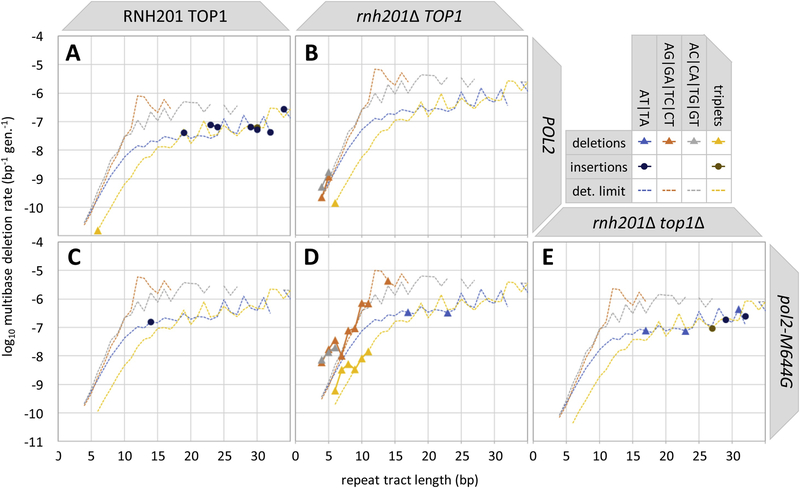
Ribonucleotides are the most common non-canonical nucleotides incorporated into DNA during replication, and their processing leads to mutations and genome instability. Yeast mutation reporter systems demonstrate that 2-5 base pair deletions (Δ2-5bp) in repetitive DNA are a signature of unrepaired ribonucleotides, and that these events are initiated by topoisomerase 1 (Top1) cleavage. However, a detailed understanding of the frequency and locations of ribonucleotide-dependent mutational events across the genome has been lacking. Here we present the results of genome-wide mutational analysis of yeast strains deficient in Ribonucleotide Excision Repair (RER). We identified mutations that accumulated over thousands of generations in strains expressing either wild-type or variant replicase alleles (M644G Pol ε, L612M Pol δ, L868M Pol α) that confer increased ribonucleotide incorporation into DNA. Using a custom-designed mutation-calling pipeline called muver (for mutationes verificatae), we observe a number of surprising mutagenic features. This includes a 24-fold preferential elevation of AG and AC relative to AT dinucleotide deletions in the absence of RER, suggesting specificity for Top1-initiated deletion mutagenesis. Moreover, deletion rates in di- and trinucleotide repeat tracts increase exponentially with tract length. Consistent with biochemical and reporter gene mutational analysis, these deletions are no longer observed upon deletion of TOP1. Taken together, results from these analyses demonstrate the global impact of genomic ribonucleotide processing by Top1 on genome integrity.
核苷酸是复制过程中最常见的非规范核苷酸,它们的处理会导致突变和基因组不稳定。酵母突变报告系统表明,在重复 DNA 中 2-5 个碱基对的缺失(Δ2-5bp)是未修复核苷酸的特征,这些事件是由拓扑异构酶 1(Top1)切割引发的。然而,对于基因组范围内核苷酸依赖性突变事件的频率和位置,人们还缺乏详细的了解。在这里,我们展示了核糖核苷酸切除修复(RER)缺陷酵母菌株全基因组突变分析的结果。我们鉴定了在表达野生型或变体复制酶等位基因(M644G Pol ε、L612M Pol δ、L868M Pol α)的菌株中积累了数千代的突变,这些等位基因导致 DNA 中核糖核苷酸掺入增加。使用名为 muver(用于验证突变)的定制突变调用管道,我们观察到一些令人惊讶的诱变特征。这包括在没有 RER 的情况下,AG 和 AC 相对于 AT 二核苷酸缺失的 24 倍优先升高,这表明 Top1 起始的缺失诱变具有特异性。此外,二核苷酸和三核苷酸重复序列的缺失率随序列长度呈指数增加。与生化和报告基因突变分析一致,在删除 TOP1 后,这些缺失不再观察到。总之,这些分析的结果表明 Top1 对基因组核苷酸处理对基因组完整性的全局影响。