Division of Respiratory Disease, Renmin Hospital of Wuhan University, Wuhan, Hubei, China (mainland).
Department of Critical Care Medicine, Renmin Hospital of Wuhan University, Wuhan, Hubei, China (mainland).
Med Sci Monit. 2019 Jul 17;25:5299-5305. doi: 10.12659/MSM.915835.
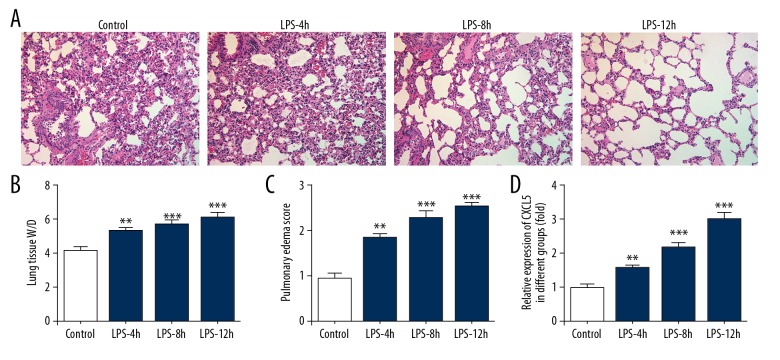
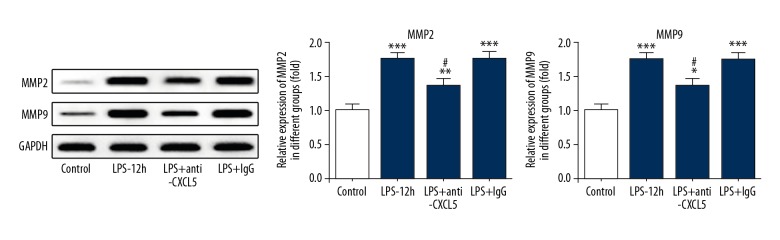
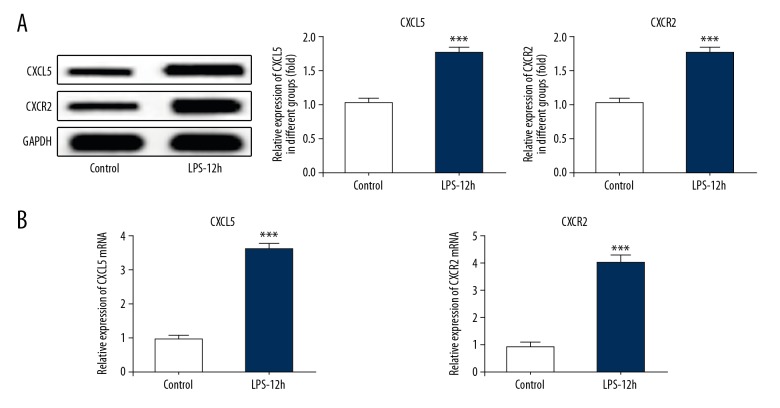
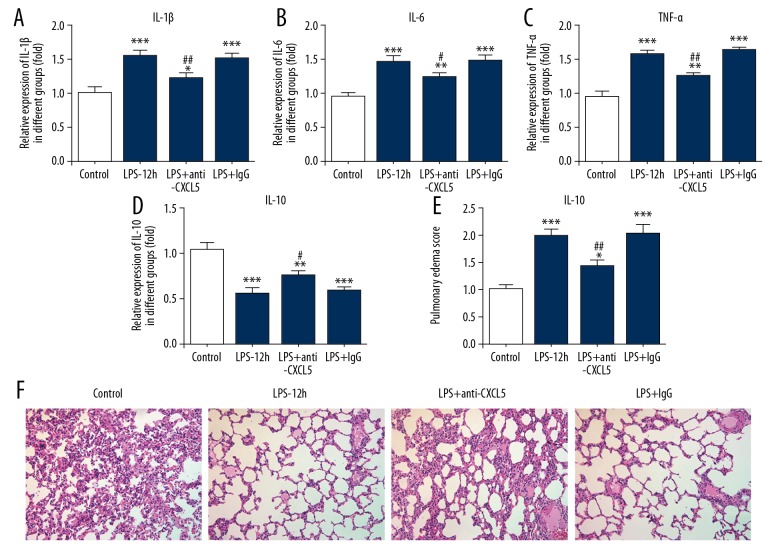
BACKGROUND Acute respiratory distress syndrome (ARDS) is a common acute and severe disease in clinic. Recent studies indicated that Cxc chemokine ligand 5 (CXCL5), an inflammatory chemokine, was associated with tumorigenesis. The present study investigated the role of the CXCL5/Cxc chemokine receptor 2 (CXCR2) bio-axis in ARDS, and explored the underlying molecular mechanism. MATERIAL AND METHODS The pathological morphology of lung tissue and degree of pulmonary edema were assessed by hematoxylin-eosin staining and pulmonary edema score, respectively. Real-time PCR and Western blot analysis were performed to detect the expression levels of CXCL5, CXCR2, Matrix metalloproteinases 2 (MMP2), and Matrix metalloproteinases 9 (MMP9) in lung tissues. Enzyme-linked immunosorbent assay (ELISA) was performed to determine the expression levels of CXCL5 and inflammatory factors (IL-1ß, IL-6, TNF-alpha, and IL-10) in serum. RESULTS The results demonstrated that diffuse alveolar damage and pulmonary edema appeared in lipopolysaccharide (LPS)-induced ARDS and were positively correlated with the severity of ARDS. In addition, CXCL5 and its receptor CXCR2 were overexpressed by upregulation of MMP2 and MMP9 in lung tissues of ARDS. In addition, CXCL5 neutralizing antibody effectively alleviated inflammatory response, diffuse alveolar damage, and pulmonary edema, and decreased the expression levels of MMP2 and MMP9 compared to LPS-induced ARDS. CONCLUSIONS We found that CXCL5/CXCR2 accelerated the progression of ARDS, partly by upregulation of MMP2 and MMP9 in lung tissues with the release of inflammatory factors.
急性呼吸窘迫综合征(ARDS)是临床常见的急性、重症疾病。最近的研究表明,趋化因子配体 5(CXCL5)是一种炎症趋化因子,与肿瘤发生有关。本研究探讨了 CXCL5/CXC 趋化因子受体 2(CXCR2)生物轴在 ARDS 中的作用,并探讨了其潜在的分子机制。
通过苏木精-伊红染色和肺水肿评分评估肺组织的病理形态和肺水肿程度。实时 PCR 和 Western blot 分析检测肺组织中 CXCL5、CXCR2、基质金属蛋白酶 2(MMP2)和基质金属蛋白酶 9(MMP9)的表达水平。酶联免疫吸附试验(ELISA)检测血清中 CXCL5 和炎症因子(IL-1β、IL-6、TNF-α和 IL-10)的表达水平。
结果表明,脂多糖(LPS)诱导的 ARDS 中出现弥漫性肺泡损伤和肺水肿,且与 ARDS 的严重程度呈正相关。此外,肺组织中 CXCL5 及其受体 CXCR2 通过 MMP2 和 MMP9 的上调而过度表达。此外,与 LPS 诱导的 ARDS 相比,CXCL5 中和抗体可有效缓解炎症反应、弥漫性肺泡损伤和肺水肿,并降低 MMP2 和 MMP9 的表达水平。
我们发现 CXCL5/CXCR2 通过肺组织中 MMP2 和 MMP9 的上调和炎症因子的释放加速 ARDS 的进展。