Li Hongyi, Wu Min, Zhao Xia
Department of Gynecology and Obstetrics, Development and Related Disease of Women and Children Key Laboratory of Sichuan Province, Key Laboratory of Birth Defects and Related Diseases of Women and Children, Ministry of Education West China Second Hospital Sichuan University Chengdu China.
Department of Biomedical Sciences, School of Medicine and Health Sciences University of North Dakota Grand Forks North Dakota USA.
MedComm (2020). 2022 Jun 8;3(2):e147. doi: 10.1002/mco2.147. eCollection 2022 Jun.
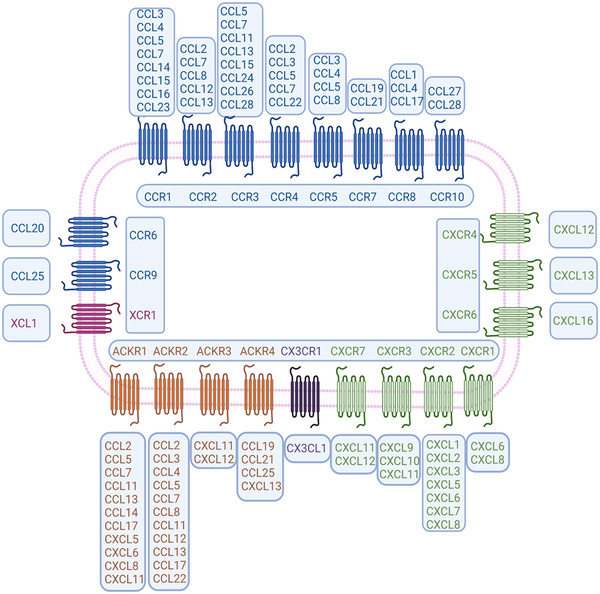
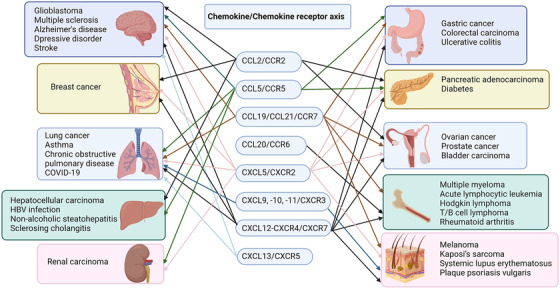
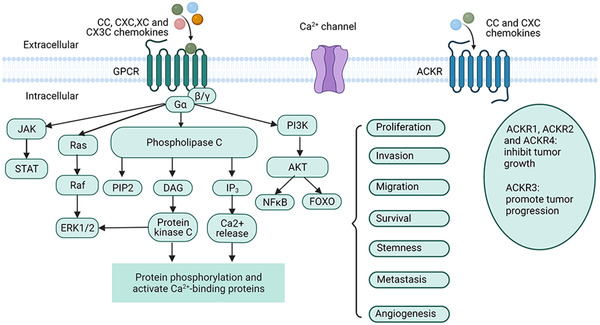
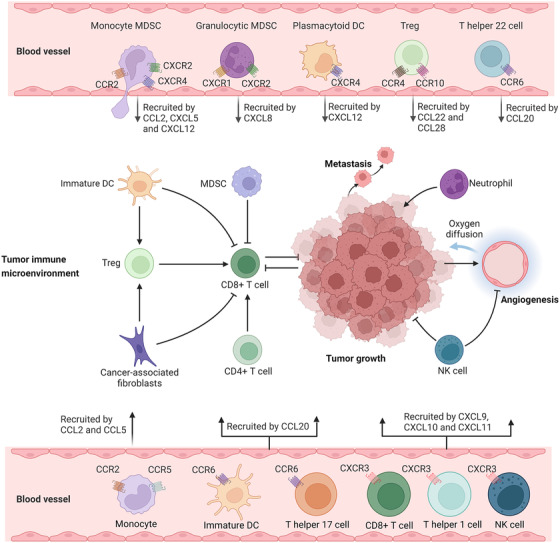
Chemokines are a large family of small secreted proteins that have fundamental roles in organ development, normal physiology, and immune responses upon binding to their corresponding receptors. The primary functions of chemokines are to coordinate and recruit immune cells to and from tissues and to participate in regulating interactions between immune cells. In addition to the generally recognized antimicrobial immunity, the chemokine/chemokine receptor axis also exerts a tumorigenic function in many different cancer models and is involved in the formation of immunosuppressive and protective tumor microenvironment (TME), making them potential prognostic markers for various hematologic and solid tumors. In fact, apart from its vital role in tumors, almost all inflammatory diseases involve chemokines and their receptors in one way or another. Modulating the expression of chemokines and/or their corresponding receptors on tumor cells or immune cells provides the basis for the exploitation of new drugs for clinical evaluation in the treatment of related diseases. Here, we summarize recent advances of chemokine systems in protumor and antitumor immune responses and discuss the prevailing understanding of how the chemokine system operates in inflammatory diseases. In this review, we also emphatically highlight the complexity of the chemokine system and explore its potential to guide the treatment of cancer and inflammatory diseases.
趋化因子是一大类小的分泌蛋白,在器官发育、正常生理功能以及与相应受体结合后的免疫反应中发挥着重要作用。趋化因子的主要功能是协调免疫细胞进出组织并将其募集到组织中,以及参与调节免疫细胞之间的相互作用。除了普遍认可的抗菌免疫外,趋化因子/趋化因子受体轴在许多不同的癌症模型中也发挥着致瘤作用,并参与免疫抑制和保护性肿瘤微环境(TME)的形成,使其成为各种血液系统肿瘤和实体瘤潜在的预后标志物。事实上,除了在肿瘤中发挥重要作用外,几乎所有炎症性疾病都以某种方式涉及趋化因子及其受体。调节肿瘤细胞或免疫细胞上趋化因子和/或其相应受体的表达,为开发用于相关疾病治疗临床评估的新药提供了依据。在此,我们总结了趋化因子系统在促肿瘤和抗肿瘤免疫反应方面的最新进展,并讨论了目前对趋化因子系统在炎症性疾病中如何发挥作用的理解。在本综述中,我们还着重强调了趋化因子系统的复杂性,并探讨其指导癌症和炎症性疾病治疗的潜力。