Department of Integrated Mathematical Oncology, H. Lee Moffitt Cancer Center and Research Institute, Tampa, Florida.
Department of Oncologic Sciences, Morsani College of Medicine, University of South Florida, Tampa, Florida.
Wiley Interdiscip Rev Syst Biol Med. 2020 Jan;12(1):e1461. doi: 10.1002/wsbm.1461. Epub 2019 Jul 17.
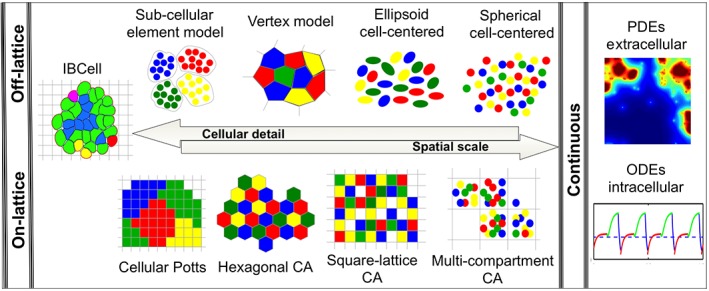
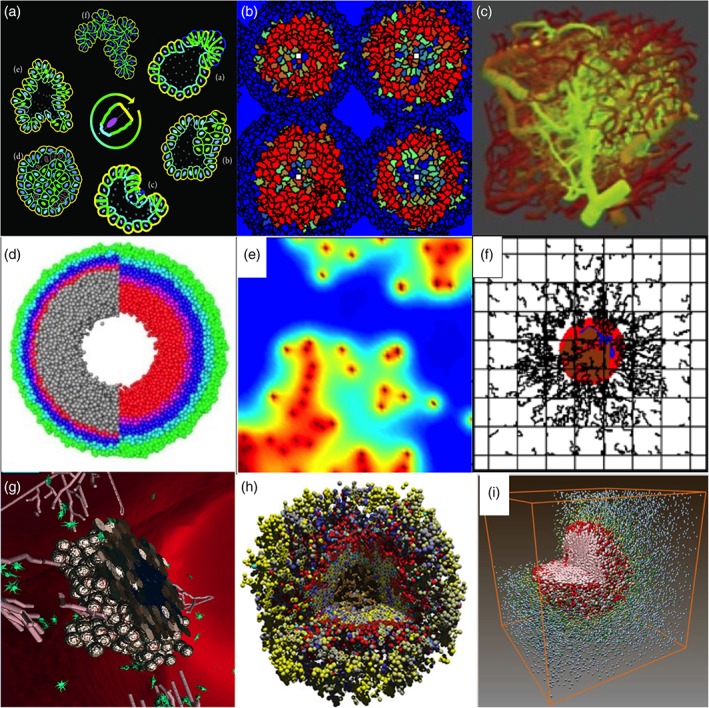
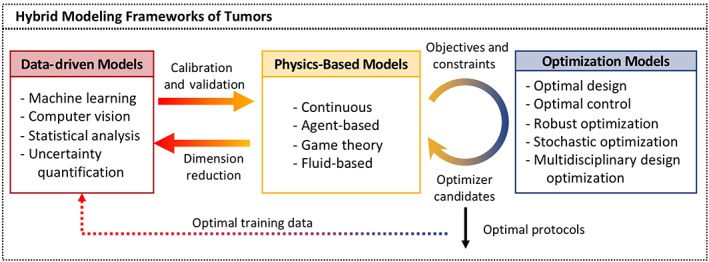
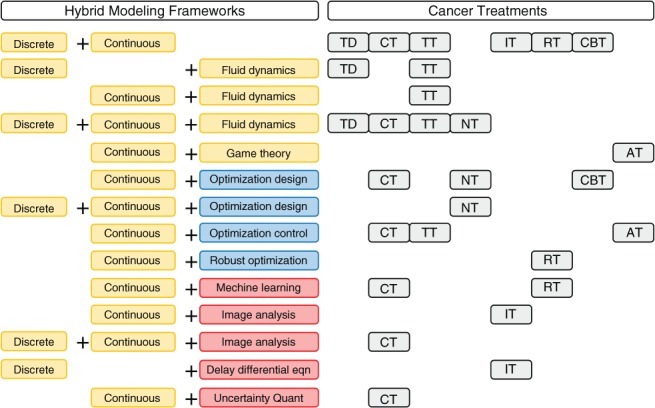
Tumors are complex multicellular heterogeneous systems comprised of components that interact with and modify one another. Tumor development depends on multiple factors: intrinsic, such as genetic mutations, altered signaling pathways, or variable receptor expression; and extrinsic, such as differences in nutrient supply, crosstalk with stromal or immune cells, or variable composition of the surrounding extracellular matrix. Tumors are also characterized by high cellular heterogeneity and dynamically changing tumor microenvironments. The complexity increases when this multiscale, multicomponent system is perturbed by anticancer treatments. Modeling such complex systems and predicting how tumors will respond to therapies require mathematical models that can handle various types of information and combine diverse theoretical methods on multiple temporal and spatial scales, that is, hybrid models. In this update, we discuss the progress that has been achieved during the last 10 years in the area of the hybrid modeling of tumors. The classical definition of hybrid models refers to the coupling of discrete descriptions of cells with continuous descriptions of microenvironmental factors. To reflect on the direction that the modeling field has taken, we propose extending the definition of hybrid models to include of coupling two or more different mathematical frameworks. Thus, in addition to discussing recent advances in discrete/continuous modeling, we also discuss how these two mathematical descriptions can be coupled with theoretical frameworks of optimal control, optimization, fluid dynamics, game theory, and machine learning. All these methods will be illustrated with applications to tumor development and various anticancer treatments. This article is characterized under: Analytical and Computational Methods > Computational Methods Translational, Genomic, and Systems Medicine > Therapeutic Methods Models of Systems Properties and Processes > Organ, Tissue, and Physiological Models.
肿瘤是由相互作用和相互修饰的成分组成的复杂多细胞异质系统。肿瘤的发生发展取决于多种因素:内在因素,如基因突变、信号通路改变或受体表达的改变;外在因素,如营养供应的差异、与基质或免疫细胞的串扰、或周围细胞外基质的组成的变化。肿瘤还具有高度的细胞异质性和动态变化的肿瘤微环境。当这种多尺度、多成分系统受到抗癌治疗的干扰时,复杂性就会增加。要对这种复杂系统进行建模并预测肿瘤对治疗的反应,需要能够处理各种类型信息并在多个时间和空间尺度上结合不同理论方法的数学模型,即混合模型。在这篇更新中,我们讨论了在过去 10 年中肿瘤混合建模领域所取得的进展。混合模型的经典定义是指将细胞的离散描述与微环境因素的连续描述进行耦合。为了反思建模领域的发展方向,我们建议将混合模型的定义扩展为包括两个或多个不同数学框架的耦合。因此,除了讨论离散/连续建模的最新进展外,我们还讨论了如何将这两种数学描述与最优控制、优化、流体动力学、博弈论和机器学习的理论框架进行耦合。所有这些方法都将通过应用于肿瘤发展和各种抗癌治疗来进行说明。本文的特点是:分析和计算方法>计算方法转化、基因组和系统医学>治疗方法系统特性和过程的模型>器官、组织和生理模型。