Department of Anthropology, University of Florida, Gainesville, FL, United States of America.
Genetics Institute, University of Florida, Gainesville, FL, United States of America.
PLoS One. 2019 Jul 17;14(7):e0219385. doi: 10.1371/journal.pone.0219385. eCollection 2019.
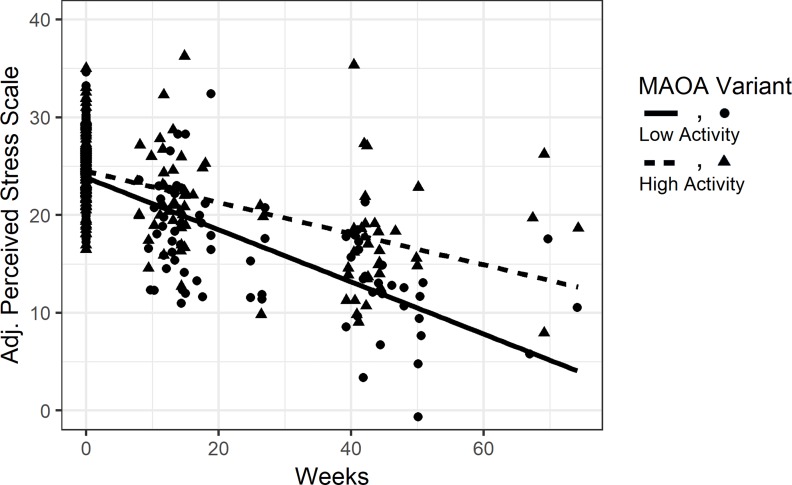
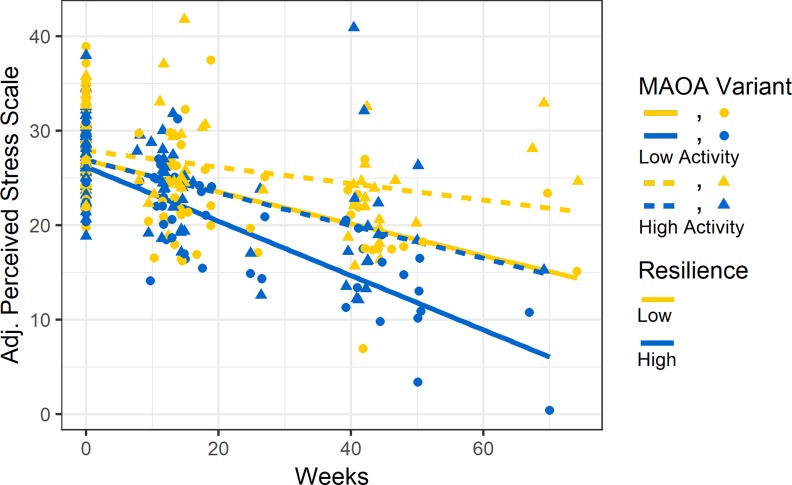
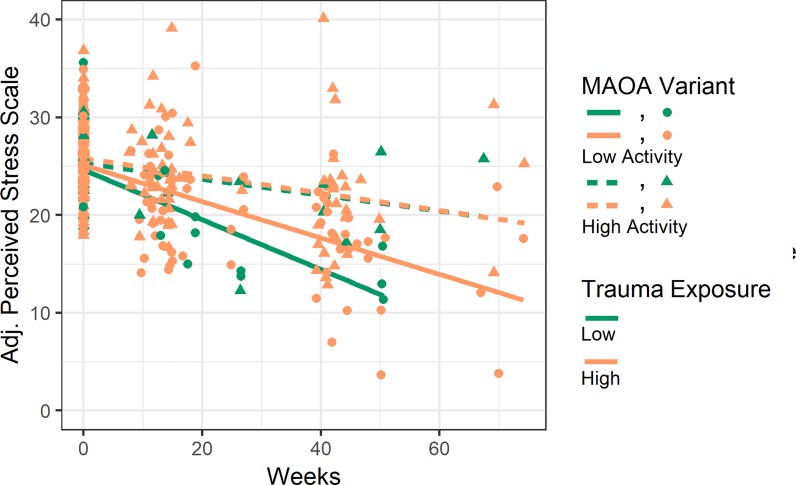
Early childhood trauma can have profound and lifelong effects on adult mental health and psychosocial wellbeing. Nevertheless, responses to trauma are highly variable. Genetic variants may help explain variation in responses to trauma by identifying alleles that associate with changes in mental health measures. Protective factors, such as resilience, likely also play an important role in responses to trauma. The effects of genetic variants, in combination with protective factors, on psychosocial health are not well understood, particularly in non-Western contexts. In this study, we test the relative influence of genetic variants of monoamine oxidase A (MAOA, a gene proposed to influence the impact of childhood trauma on adult violence and antisocial behavior), levels of resilience, and exposure to traumatic events on psychosocial stress and mental health trajectories over time. We use data from a cohort of 12-18-year-old Syrian refugees who were forcibly displaced to neighboring Jordan (n = 399). DNA samples and survey data on trauma exposure, resilience (CYRM-12), and psychosocial stress were collected at three time points: baseline, ~13 weeks, and ~48 weeks. Using multilevel models, we identified an association of MAOA variant, in males only, with symptom scores of psychosocial stress on the Perceived Stress Scale (PSS) over time (p = 8.1 x 10⁻⁴). We also found that resilience is strongly associated with PSS (p = 7.9 x 10⁻⁹), underscoring the importance of protective factors in influencing levels of psychosocial stress. Furthermore, there was an additive effect wherein the sharpest reductions in perceived psychosocial stress are seen in low-activity MAOA males with low trauma exposure or high resilience levels. Our results highlight the value of studies that integrate genetic and psychosocial factors to better understand complex phenotypes, such as responses to trauma in contexts of high trauma exposure.
早期儿童创伤会对成人的精神健康和社会心理福利产生深远且终身的影响。然而,创伤的反应具有高度可变性。遗传变异可以通过确定与心理健康测量变化相关的等位基因来帮助解释对创伤的反应变化。保护因素,如韧性,可能在对创伤的反应中也发挥重要作用。遗传变异与保护因素对社会心理健康的影响尚未得到很好的理解,尤其是在非西方背景下。在这项研究中,我们测试了单胺氧化酶 A(MAOA,一种被认为会影响儿童期创伤对成人暴力和反社会行为的影响的基因)的遗传变异、韧性水平以及暴露于创伤性事件对社会心理压力和心理健康轨迹的相对影响。我们使用了一组被迫迁移到邻国约旦的 12-18 岁叙利亚难民的队列数据(n=399)。在三个时间点收集了 DNA 样本和关于创伤暴露、韧性(CYRM-12)和社会心理压力的调查数据:基线、约 13 周和约 48 周。使用多层次模型,我们发现 MAOA 变异体(仅在男性中)与感知压力量表(PSS)上的社会心理压力症状评分随时间的变化有关(p=8.1×10⁻⁴)。我们还发现韧性与 PSS 密切相关(p=7.9×10⁻⁹),这突显了保护因素在影响社会心理压力水平方面的重要性。此外,还有一个附加效应,即低活动 MAOA 男性的感知社会心理压力降幅最大,这些男性的创伤暴露程度较低或韧性水平较高。我们的结果强调了整合遗传和社会心理因素的研究的价值,这些研究可以更好地理解高创伤暴露背景下的复杂表型,如对创伤的反应。