Institute for Global Health and Development, Queen Margaret University, Edinburgh, UK.
J Child Psychol Psychiatry. 2021 May;62(5):484-509. doi: 10.1111/jcpp.13355. Epub 2020 Dec 5.
This paper revisits the themes of an influential 1993 review regarding the factors shaping the mental health and psychosocial well-being of refugees to take stock of developments in the evidence base and conceptualisation of issues for refugee children over the last 25 years.
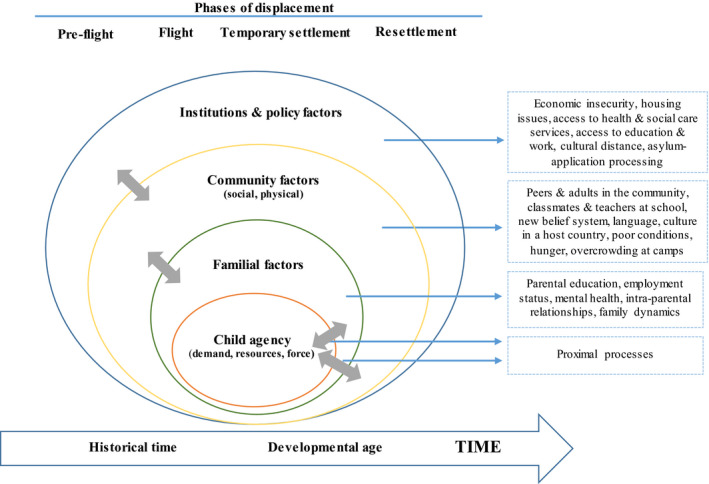
The study deployed a systematic search strategy. This initially identified 784 papers, which was reduced to 65 studies following application of inclusion and exclusion criteria. We used a later iteration of Bronfenbrenner's bioecological model of human development - the PPCT model - to consolidate evidence.
We identify a range of risk and protective factors operating at individual, familial, community and institutional and policy levels that influence outcomes for refugee children. The dynamics shaping the interaction of these influences are linked to the life course principles of socio-historical time and developmental age, proximal processes and child agency.
Actions at individual, familial, community, school, institutional and policy levels all have potential traction on mental health and psychosocial well-being of refugee children. However, evidence suggests that greatest impact will be secured by multilevel interventions addressing synergies between ecological systems, approaches engaging proximal processes (including parenting programmes) and interventions facilitating the agency of the developing refugee child.
本文重新审视了 1993 年一篇有影响力的综述中关于塑造难民心理健康和社会心理福祉的因素的主题,以了解过去 25 年来有关难民儿童问题的证据基础和概念化的发展。
该研究采用了系统的搜索策略。最初确定了 784 篇论文,在应用纳入和排除标准后,减少到 65 项研究。我们使用了布伦芬布伦纳人类发展的生物生态模型的一个后期迭代 - PPCT 模型 - 来整合证据。
我们确定了一系列在个人、家庭、社区和机构以及政策层面上运作的风险和保护因素,这些因素影响着难民儿童的结果。影响这些因素相互作用的动态与社会历史时间和发展年龄、近端过程和儿童能动性的生命历程原则有关。
个人、家庭、社区、学校、机构和政策层面的行动都有可能对难民儿童的心理健康和社会心理福祉产生影响。然而,有证据表明,通过多层次干预措施来解决生态系统之间的协同作用、涉及近端过程的方法(包括育儿计划)以及促进发展中难民儿童能动性的干预措施,将获得最大的效果。