Department of Endocrinology and Metabolism, Ningbo First Hospital, Ningbo, Zhejiang Province, PR China.
Division of Epidemiology and Public Health, School of Medicine, The University of Nottingham, Nottingham, United Kingdom.
PLoS One. 2019 Jul 17;14(7):e0220047. doi: 10.1371/journal.pone.0220047. eCollection 2019.
To determine the prevalence of polypharmacy prescription among type 2 diabetes (T2DM) patients at a tertiary care department in Ningbo, China, and to determine factors that independently predict this polypharmacy prescription.
A retrospective cross-sectional study was conducted using an existing computerised medical records database. This database was screened from 2012 to 2017 for adult patients with T2DM and parameters like prescribed medicines and socio-demographic, behavioural and other medical information. Polypharmacy prescription was defined as the simultaneous prescription of ≥5 medicines by the clinician at the time of discharge for daily usage by the patient as part of his/her long-term treatment plan.
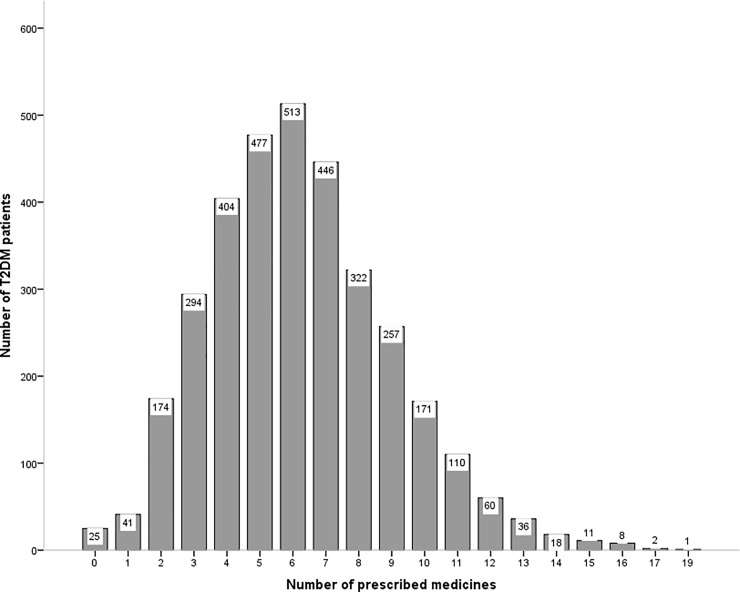
The study inclusion criteria were satisfied by 3370 T2DM patients. Over a 5-year period, 72.2% (n = 2432) of T2DM patients were prescribed polypharmacy. On an average, eight medicines were prescribed to them. The odds of polypharmacy prescription increased with patients' age (18-39 years: 1; 40-59 years: OR 1.86, 95% CI 1.28-2.71; and ≥60 years: 2.42, 1.65-3.55), duration of T2DM (≤1 year: 1; >5-10 years: 1.70, 1.10-2.62; and >10 years: 2.55, 1.68-3.89), and length of hospital stay (≤5 days: 1; >5-10 days: 2.43, 1.86-3.17; and >10 days: 2.99, 2.24-3.99), and were higher in those with poor blood glucose level (2.09, 1.67-2.62) and with comorbidities like other endocrine, nutritional and metabolic diseases (2.24, 1.76-2.85), circulatory system diseases (4.35, 3.62-5.23), skin and subcutaneous tissue diseases (1.64, 1.04-2.59), and musculoskeletal system and connective tissue diseases (1.61, 1.27-2.03). The odds of polypharmacy prescription were lower in those with comorbidities like neoplasms (0.51, 0.36-0.70) and during pregnancy, childbirth and the puerperium (0.06, 0.01-0.49).
Around three fourth of T2DM patients at the tertiary care department were prescribed polypharmacy, and the predictors were identified. The study findings could be taken into consideration in future interventional studies aimed at supporting medicines optimisation (and deprescribing) among these patients.
在中国宁波的一家三级保健部门确定 2 型糖尿病(T2DM)患者的多药处方流行率,并确定独立预测这种多药处方的因素。
使用现有的计算机病历数据库进行回顾性横断面研究。该数据库于 2012 年至 2017 年筛查了成年 T2DM 患者,并记录了规定的药物以及社会人口统计学、行为和其他医疗信息等参数。多药处方定义为临床医生在出院时同时开具≥5 种药物,以供患者作为其长期治疗计划的一部分日常使用。
3370 名 T2DM 患者符合研究纳入标准。在 5 年期间,72.2%(n=2432)的 T2DM 患者接受了多药处方治疗。平均而言,给他们开了八种药物。多药处方的可能性随着患者年龄的增加而增加(18-39 岁:1;40-59 岁:OR 1.86,95%CI 1.28-2.71;和≥60 岁:2.42,1.65-3.55)、T2DM 持续时间(≤1 年:1;>5-10 年:1.70,1.10-2.62;和>10 年:2.55,1.68-3.89)和住院时间(≤5 天:1;>5-10 天:2.43,1.86-3.17;和>10 天:2.99,2.24-3.99),并且血糖水平较差(2.09,1.67-2.62)和患有其他内分泌、营养和代谢疾病(2.24,1.76-2.85)、循环系统疾病(4.35,3.62-5.23)、皮肤和皮下组织疾病(1.64,1.04-2.59)和肌肉骨骼系统和结缔组织疾病(1.61,1.27-2.03)的患者多药处方的可能性更高。患有肿瘤等合并症(0.51,0.36-0.70)和妊娠、分娩和产褥期(0.06,0.01-0.49)的患者多药处方的可能性较低。
在三级保健部门,大约四分之三的 T2DM 患者接受了多药处方治疗,并且确定了预测因素。未来针对这些患者的药物优化(和减药)的干预性研究可以考虑这些研究结果。