LoPresti Patrizia
Department of Psychology, University of Illinois at Chicago, Chicago, IL, United States.
Front Neurol. 2019 Jun 28;10:519. doi: 10.3389/fneur.2019.00519. eCollection 2019.
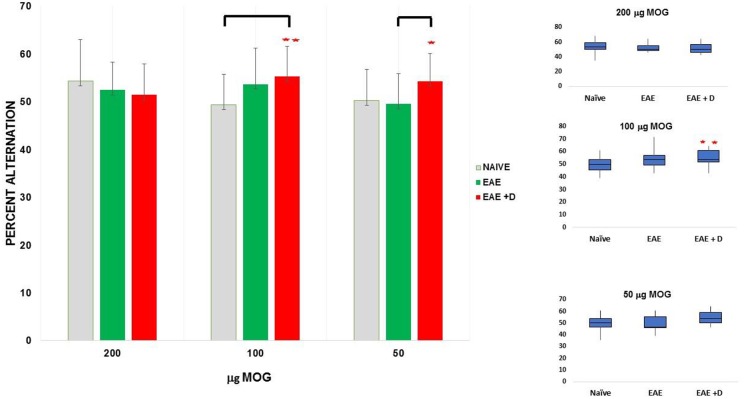
Multiple sclerosis (MS) is a complex disease characterized by autoimmune demyelination and progressive neurodegeneration. Pathogenetic mechanisms of the disease remain largely unknown. Changes in synaptic functions have been reported; however, the significance of such alterations in the disease course remains unclear. Furthermore, the therapeutic potential of targeting synapses is not well-established. Synapses have key signaling elements that regulate intracellular transport and overall neuronal health. Histone deacetylase (HDAC)6 is a microtubule-associated deacetylase. The interaction between HDAC6 and microtubules is augmented by HDAC6 inhibitors. In this study, experimental autoimmune encephalomyelitis (EAE) mice, an animal model of MS, were treated with the HDAC6 inhibitor drug ACY-738 (20 mg/kg) on day 9 and day 10 post-immunization. Mice were assessed for working memory using the cross-maze test at 10 days post-immunization (d.p.i.), whereas disease scores were recorded over approximately 4 weeks post-immunization. We observed that ACY-738 delayed disease onset and reduced disease severity. Most importantly, ACY-738 increased short-term memory in a manner sensitive to disease severity. We induced EAE disease with various amounts of myelin oligodendrocyte glycoprotein (MOG35-55). EAE mice receiving 100 μg of MOG35-55 and treated with ACY-738 had a statistically significant increase in short term-memory compared to naive mice. Additionally, EAE mice receiving 50 μg MOG35-55 and treated with ACY-738 had a statistically significant increase in short term-memory when compared to EAE mice without drug treatment. In contrast, ACY-738 did not change short-term memory in EAE mice immunized with 200 μg of MOG35-55. Because ACY-738 increases short-term memory only with lower amounts of EAE-inducing reagents, we hypothesize that the inflammatory-demyelinating environment induced by higher amount of EAE-inducing reagents overpowers (at day 10 post-immunization) the synaptic molecules targeted by ACY-738. These studies pave the way for developing ACY-738-like compounds for MS patients and for using ACY-738 as a probe to elucidate disease-sensitive changes at the synapses occurring early in the disease course.
多发性硬化症(MS)是一种复杂的疾病,其特征为自身免疫性脱髓鞘和进行性神经退行性变。该疾病的发病机制在很大程度上仍不清楚。已有报道称突触功能发生了变化;然而,这种改变在疾病进程中的意义仍不明确。此外,靶向突触的治疗潜力尚未得到充分证实。突触具有调节细胞内运输和整体神经元健康的关键信号元件。组蛋白脱乙酰酶(HDAC)6是一种与微管相关的脱乙酰酶。HDAC6抑制剂可增强HDAC6与微管之间的相互作用。在本研究中,实验性自身免疫性脑脊髓炎(EAE)小鼠(一种MS动物模型)在免疫后第9天和第10天用HDAC6抑制剂药物ACY - 738(20 mg/kg)进行治疗。在免疫后10天(d.p.i.)使用十字迷宫试验评估小鼠的工作记忆,而在免疫后约4周记录疾病评分。我们观察到ACY - 738延迟了疾病发作并降低了疾病严重程度。最重要的是,ACY - 738以对疾病严重程度敏感的方式增加了短期记忆。我们用不同量的髓鞘少突胶质细胞糖蛋白(MOG35 - 55)诱导EAE疾病。与未处理的小鼠相比,接受100μg MOG35 - 55并经ACY - 738治疗的EAE小鼠短期记忆有统计学显著增加。此外,与未接受药物治疗的EAE小鼠相比,接受50μg MOG35 - 55并经ACY - 738治疗的EAE小鼠短期记忆有统计学显著增加。相比之下,ACY - 738对用200μg MOG35 - 55免疫的EAE小鼠的短期记忆没有影响。由于ACY - 738仅在使用较低量的EAE诱导剂时增加短期记忆,我们推测较高量的EAE诱导剂所诱导的炎性脱髓鞘环境(在免疫后第10天)超过了(掩盖了)ACY - 738靶向的突触分子的作用。这些研究为开发用于MS患者的类似ACY - 738的化合物以及将ACY - 738用作探针以阐明疾病早期病程中突触处疾病敏感变化铺平了道路。