Steen Krawcyk Rikke, Vinther Anders, Petersen Nicolas Caesar, Faber Jens, Iversen Helle K, Christensen Thomas, Lambertsen Kate Lykke, Rehman Shazia, Klausen Tobias Wirenfeldt, Rostrup Egill, Kruuse Christina
Department of Physiotherapy and Occupational Therapy, Herlev Gentofte Hospital, University of Copenhagen, Copenhagen, Denmark.
Neurovascular Research Unit, Department of Neurology, Herlev Gentofte Hospital, University of Copenhagen, Copenhagen, Denmark.
Front Neurol. 2019 Jun 28;10:664. doi: 10.3389/fneur.2019.00664. eCollection 2019.
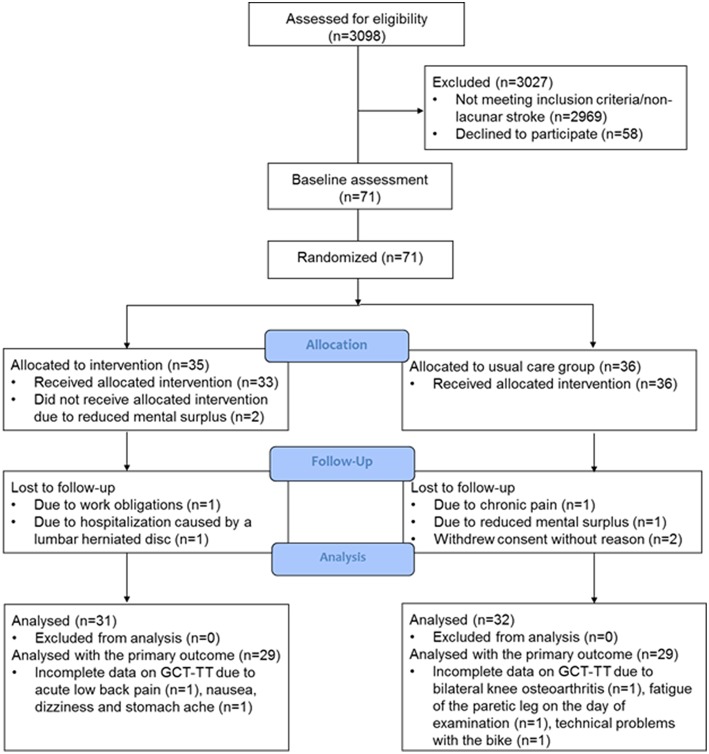
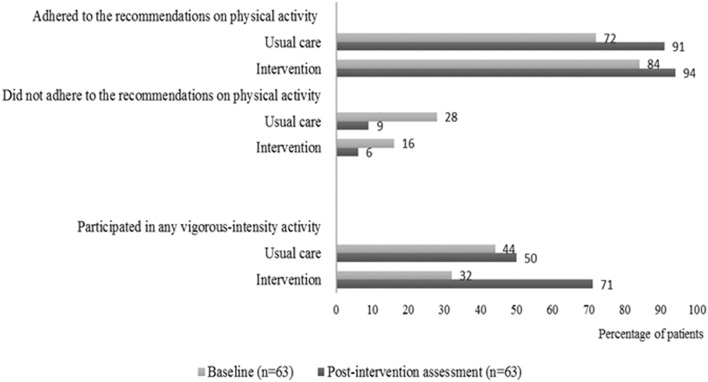
High-intensity interval training (HIIT) is superior to moderate-intensity continuous training in improving cardiorespiratory fitness in patients with cardiovascular disease, but is it safe, feasible and effective in patients with stroke? We investigated feasibility and effect of early, home-based HIIT in patients with lacunar stroke combined with usual care vs. usual care, only. Patients with minor stroke (severity: 55/58 point on the Scandinavian Stroke Scale) were randomized to HIIT or usual care in a randomized, controlled trial. We measured the following outcomes at baseline and post-intervention: cardiorespiratory fitness monitored as power output from the Graded Cycling Test with Talk Test (GCT-TT; primary outcome), physical activity, fatigue, depression, well-being, stress, cognition, endothelial function, blood pressure, body mass index, and biomarkers. We included 71 patients (mean age 63.7 ± 9.2), 49 men, 31 in intervention group. Home-based HIIT was feasible with no reported adverse events in relation to the intervention. No significant change between the groups in GCT-TT power output was detected ( = 0.90). The change in time spent on vigorous-intensity activity was 2 h/week and 0.6 h/week, intervention and usual care, respectively ( = 0.045). There were no significant differences between groups in the remaining secondary outcomes. HIIT was feasible and safe in patients with lacunar stroke. Patients can engage early in home-based HIIT when involved in choosing exercise modality and guided by weekly motivational phone calls. Within 3 months, HIIT did, however, not yield effect on cardiorespiratory fitness. We await further evaluation of long-term effects of this intervention on continued regular physical exercise and cardiovascular event. https://clinicaltrials.gov, identifier NCT02731235.
高强度间歇训练(HIIT)在改善心血管疾病患者的心肺适能方面优于中等强度持续训练,但它对中风患者是否安全、可行且有效呢?我们研究了早期居家HIIT联合常规护理与单纯常规护理相比,对腔隙性中风患者的可行性和效果。在一项随机对照试验中,将轻度中风患者(严重程度:斯堪的纳维亚中风量表评分为55/58分)随机分为HIIT组或常规护理组。我们在基线和干预后测量了以下指标:通过带谈话测试的分级自行车测试(GCT-TT)监测的心肺适能(主要结局)、身体活动、疲劳、抑郁、幸福感、压力、认知、内皮功能、血压、体重指数和生物标志物。我们纳入了71例患者(平均年龄63.7±9.2岁),49例男性,干预组31例。居家HIIT是可行的,且未报告与干预相关的不良事件。未检测到两组在GCT-TT功率输出方面有显著变化(P = 0.90)。干预组和常规护理组在剧烈强度活动上花费时间的变化分别为每周2小时和每周0.6小时(P = 0.045)。其余次要结局在两组之间无显著差异。HIIT对腔隙性中风患者是可行且安全的。当患者参与选择运动方式并在每周激励性电话指导下,可早期进行居家HIIT。然而,在3个月内,HIIT对心肺适能未产生效果。我们期待进一步评估该干预对持续规律体育锻炼和心血管事件的长期影响。https://clinicaltrials.gov,标识符NCT02731235