Uemura Masahiro, Nozaki Hiroaki, Koyama Akihide, Sakai Naoko, Ando Shoichiro, Kanazawa Masato, Kato Taisuke, Onodera Osamu
Department of Neurology, Brain Research Institute, Niigata University, Niigata, Japan.
Department of Medical Technology, Graduate School of Health Sciences, Niigata University, Niigata, Japan.
Front Neurol. 2019 Jun 28;10:693. doi: 10.3389/fneur.2019.00693. eCollection 2019.
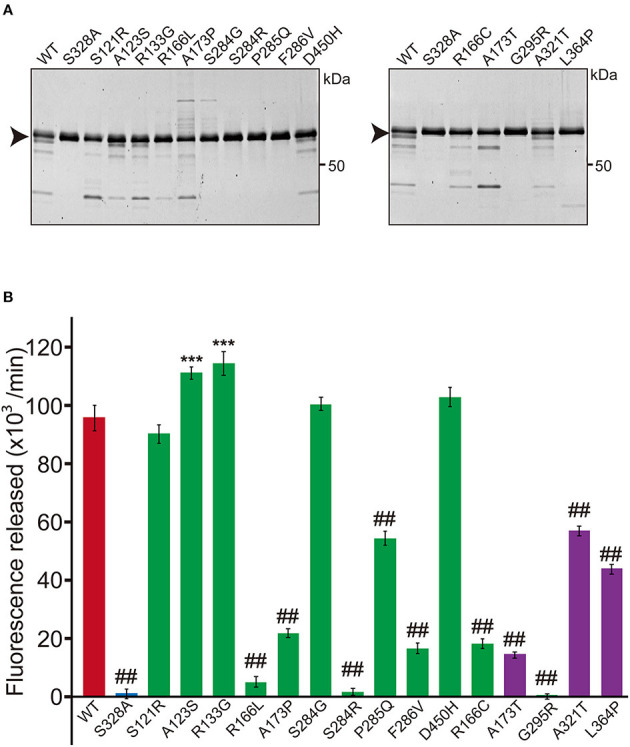
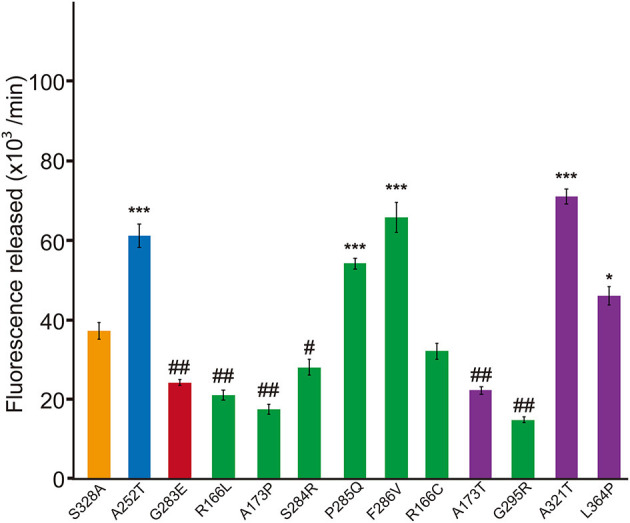
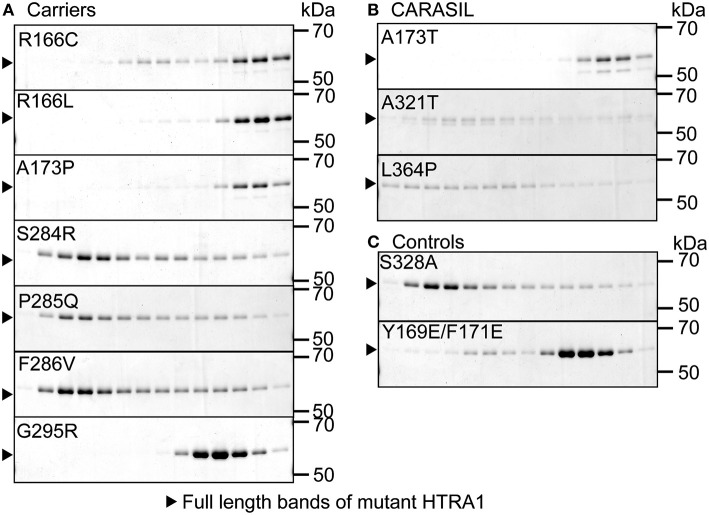
Mutations in the cause cerebral autosomal recessive arteriopathy with subcortical infarcts and leukoencephalopathy (CARASIL). Most carriers for mutations are asymptomatic, but more than 10 mutations have been reported in symptomatic carriers. The molecular differences between the mutations identified in symptomatic carriers and mutations identified only in CARASIL patients are unclear. HTRA1 is a serine protease that forms homotrimers, with each HTRA1 subunit activating the adjacent HTRA1 via the sensor domain of loop 3 (L3) and the activation domain of loop D (LD). Previously, we analyzed four HTRA1 mutant proteins identified in symptomatic carriers and found that they were unable to form trimers or had mutations in the LD or L3 domain. The mutant HTRA1s with these properties are presumed to inhibit trimer-dependent activation cascade. Indeed, these mutant HTRA1s inhibited wild-type (WT) protease activity. In this study, we further analyzed 15 missense HTRA1s to clarify the molecular character of mutant HTRA1s identified in symptomatic carriers. We analyzed 12 missense HTRA1s identified in symptomatic carriers (hetero-HTRA1) and three missense HTRA1s found only in CARASIL (CARASIL-HTRA1). The protease activity of the purified recombinant mutant HTRA1s was measured using fluorescein isothiocyanate-labeled casein as substrate. Oligomeric structure was evaluated by size-exclusion chromatography. The protease activities of mixtures of WT with each mutant HTRA1 were also measured. Five hetero-HTRA1s had normal protease activity and were excluded from further analysis. Four of the seven hetero-HTRA1s and one of the three CARASIL-HTRA1s were unable to form trimers. The other three hetero-HTRA1s had mutations in the LD domain. Together with our previous work, 10 of 11 hetero-HTRA1s and two of six CARASIL-HTRA1s were either defective in trimerization or had mutations in the LD or L3 domain ( = 0.006). By contrast, eight of 11 hetero-HTRA1s and two of six CARASIL-HTRA1 inhibited WT protease activity ( = 0.162). HTRA1 mutations identified in symptomatic carriers have the property of interfering the trimer-dependent activation cascade of HTRA1.
[基因名称]突变会导致伴有皮质下梗死和白质脑病的脑常染色体隐性动脉病(CARASIL)。大多数[基因名称]突变携带者没有症状,但已有超过10种突变在有症状的携带者中被报道。在有症状的携带者中鉴定出的突变与仅在CARASIL患者中鉴定出的突变之间的分子差异尚不清楚。HTRA1是一种丝氨酸蛋白酶,可形成同源三聚体,每个HTRA1亚基通过环3(L3)的传感器结构域和环D(LD)的激活结构域激活相邻的HTRA1。此前,我们分析了在有症状的携带者中鉴定出的四种HTRA1突变蛋白,发现它们无法形成三聚体,或者在LD或L3结构域中有突变。具有这些特性的突变HTRA1被认为会抑制三聚体依赖性激活级联反应。事实上,这些突变HTRA1抑制了野生型(WT)蛋白酶活性。在本研究中,我们进一步分析了15种错义HTRA1,以阐明在有症状的携带者中鉴定出的突变HTRA1的分子特征。我们分析了在有症状的携带者中鉴定出的12种错义HTRA1(杂合HTRA1)和仅在CARASIL中发现的3种错义HTRA1(CARASIL - HTRA1)。使用异硫氰酸荧光素标记的酪蛋白作为底物,测定纯化的重组突变HTRA1的蛋白酶活性。通过尺寸排阻色谱法评估寡聚体结构。还测量了WT与每种突变HTRA1混合物的蛋白酶活性。5种杂合HTRA1具有正常的蛋白酶活性,被排除在进一步分析之外。7种杂合HTRA1中的4种和3种CARASIL - HTRA1中的1种无法形成三聚体。其他3种杂合HTRA1在LD结构域中有突变。与我们之前的工作一起,11种杂合HTRA1中的10种和6种CARASIL - HTRA1中的2种在三聚化方面存在缺陷,或者在LD或L3结构域中有突变(P = 0.006)。相比之下,11种杂合HTRA1中的8种和6种CARASIL - HTRA1中的2种抑制了WT蛋白酶活性(P = 0.162)。在有症状的携带者中鉴定出的HTRA1突变具有干扰HTRA1三聚体依赖性激活级联反应的特性。