Horvath Lukas, Bächinger David, Honegger Tim, Bodmer Daniel, Naldi Arianne Monge
Department of Otorhinolaryngology, Head and Neck Surgery, University of Zurich, University Hospital Zurich, 8091 Zurich, Switzerland.
Department of Biomedicine and The Clinic for Otorhinolaryngology, University Hospital Basel, 4031 Basel, Switzerland.
Exp Ther Med. 2019 Aug;18(2):1123-1130. doi: 10.3892/etm.2019.7687. Epub 2019 Jun 18.
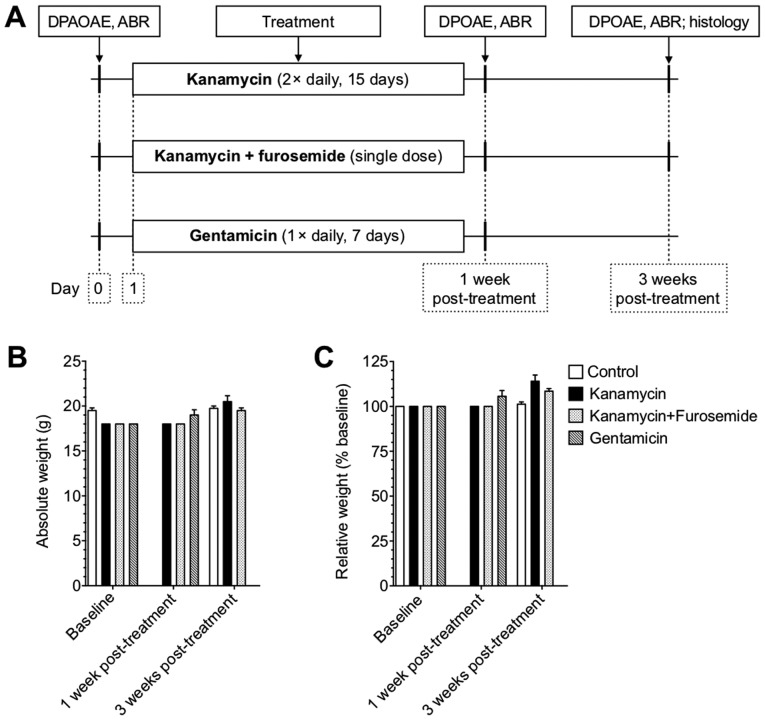
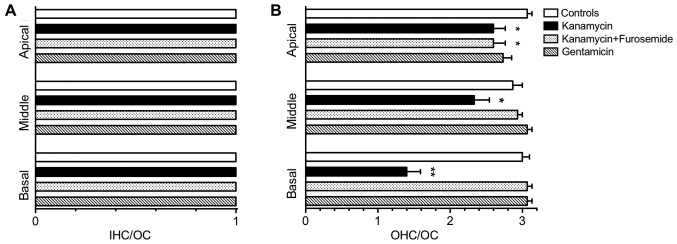
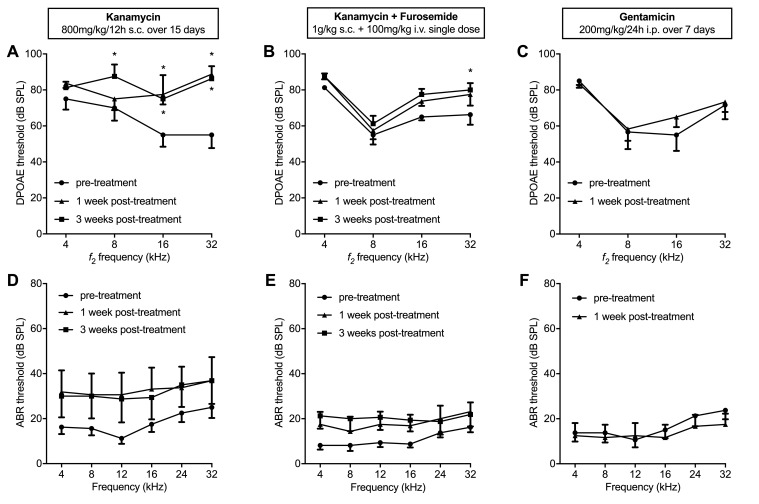
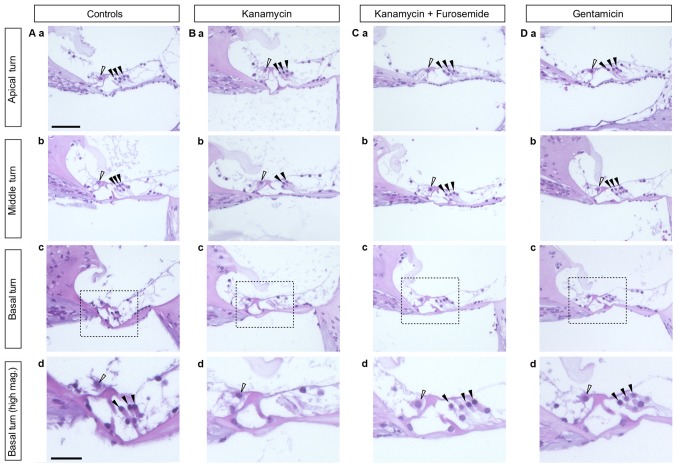
Aminoglycoside ototoxicity is common in clinical practice but reliable protective agents currently do not exist. Aminoglycoside regimens causing ototoxicity in different laboratory animals are under investigation. The assessment method used most commonly to determine auditory effects is the auditory brainstem response (ABR). Distortion product otoacoustic emissions (DPOAE) have been used less frequently. A precise recommendation on the specific method to assess peripheral auditory function before and after aminoglycoside toxicity in mice does not exist. In order to evaluate various mouse models for ototoxic injury caused by various aminoglycoside regimens, there is a need for performing preliminary tests in small cohorts before large experiments. The aim of our study was to investigate different aminoglycoside regimens that cause substantial ototoxic damage . Aminoglycosides are safe and produce a detectable hearing threshold shift in a small cohort of mice that can be used as a model for preliminary tests. Different ototoxic regimens were assessed by ABR and DPOAE measurements pre- and post-treatment. Further, the sensory cell loss was quantified by counting hair cells in the cochlea. It was revealed that an ototoxic regimen with kanamycin twice daily for 15 consecutive days is safe, well tolerated and produces an early significant hearing threshold shift detected by DPOAE in a small cohort of mice. The study compared ABR and DPOAE in mentioned regimens for the first time and illustrated that DPOAE is well suited for detecting hearing threshold shifts in high frequencies before ABR threshold shifts occur in accordance with predominating outer hair cell damage mainly in the basal turn of the cochlea.
氨基糖苷类药物耳毒性在临床实践中很常见,但目前尚无可靠的保护剂。不同实验室动物中导致耳毒性的氨基糖苷类给药方案正在研究中。最常用于确定听觉影响的评估方法是听性脑干反应(ABR)。畸变产物耳声发射(DPOAE)的使用频率较低。目前不存在关于在小鼠氨基糖苷类毒性前后评估外周听觉功能的具体方法的确切建议。为了评估各种氨基糖苷类给药方案引起的耳毒性损伤的各种小鼠模型,需要在大型实验前在小样本中进行初步测试。我们研究的目的是调查导致严重耳毒性损伤的不同氨基糖苷类给药方案。氨基糖苷类药物是安全的,并且在一小群小鼠中会产生可检测到的听力阈值变化,可作为初步测试的模型。通过治疗前后的ABR和DPOAE测量评估不同的耳毒性给药方案。此外,通过计数耳蜗中的毛细胞来量化感觉细胞损失。结果表明,连续15天每天两次使用卡那霉素的耳毒性给药方案是安全的,耐受性良好,并且在一小群小鼠中通过DPOAE检测到早期显著的听力阈值变化。该研究首次比较了上述给药方案中的ABR和DPOAE,并表明DPOAE非常适合在ABR阈值变化发生之前检测高频听力阈值变化,这与主要在耳蜗基底转的外毛细胞损伤占主导地位一致。