DiCesare Christopher A, Montalvo Alicia, Barber Foss Kim D, Thomas Staci M, Ford Kevin R, Hewett Timothy E, Jayanthi Neeru A, Stracciolini Andrea, Bell David R, Myer Gregory D
Division of Sports Medicine, The SPORT Center, Cincinnati Children's Hospital Medical Center, Cincinnati, OH, United States.
Department of Athletic Training, Nicole Wertheim College of Nursing and Health Sciences, Florida International University, Miami, FL, United States.
Front Pediatr. 2019 Jun 28;7:268. doi: 10.3389/fped.2019.00268. eCollection 2019.
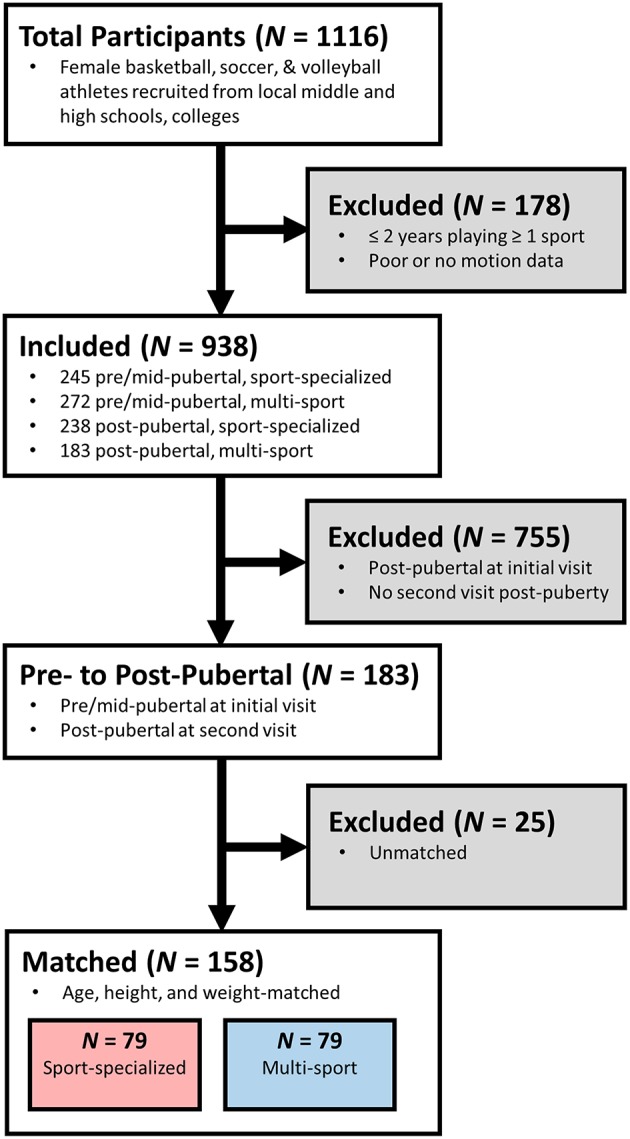
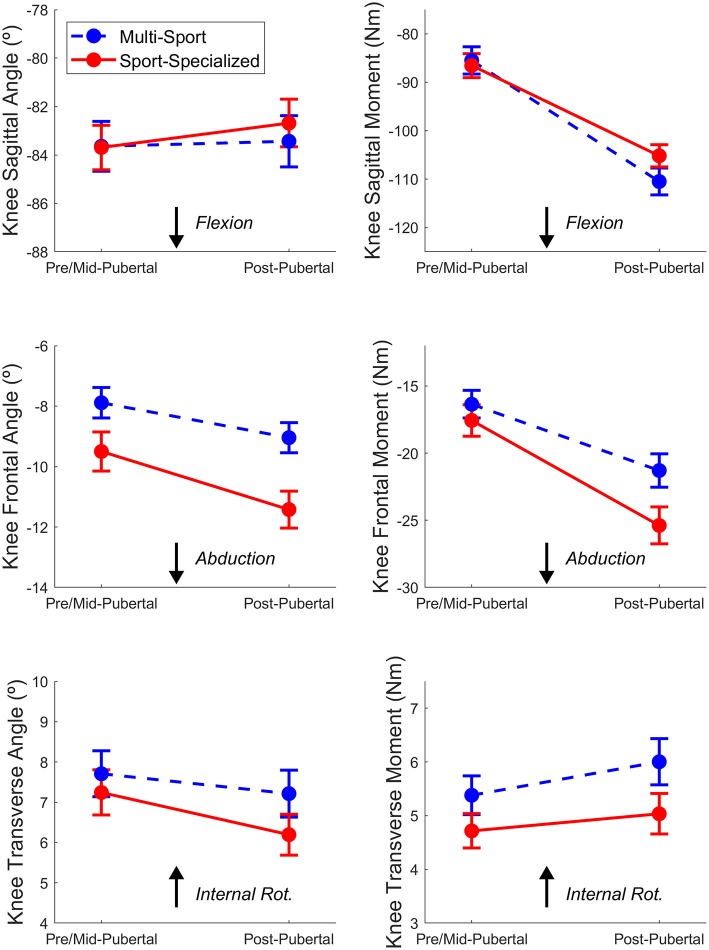
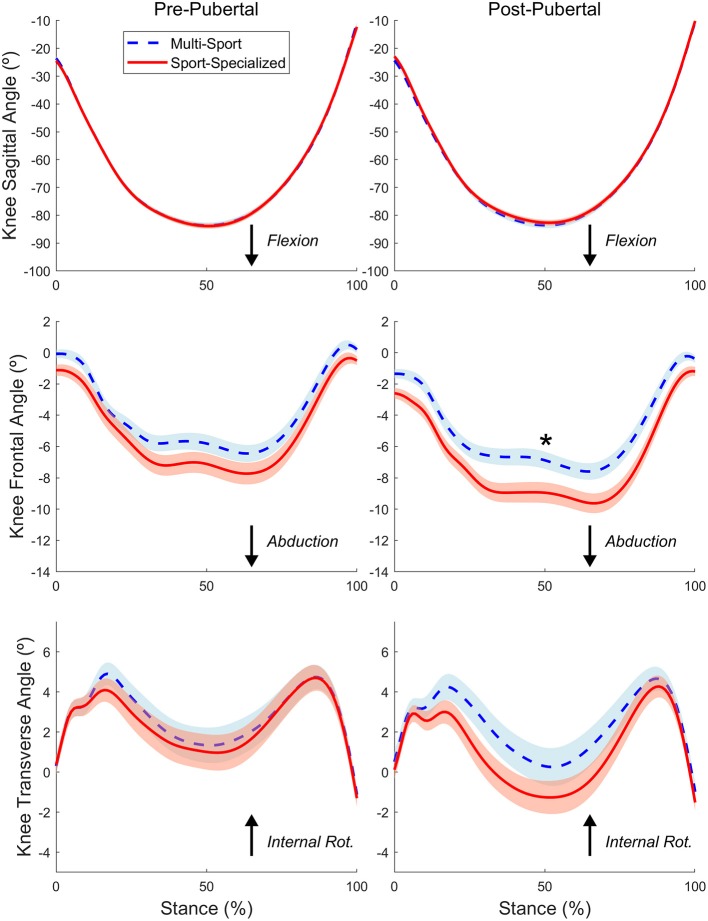
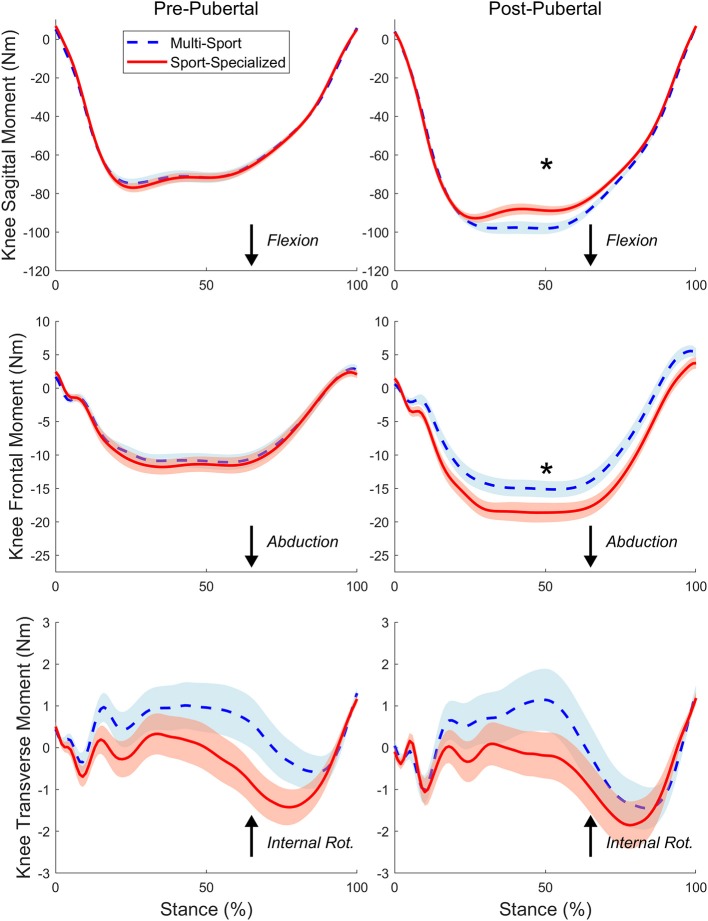
Sport specialization is a growing trend in youth athletes and may contribute to increased injury risk. The neuromuscular deficits that often manifest during maturation in young, female athletes may be exacerbated in athletes who specialize in a single sport. The purpose of this study was to investigate if sport specialization is associated with increased lower extremity biomechanical deficits pre- to post-puberty in adolescent female athletes. Seventy-nine sport-specialized female adolescent (Mean ± SD age = 13.4 ± 1.8 years) basketball, soccer, and volleyball athletes were identified and matched with seventy-nine multi-sport (soccer, basketball, and volleyball) female athletes from a database of 1,116 female adolescent basketball, soccer, and volleyball athletes who were enrolled in one of two large prospective, longitudinal studies. The athletes were assessed over two visits (Mean ± SD time = 724.5 ± 388.7 days) in which they were classified as pre-pubertal and post-pubertal, respectively. Separate 2 × 2 analyses of covariance were used to compare sport-specialized and multi-sport groups and dominant/non-dominant limbs with respect to pubertal changes in peak knee sagittal, frontal, and transverse plane joint angular measures and moments of force recorded while performing a drop vertical jump task. The sport-specialized group were found to exhibit significantly larger post-pubertal increases in peak knee abduction angle ( = 0.005) and knee abduction moment ( = 0.006), as well as a smaller increase in peak knee extensor moment ( = 0.032) during landing when compared to the multi-sport group. These biomechanical changes are indicative of potentially compromised neuromuscular control that may increase injury risk pre- to post-puberty in sport-specialized female athletes. Consideration of maturation status may be an important factor in assessing the injury risk profiles of adolescent athletes who specialize in sport.
运动专项化在青少年运动员中是一种日益增长的趋势,可能会导致受伤风险增加。年轻女性运动员在成熟过程中经常出现的神经肌肉缺陷,在专门从事单一运动的运动员中可能会加剧。本研究的目的是调查运动专项化是否与青春期前至青春期后青少年女性运动员下肢生物力学缺陷增加有关。从1116名参加两项大型前瞻性纵向研究之一的青少年女性篮球、足球和排球运动员数据库中,确定了79名专项从事篮球、足球和排球运动的女性青少年运动员(平均年龄±标准差=13.4±1.8岁),并将其与79名从事多种运动(足球、篮球和排球)的女性运动员进行匹配。运动员在两次访视中接受评估(平均时间±标准差=724.5±388.7天),在这两次访视中,她们分别被归类为青春期前和青春期后。采用单独的2×2协方差分析,比较专项运动组和多项运动组以及优势/非优势肢体在进行下落垂直跳跃任务时记录的膝关节矢状面、额状面和横断面关节角度峰值测量值和力矩的青春期变化。结果发现,与多项运动组相比,专项运动组在青春期后膝关节外展角峰值(=0.005)和膝关节外展力矩(=0.006)的增加显著更大,而在着地时膝关节伸肌力矩峰值的增加较小(=0.032)。这些生物力学变化表明,神经肌肉控制可能受到潜在损害,这可能会增加专项从事运动的青春期前至青春期后女性运动员的受伤风险。在评估专项从事运动的青少年运动员的受伤风险时,考虑成熟状态可能是一个重要因素。