Emeritus Professor of Clinical Psychology, Department of Psychology, University of Southampton, UK.
Senior Research Fellow, Department of Psychology, University of Southampton, UK.
Br J Psychiatry. 2020 Apr;216(4):204-212. doi: 10.1192/bjp.2019.53.
Individuals with depression often do not respond to medication or psychotherapy. Radically open dialectical behaviour therapy (RO DBT) is a new treatment targeting overcontrolled personality, common in refractory depression.
To compare RO DBT plus treatment as usual (TAU) for refractory depression with TAU alone (trial registration: ISRCTN 85784627).
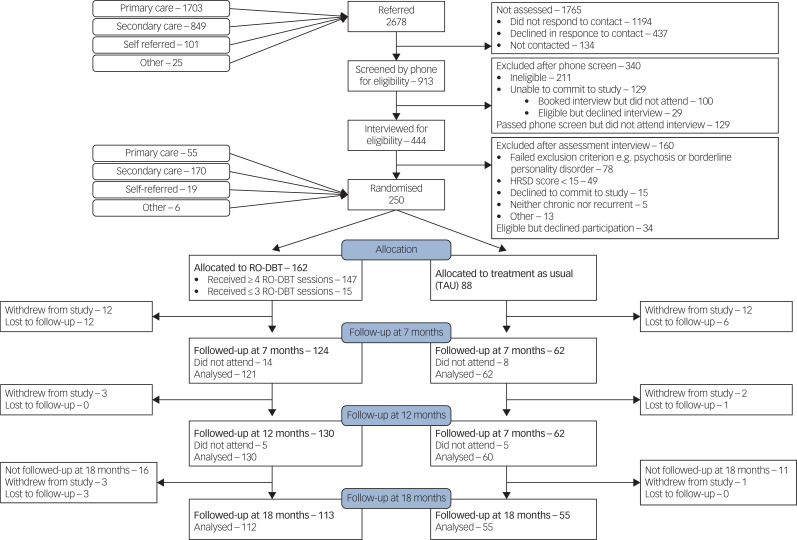
RO DBT comprised 29 therapy sessions and 27 skills classes over 6 months. Our completed randomised trial evaluated RO DBT for refractory depression over 18 months in three British secondary care centres. Of 250 adult participants, we randomised 162 (65%) to RO DBT. The primary outcome was the Hamilton Rating Scale for Depression (HRSD), assessed masked and analysed by treatment allocated.
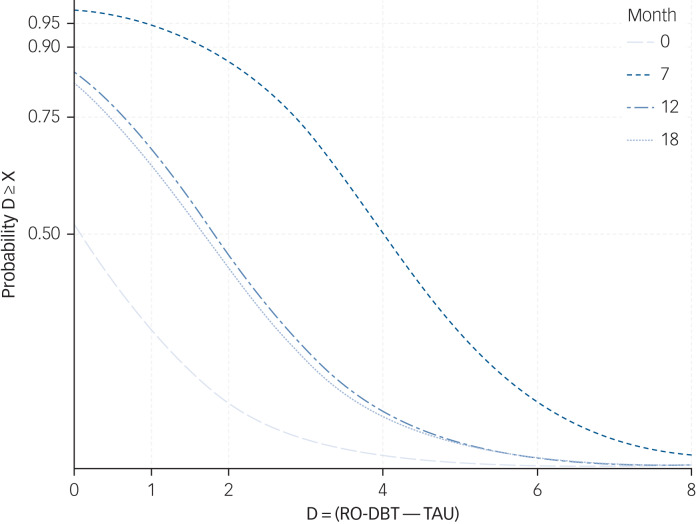
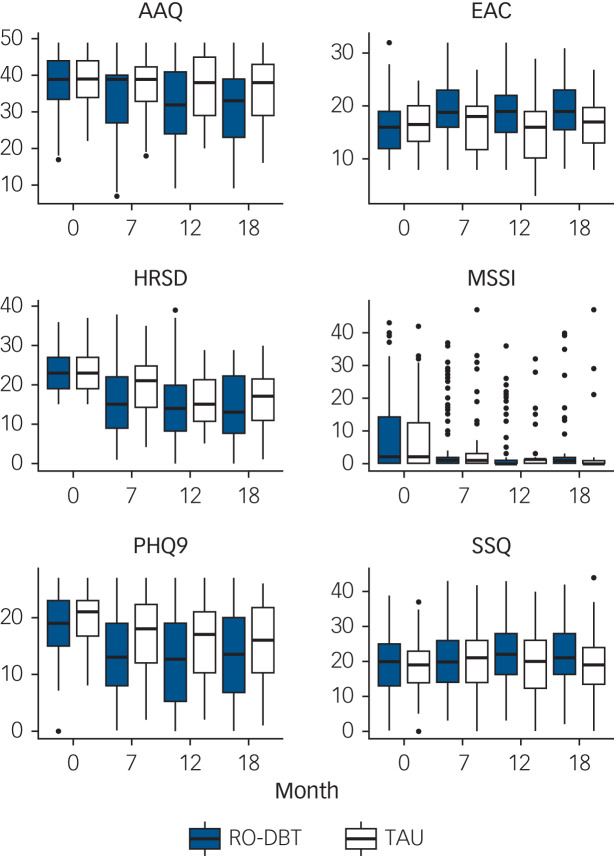
After 7 months, immediately following therapy, RO DBT had significantly reduced depressive symptoms by 5.40 points on the HRSD relative to TAU (95% CI 0.94-9.85). After 12 months (primary end-point), the difference of 2.15 points on the HRSD in favour of RO DBT was not significant (95% CI -2.28 to 6.59); nor was that of 1.69 points on the HRSD at 18 months (95% CI -2.84 to 6.22). Throughout RO DBT participants reported significantly better psychological flexibility and emotional coping than controls. However, they reported eight possible serious adverse reactions compared with none in the control group.
The RO DBT group reported significantly lower HRSD scores than the control group after 7 months, but not thereafter. The imbalance in serious adverse reactions was probably because of the controls' limited opportunities to report these.
患有抑郁症的个体经常对药物或心理治疗没有反应。激进开放辩证行为疗法(RO DBT)是一种针对过度控制型人格的新治疗方法,这种人格在难治性抑郁症中很常见。
比较 RO DBT 加常规治疗(TAU)与单独 TAU 治疗难治性抑郁症(试验注册:ISRCTN 85784627)。
RO DBT 包括 6 个月内的 29 次治疗和 27 次技能课程。我们已完成的随机试验评估了 RO DBT 在英国三个二级保健中心对难治性抑郁症的 18 个月疗效。在 250 名成年参与者中,我们将 162 名(65%)随机分为 RO DBT 组。主要结局指标是汉密尔顿抑郁量表(HRSD),评估采用盲法并按治疗分配进行分析。
在 7 个月时,即治疗结束后立即,RO DBT 组在 HRSD 上的抑郁症状较 TAU 组显著降低 5.40 分(95%CI:0.94-9.85)。在 12 个月(主要终点)时,RO DBT 组在 HRSD 上的 2.15 分差异无统计学意义(95%CI:-2.28 至 6.59);在 18 个月时,HRSD 上的 1.69 分差异也无统计学意义(95%CI:-2.84 至 6.22)。在整个 RO DBT 过程中,参与者报告的心理灵活性和情绪应对能力明显优于对照组。然而,他们报告了 8 种可能的严重不良反应,而对照组无一例。
RO DBT 组在 7 个月后报告的 HRSD 评分明显低于对照组,但此后不再如此。严重不良反应的不平衡可能是因为对照组报告这些不良反应的机会有限。