Hammersmith Hospital, Imperial College NHS Trust, London, United Kingdom.
Hammersmith Hospital, Imperial College NHS Trust, London, United Kingdom; St. Marianna University School of Medicine, Kawasaki, Japan.
JACC Cardiovasc Interv. 2019 Jul 22;12(14):1315-1324. doi: 10.1016/j.jcin.2019.05.025.
The aim of this study was to investigate whether algorithmic interpretation (AI) of instantaneous wave-free ratio (iFR) pressure-wire pull back data would be noninferior to expert human interpretation.
Interpretation of iFR pressure-wire pull back data can be complex and is subjective.
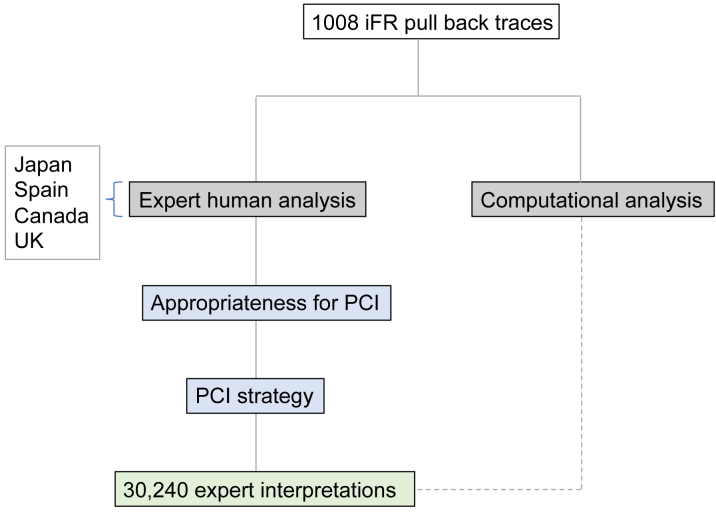
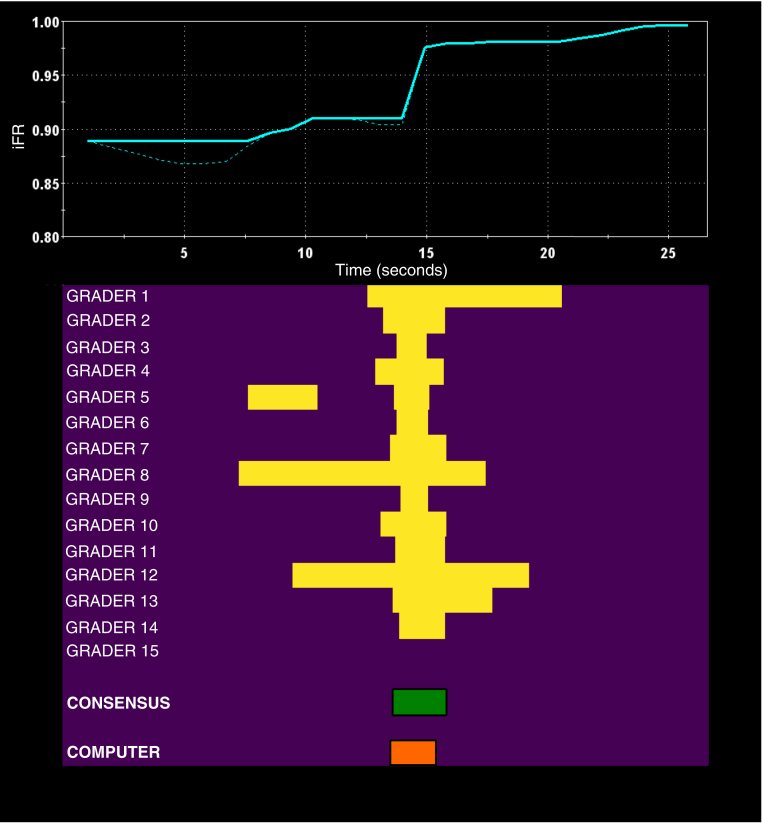
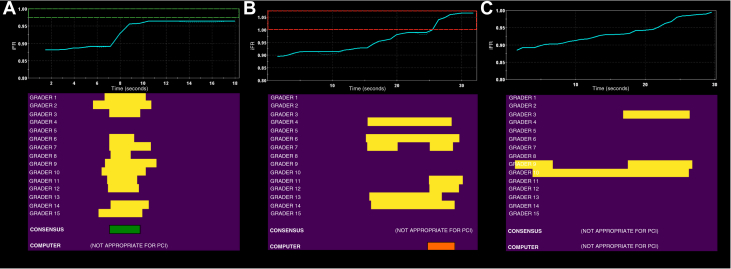
Fifteen human experts interpreted 1,008 iFR pull back traces (691 unique, 317 duplicate). For each trace, experts determined the hemodynamic appropriateness for percutaneous coronary intervention (PCI) and, in such cases, the optimal physiological strategy for PCI. The heart team (HT) interpretation was determined by consensus of the individual expert opinions. The same 1,008 pull back traces were also interpreted algorithmically. The coprimary hypotheses of this study were that AI would be noninferior to the interpretation of the median expert human in determining: 1) the hemodynamic appropriateness for PCI; and 2) the physiological strategy for PCI.
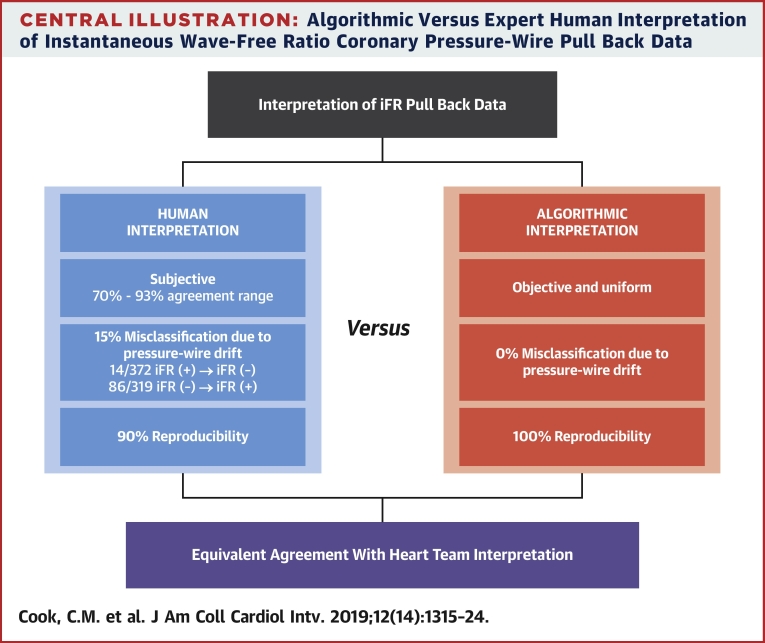
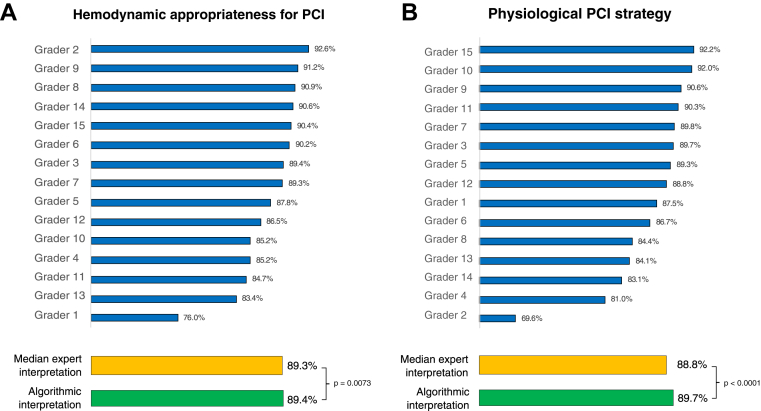
Regarding the hemodynamic appropriateness for PCI, the median expert human demonstrated 89.3% agreement with the HT in comparison with 89.4% for AI (p < 0.01 for noninferiority). Across the 372 cases judged as hemodynamically appropriate for PCI according to the HT, the median expert human demonstrated 88.8% agreement with the HT in comparison with 89.7% for AI (p < 0.0001 for noninferiority). On reproducibility testing, the HT opinion itself changed 1 in 10 times for both the appropriateness for PCI and the physiological PCI strategy. In contrast, AI showed no change.
AI of iFR pressure-wire pull back data was noninferior to expert human interpretation in determining both the hemodynamic appropriateness for PCI and the optimal physiological strategy for PCI.
本研究旨在探讨即时无波比(iFR)压力导丝回撤数据的算法解读是否不劣于专家人工解读。
iFR 压力导丝回撤数据的解读可能较为复杂且具有主观性。
15 位人类专家解读了 1008 次 iFR 回撤迹线(691 次为单次,317 次为重复)。对于每条迹线,专家均确定经皮冠状动脉介入治疗(PCI)的血流动力学适宜性,且在这种情况下,确定 PCI 的最佳生理策略。心脏团队(HT)的解读由各专家意见的共识决定。同样的 1008 条回撤迹线也通过算法进行解读。本研究的主要假设是,AI 在确定以下两个方面时不劣于中位数专家人类的解读:1)PCI 的血流动力学适宜性;2)PCI 的生理策略。
在 PCI 的血流动力学适宜性方面,中位数专家人类与 HT 的一致性为 89.3%,而 AI 为 89.4%(非劣效性 p<0.01)。在根据 HT 判定为血流动力学适宜进行 PCI 的 372 例病例中,中位数专家人类与 HT 的一致性为 88.8%,而 AI 为 89.7%(非劣效性 p<0.0001)。在重复性测试中,HT 的意见本身在 PCI 的适宜性和 PCI 的生理策略方面,每 10 次中有 1 次发生改变。相比之下,AI 则没有变化。
iFR 压力导丝回撤数据的 AI 解读在确定 PCI 的血流动力学适宜性和 PCI 的最佳生理策略方面不劣于专家人工解读。