Guo Xiaohui, Xu Yifan, He Hairong, Cai Hao, Zhang Jianfen, Li Yibin, Yan Xinyu, Zhang Man, Zhang Na, Maddela Rolando L, Ma Guansheng
1Department of Nutrition and Food Hygiene, School of Public Health, Peking University, 38 Xue Yuan Road, Haidian District, Beijing, 100191 China.
2Beijing Key Laboratory of Toxicological Research and Risk Assessment for Food Safety, School of Public Health, Peking University, 38 Xue Yuan Road, Haidian District, Beijing, 100191 China.
Nutr Metab (Lond). 2019 Jul 10;16:44. doi: 10.1186/s12986-019-0369-0. eCollection 2019.
Visceral adiposity has been reported to play a key role in hypertension compared with other measurements of regional or general obesity. The aim of current study was to evaluate the relationship between visceral fat reduction and changes in blood pressure in a group of overweight or obese Chinese individuals.
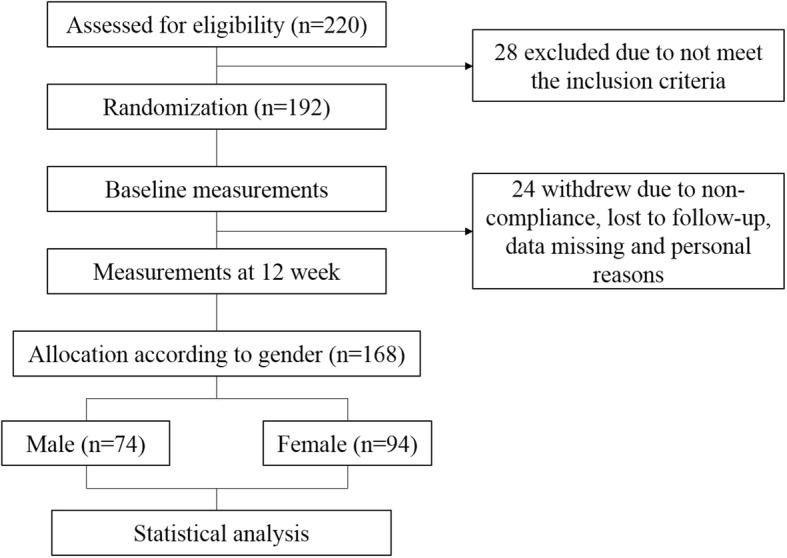
An observational study was conducted with 168 participants (ChiCTR-OOC-17012000). Body composition, blood parameters and blood pressure were assessed at the beginning and end of the intervention. Males and females were categorized separately into quartiles according to changes in visceral fat during the intervention. Multiple linear regression models were used to assess the associations of changes in systolic and diastolic blood pressure with changes of visceral fat area, adjusted for potential confounders.
Changes in visceral fat was significantly associated with systolic and diastolic blood pressure in men for systolic (β = 0.234, 95% CI: 0.103, 0.365; = 0.001) and diastolic blood pressure (β = 0.237; 95% CI: 0.127, 0.346; <0.001), but not in women after adjustment for the same potential confounders for systolic blood (β = - 0.003, 95% CI: - 0.260, 0.255; = 0.984) and diastolic blood pressure (β = 0.101, 95% CI: - 0.072, 0.273; = 0.249).
A positive association was observed between reduction in visceral fat and improvements in both systolic blood and diastolic blood pressures in males but not females in a 12-week meal replacement intervention.
The Ethics Committee of Peking University Health Science Center approved the study protocol on 6 July 2017. The authors confirm that all ongoing and related trials for this intervention were carried out following the rules of the Declaration of Helsinki of 1975 and registered (ChiCTR-OOC-17012000). http://www.chictr.org.cn/showprojen.aspx?proj=20426.
与其他局部或全身肥胖测量指标相比,内脏脂肪过多被认为在高血压形成过程中起关键作用。本研究旨在评估一组超重或肥胖的中国人群中内脏脂肪减少与血压变化之间的关系。
对168名参与者开展了一项观察性研究(中国临床试验注册中心注册号:ChiCTR-OOC-17012000)。在干预开始和结束时评估身体成分、血液参数和血压。根据干预期间内脏脂肪的变化,将男性和女性分别分为四分位数。使用多元线性回归模型评估收缩压和舒张压变化与内脏脂肪面积变化之间的关联,并对潜在混杂因素进行校正。
校正相同潜在混杂因素后,男性内脏脂肪变化与收缩压(β = 0.234,95%CI:0.103,0.365;P = 0.001)和舒张压(β = 0.237;95%CI:0.127,0.346;P <0.001)显著相关,而女性收缩压(β = -0.003,95%CI:-0.260,0.255;P = 0.984)和舒张压(β = 0.101,95%CI:-0.072,0.273;P = 0.249)与之无关。
在为期12周的代餐干预中,男性内脏脂肪减少与收缩压和舒张压改善呈正相关,而女性则不然。
北京大学医学部伦理委员会于2017年7月6日批准了本研究方案。作者确认,所有正在进行的以及与此干预相关的试验均遵循1975年《赫尔辛基宣言》的规定进行,并已注册(ChiCTR-OOC-17012000)。http://www.chictr.org.cn/showprojen.aspx?proj=20426