Fazliana Mansor, Liyana Ahmad Zamri, Omar Azahadi, Ambak Rashidah, Mohamad Nor Noor Safiza, Shamsudin Ummi Kalthom, Salleh Narul Aida, Aris Tahir
Diabetes & Endocrine Unit, Institute for Medical Research, National Institutes of Health, Ministry of Health Malaysia, Jalan Pahang, 50588, Kuala Lumpur, Malaysia.
Institute for Public Health, National Institutes of Health, Ministry of Health Malaysia, Kuala Lumpur, Malaysia.
BMC Womens Health. 2018 Jul 19;18(Suppl 1):93. doi: 10.1186/s12905-018-0592-2.
Obesity is related to the increased incidence of hypertension and in healthy individuals, blood pressure changes with age and body mass. The aims of this paper were to evaluate the effectiveness of the weight loss intervention on body composition and blood pressure, and to evaluate the relationship between these factors among housewives in the MyBFF@home study.
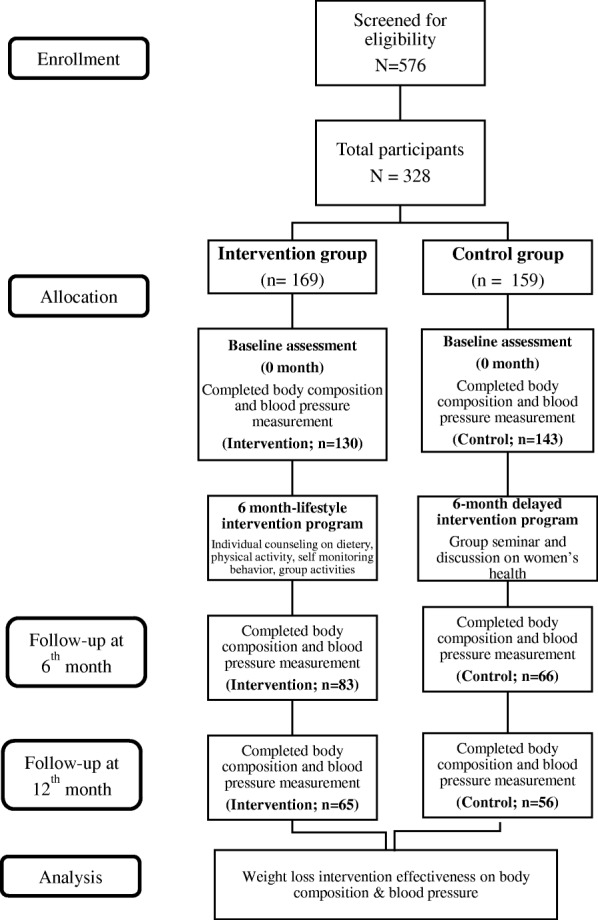
MyBFF@home intervention was a quasi-experimental study which involved 328 overweight and obese housewives aged 18-59 years old (Control group: 159, Intervention group: 169). Data of the control and intervention group (pre and post intervention who completed the body composition and blood pressure measurements were analysed. Body compositions were measured using the Body Impedance Analyser (InBody 720) and blood pressure (Systolic and Diastolic) was taken using the blood pressure monitoring device (Omron HEM 907) at baseline, 6 month and 12 month. Data analyses (Pearson's correlation test and ANOVA) were performed and analysed using SPSS Statistics for Windows, version 22.0.
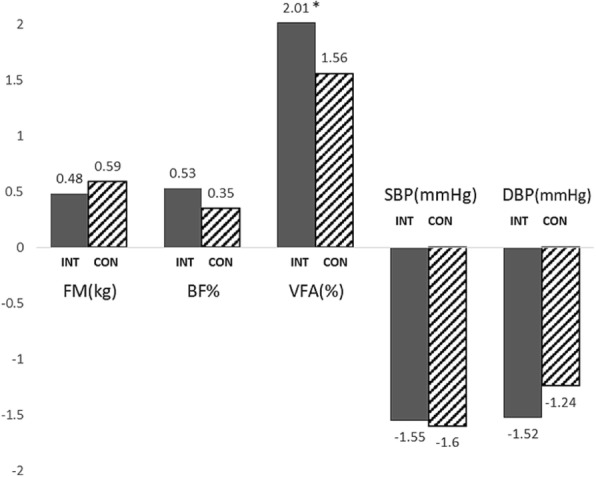
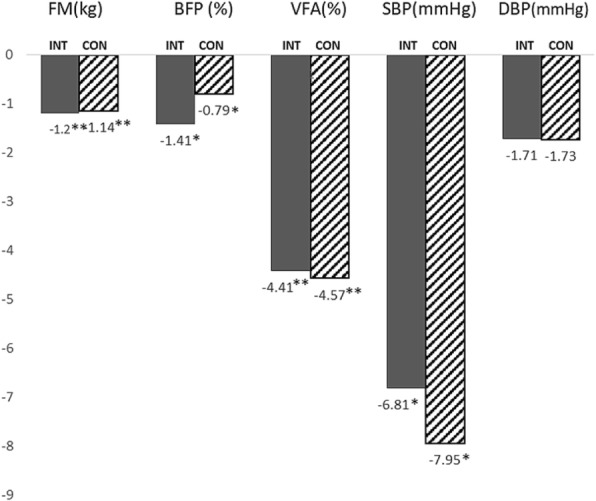
Visceral fat area, fat mass and body fat percentage, were all significantly decreased in the intervention group compared to the control group after 6 month intervention (p < 0.05). Systolic blood pressure was reduced significantly by - 6.81 mmHg (95% CI: -9.72,-3.90; p < 0.01) in the intervention and by - 7.95 mmHg (95% CI: -11.69,-4.20; p < 0.01) in the control group after 6 month intervention. Diastolic blood pressure was significantly correlated with BMI (r = 0.19), waist circumference (r = 0.23), body fat mass (r = 0.22), body fat percentage (r = 0.18) visceral fat area (r = 0.22) and skeletal muscle mass (r = 0.14) with p < 0.05. At 12-month follow-up, no significant changes of blood pressure were detected in both groups.
There were significant changes in the body fat and systolic blood pressure over 6 month among the participants in the intervention group compared to the control group. However, both groups were unable to sustain the positive changes in the body fats during the maintenance phase. There was a relationship between the body composition and blood pressure during the weight loss intervention and weight loss maintenance phase. Participation among obese housewives in a community-based intervention programme led to the improvements in blood pressure and body composition.
肥胖与高血压发病率增加有关,在健康个体中,血压会随年龄和体重变化。本文旨在评估减肥干预对身体成分和血压的有效性,并在“MyBFF@home研究”中评估家庭主妇群体中这些因素之间的关系。
“MyBFF@home干预”是一项准实验研究,涉及328名年龄在18 - 59岁的超重和肥胖家庭主妇(对照组:159人,干预组:169人)。分析了对照组和干预组(干预前后完成身体成分和血压测量者)的数据。在基线、6个月和12个月时,使用人体阻抗分析仪(InBody 720)测量身体成分,使用血压监测设备(欧姆龙HEM 907)测量血压(收缩压和舒张压)。使用SPSS Statistics for Windows 22.0版本进行数据分析(Pearson相关检验和方差分析)。
干预6个月后,与对照组相比,干预组的内脏脂肪面积、脂肪量和体脂百分比均显著降低(p < 0.05)。干预组收缩压在干预6个月后显著降低-6.81 mmHg(95%置信区间:-9.72,-3.90;p < 0.01),对照组降低-7.95 mmHg(95%置信区间:-11.69,-4.20;p < 0.01)。舒张压与BMI(r = 0.19)、腰围(r = 0.23)、体脂肪量(r = 0.22)、体脂百分比(r = 0.18)、内脏脂肪面积(r = 0.22)和骨骼肌量(r = 0.