Cairns Alice J, Kavanagh David J, Dark Frances, McPhail Steven M
1Centre for Rural and Remote Health, James Cook University, PO Box 341, Weipa, QLD 4874 Australia.
2Centre for Children's Health Research, School of Psychology and Counselling and Institute of Health and Biomedical Innovation, Queensland University of Technology, Brisbane, Australia.
Child Adolesc Psychiatry Ment Health. 2019 Jul 9;13:31. doi: 10.1186/s13034-019-0288-x. eCollection 2019.
This study explored if a youth-specific mental health service routinely set goals with young people during initial intake/assessment and if goal setting and goal quality in this service was associated with patient retention.
Consecutive initial assessments (n = 283) and administrative service data from two youth-specific health services in Australia were audited for evidence of goal setting, content and quality of the goal and number of therapy services provided after the intake/assessment process. Logistic regression was used to determine if goal setting was associated with disengagement after the assessment session, controlling for drug use, unemployment, age, gender, mental health diagnosis and service site. A consecutive sub-sample of 166 goals (74 participants), was analysed for goal quality. Each goal was assessed against three components of the SMART (specific, measurable, acceptable/achievable, realistic and timed goals) criteria; specific, measurable and timed; and assigned a goal quality score 1-3. A multiple regression explored whether goal quality was predictive of the number of sessions attended, controlling for the same variables as the logistic regression.
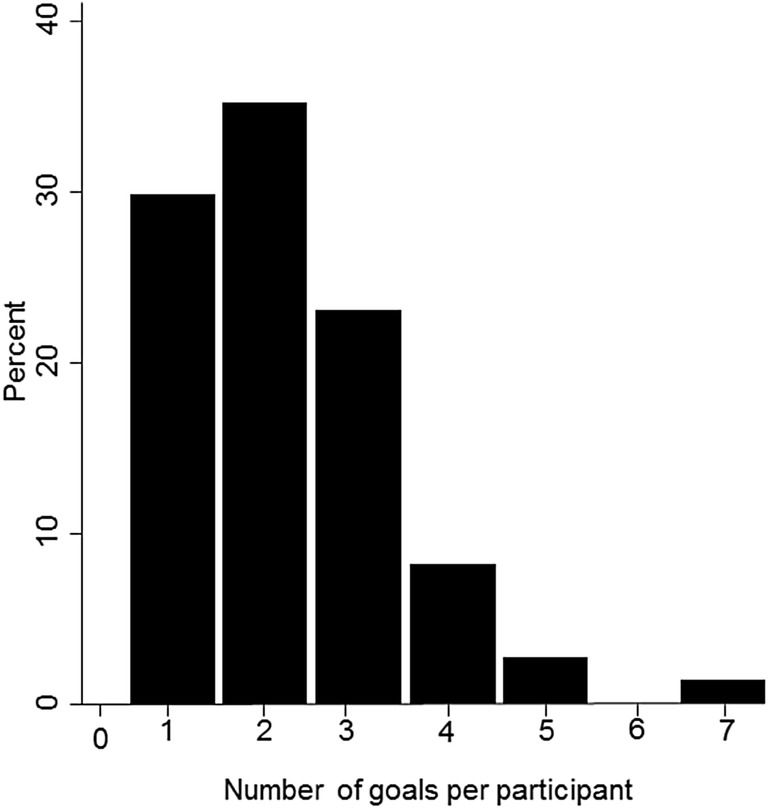
Goal setting was evident in the records of 187 participants (66%). Although most goals were for emotional management, 24% addressed improvements in function. Of the 166 goals analysed in depth, 95 were specific, 23 measurable, but none were timed. Not setting goals during initial assessments correlated with service disengagement (OR 0.30, p > 0.001). Goal setting was positively associated with more therapy sessions attended, regardless of goal quality rating.
Engagement and retention of young people within mental health services can be challenging. Clinical tools such as goal setting may keep young people engaged in services longer, potentially improving clinical outcomes. Further research exploring the effectiveness of current youth service models on client-specific goal based outcomes is recommended.
本研究探讨了针对青少年的心理健康服务在初次接诊/评估时是否会常规性地与青少年设定目标,以及该服务中的目标设定和目标质量是否与患者留存率相关。
对澳大利亚两家针对青少年的健康服务机构的连续初次评估(n = 283)及行政服务数据进行审核,以查找目标设定、目标内容和质量的证据,以及在接诊/评估过程后提供的治疗服务数量。使用逻辑回归来确定目标设定是否与评估 session 后的退出相关,同时控制药物使用、失业、年龄、性别、心理健康诊断和服务地点等因素。对 166 个目标(74 名参与者)的连续子样本进行目标质量分析。每个目标根据 SMART(具体、可衡量、可接受/可实现、现实和有时限的目标)标准的三个组成部分进行评估:具体、可衡量和有时限;并赋予 1 - 3 的目标质量分数。多元回归探讨了目标质量是否可预测就诊次数,同时控制与逻辑回归相同的变量。
187 名参与者(66%)的记录中有目标设定。尽管大多数目标是关于情绪管理,但 24%涉及功能改善。在深入分析的 166 个目标中,95 个是具体的,23 个是可衡量的,但没有一个是有时限的。在初次评估时未设定目标与退出服务相关(OR 0.30,p > 0.001)。无论目标质量评级如何,目标设定与更多的治疗就诊次数呈正相关。
让青少年参与并留存于心理健康服务可能具有挑战性。诸如目标设定等临床工具可能会使青少年在服务中停留更长时间,有可能改善临床结果。建议进一步研究探索当前青少年服务模式对基于特定客户目标的结果的有效性。