Takeda Pharmaceuticals U.S.A., Inc., 95 Hayden Avenue, Lexington, MA, 02421, USA.
Lundbeck LLC, 6 Parkway North Blvd, Deerfield, IL, 60015, USA.
BMC Psychiatry. 2021 Dec 11;21(1):622. doi: 10.1186/s12888-021-03608-1.
Major depressive disorder (MDD) is the leading cause of disability worldwide. Response to pharmacologic treatment is generally evaluated by traditional clinician- and patient-reported rating scales. Assessing therapeutic efficacy using the Goal Attainment Scale offers a complementary measure that focuses on recovery-oriented outcomes that patients consider valuable and vital to their well-being. This study aimed to examine outcomes using the Goal Attainment Scale adapted for depression (GAS-D).
A phase 4, single-arm, open-label, multicenter study enrolled patients with MDD who were switching antidepressant medication. Patients received vortioxetine 10-20 mg over 12 weeks. Three specific, measurable, attainable, relevant, and time-bound goals were collaboratively set by patients with their clinicians. One goal was determined by the patient's self-defined objectives; 2 were related to predefined domain categories. Prespecified domains included psychological, motivational, emotional, physical/functional, and cognitive categories. The primary endpoint was the proportion of patients who achieved a GAS-D score ≥ 50 at week 12. Secondary and exploratory endpoints included changes from baseline in several clinical and patient-reported measures of depression and cognitive function. Safety and tolerability were also assessed.
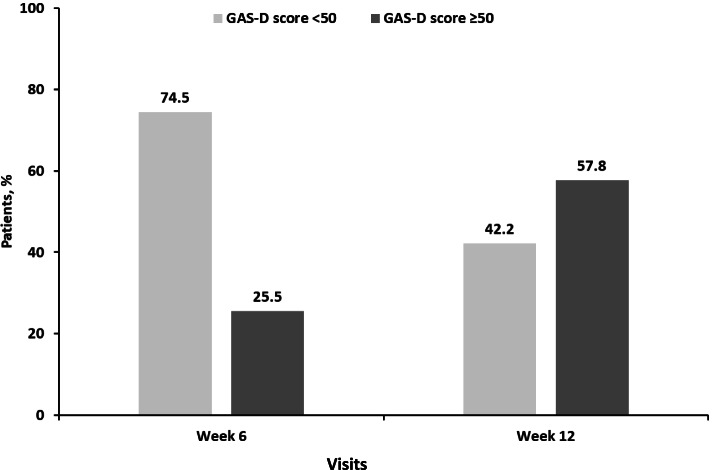
At week 12, of the 122 adults participating in the study, 57.8% achieved a GAS-D score ≥ 50. Depression severity, cognitive function, cognitive performance, well-being, employment, and quality of life also significantly improved. Treatment response and remission rates were 65 and 40%, respectively. Vortioxetine was well tolerated, with adverse events consistent with product labeling.
A majority of patients with MDD switching to vortioxetine achieved their treatment goals, including improvement in specific functional outcomes relating to physical and emotional goals, as assessed by the GAS-D and standard patient- and clinician-reported measures. When assayed for convergent validity in a separate analysis, changes in goal scores on the GAS-D were statistically significantly correlated with multiple commonly used clinical measures of depression assessed in this study. The GAS-D approach provides a new patient-centric paradigm for the collaborative development and assessment of progress toward meaningful treatment goals, contributing to a comprehensive evaluation of treatment outcomes in patients with MDD. Longer studies against a control intervention are justified.
ClinicalTrials.gov identifier: NCT02972632 . Registered 21 November 2016.
重度抑郁症(MDD)是全球导致残疾的主要原因。药物治疗的反应通常通过传统的临床医生和患者报告的评定量表进行评估。使用目标达成量表评估治疗效果提供了一种互补的方法,重点关注患者认为对其健康至关重要的康复结果。本研究旨在使用适应于抑郁症的目标达成量表(GAS-D)来评估结果。
一项 4 期、单臂、开放标签、多中心研究招募了正在转换抗抑郁药物的 MDD 患者。患者接受了为期 12 周的文拉法辛 10-20mg 治疗。患者及其临床医生共同设定了三个具体、可衡量、可实现、相关和有时限的目标。一个目标由患者自己定义的目标决定;另外两个与预先确定的领域类别相关。预先指定的领域包括心理、动机、情感、身体/功能和认知类别。主要终点是在第 12 周达到 GAS-D 评分≥50 的患者比例。次要和探索性终点包括抑郁和认知功能的几个临床和患者报告测量从基线的变化。还评估了安全性和耐受性。
在第 12 周,参与研究的 122 名成年人中,有 57.8%达到了 GAS-D 评分≥50。抑郁严重程度、认知功能、认知表现、幸福感、就业和生活质量也显著改善。治疗反应和缓解率分别为 65%和 40%。文拉法辛具有良好的耐受性,不良反应与产品标签一致。
大多数转换为文拉法辛的 MDD 患者达到了他们的治疗目标,包括通过 GAS-D 和标准患者和临床医生报告的措施评估的与身体和情感目标相关的特定功能结果的改善。在另一项分析中,对效标效度进行检验时,GAS-D 上的目标评分变化与本研究中评估的多个常用抑郁临床测量结果呈统计学显著相关。GAS-D 方法为协作制定和评估对有意义的治疗目标的进展提供了一种新的以患者为中心的范例,有助于对 MDD 患者的治疗结果进行全面评估。有理由进行更长时间的对照干预研究。
ClinicalTrials.gov 标识符:NCT02972632。注册日期:2016 年 11 月 21 日。