Masud Rafia, Al-Rei Mona, Lokker Cynthia
Health Information Research Unit, Department of Health Research Methods, Evidence, and Impact, McMaster University, Hamilton, ON, Canada.
JMIR Med Inform. 2019 Jul 18;7(3):e12660. doi: 10.2196/12660.
With the growth of machine learning applications, the practice of medicine is evolving. Computer-aided detection (CAD) is a software technology that has become widespread in radiology practices, particularly in breast cancer screening for improving detection rates at earlier stages. Many studies have investigated the diagnostic accuracy of CAD, but its implementation in clinical settings has been largely overlooked.
The aim of this scoping review was to summarize recent literature on the adoption and implementation of CAD during breast cancer screening by radiologists and to describe barriers and facilitators for CAD use.
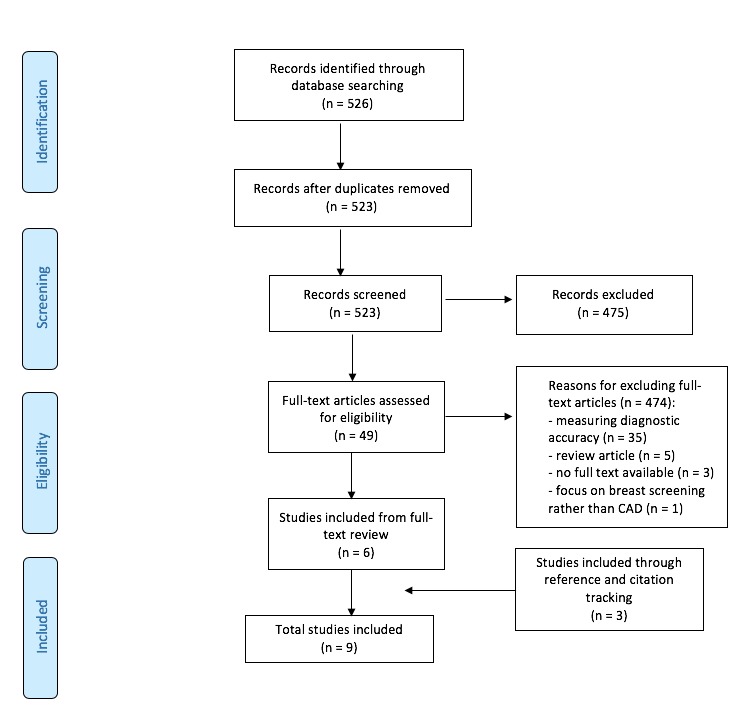
The MEDLINE database was searched for English, peer-reviewed articles that described CAD implementation, including barriers or facilitators, in breast cancer screening and were published between January 2010 and March 2018. Articles describing the diagnostic accuracy of CAD for breast cancer detection were excluded. The search returned 526 citations, which were reviewed in duplicate through abstract and full-text screening. Reference lists and cited references in the included studies were reviewed.
A total of nine articles met the inclusion criteria. The included articles showed that there is a tradeoff between the facilitators and barriers for CAD use. Facilitators for CAD use were improved breast cancer detection rates, increased profitability of breast imaging, and time saved by replacing double reading. Identified barriers were less favorable perceptions of CAD compared to double reading by radiologists, an increase in recall rates of patients for further testing, increased costs, and unclear effect on patient outcomes.
There is a gap in the literature between CAD's well-established diagnostic accuracy and its implementation and use by radiologists. Generally, the perceptions of radiologists have not been considered and details of implementation approaches for adoption of CAD have not been reported. The cost-effectiveness of CAD has not been well established for breast cancer screening in various populations. Further research is needed on how to best facilitate CAD in radiology practices in order to optimize patient outcomes, and the views of radiologists need to be better considered when advancing CAD use.
随着机器学习应用的发展,医学实践正在不断演变。计算机辅助检测(CAD)是一种软件技术,已在放射学实践中广泛应用,尤其是在乳腺癌筛查中,以提高早期检测率。许多研究调查了CAD的诊断准确性,但其在临床环境中的应用在很大程度上被忽视了。
本范围综述的目的是总结近期关于放射科医生在乳腺癌筛查中采用和实施CAD的文献,并描述CAD使用的障碍和促进因素。
在MEDLINE数据库中搜索2010年1月至2018年3月期间发表的、描述CAD在乳腺癌筛查中的实施情况(包括障碍或促进因素)的英文同行评审文章。排除描述CAD对乳腺癌检测诊断准确性的文章。检索返回526条引文,通过摘要和全文筛选进行重复评审。对纳入研究中的参考文献列表和引用文献进行了评审。
共有9篇文章符合纳入标准。纳入的文章表明,CAD使用的促进因素和障碍之间存在权衡。CAD使用的促进因素包括提高乳腺癌检测率、增加乳腺成像的盈利能力以及通过取代双人读片节省时间。已确定的障碍包括与放射科医生的双人读片相比,对CAD的看法不太有利、患者进一步检测召回率增加、成本增加以及对患者预后的影响不明确。
在文献中,CAD已确立的诊断准确性与其在放射科医生中的实施和使用之间存在差距。一般来说,放射科医生的看法未被考虑,且未报告采用CAD的实施方法细节。CAD在不同人群乳腺癌筛查中的成本效益尚未得到充分确立。需要进一步研究如何在放射学实践中最好地促进CAD的使用,以优化患者预后,并且在推进CAD使用时需要更好地考虑放射科医生的观点。