Departamento de Parasitologia, Instituto de Biofísica Carlos, Chagas Filho (IBCCF), Universidade Federal do Rio de Janeiro, Rio de Janeiro 21044-020, Brazil.
Red Imported Fire Ant Research Centre, South China Agricultural University (SCAU), Guangzhou 510642, China.
Toxins (Basel). 2019 Jul 18;11(7):420. doi: 10.3390/toxins11070420.
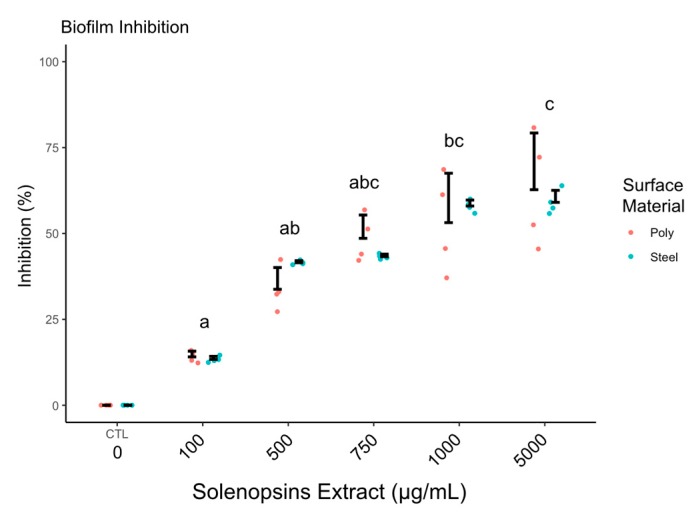
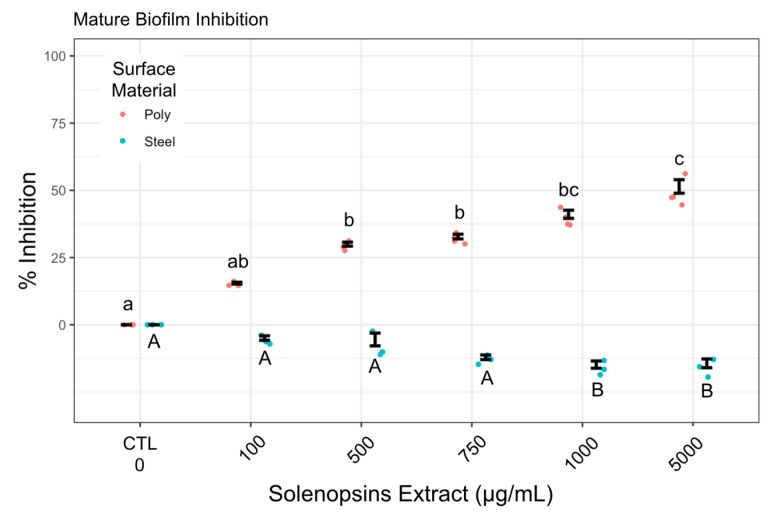
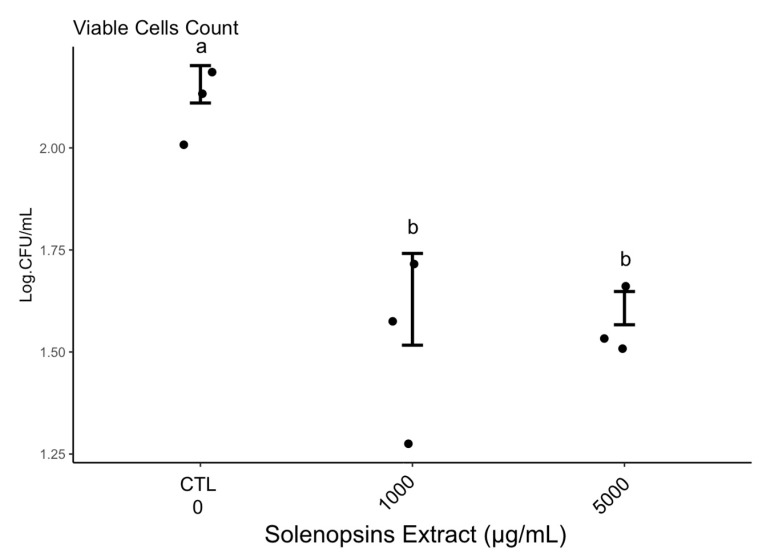
Biofilm formation on exposed surfaces is a serious issue for the food industry and medical health facilities. There are many proposed strategies to delay, reduce, or even eliminate biofilm formation on surfaces. The present study focuses on the applicability of fire ant venom alkaloids (aka 'solenopsins', from ) tested on polystyrene and stainless steel surfaces relative to the adhesion and biofilm-formation by the bacterium . Conditioning with solenopsins demonstrates significant reduction of bacterial adhesion. Inhibition rates were 62.7% on polystyrene and 59.0% on stainless steel surfaces. In addition, solenopsins drastically reduced cell populations already growing on conditioned surfaces. Contrary to assumptions by previous authors, solenopsins tested negative for amphipathic properties, thus understanding the mechanisms behind the observed effects still relies on further investigation.
暴露表面的生物膜形成是食品工业和医疗保健设施的一个严重问题。有许多被提议的策略来延迟、减少甚至消除表面的生物膜形成。本研究集中于火蚁毒液生物碱(也称为“ solenopsins”,来自 )在聚苯乙烯和不锈钢表面的适用性,相对于细菌 的粘附和生物膜形成。用 solenopsins 处理可显著减少细菌的粘附。在聚苯乙烯表面的抑制率为 62.7%,在不锈钢表面的抑制率为 59.0%。此外, solenopsins 大大减少了已经在处理过的表面上生长的细胞群体。与之前作者的假设相反, solenopsins 对两亲性的测试结果为阴性,因此,要理解观察到的效果背后的机制仍需要进一步研究。