Institute of Cytology and Genetics, Siberian Branch, Russian Academy of Sciences, Novosibirsk 630090, Russia.
Department of Plant Physiology and Biotechnology, Tomsk State University, Tomsk 634050, Russia.
Int J Mol Sci. 2019 Jul 9;20(13):3371. doi: 10.3390/ijms20133371.
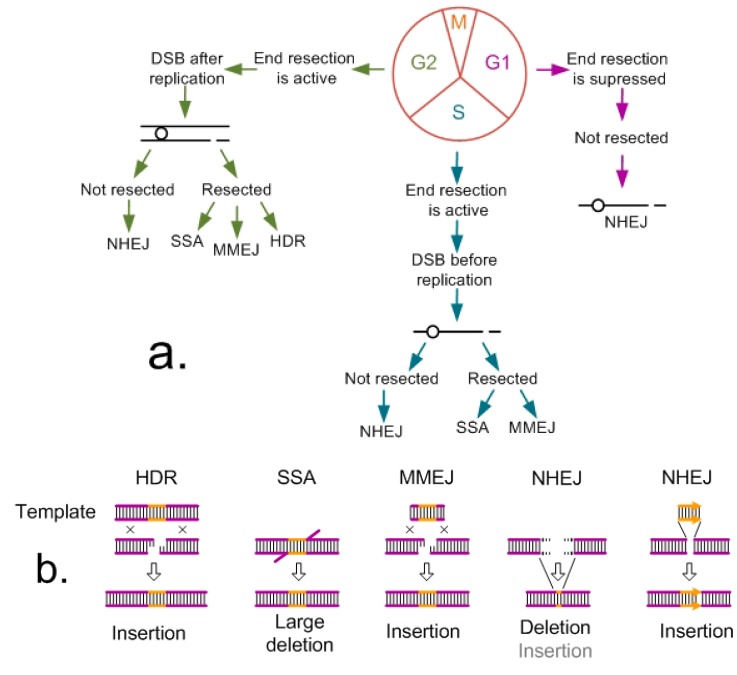
The main number of genome editing events in plant objects obtained during the last decade with the help of specific nucleases zinc finger (ZFN), transcription activator-like effector nucleases (TALEN), and clustered regularly interspaced short palindromic repeats (CRISPR)/Cas are the microindels causing frameshift and subsequent gene knock-out. The knock-ins of genes or their parts, i.e., the insertion of them into a target genome region, are between one and two orders of magnitude less frequent. First and foremost, this is associated with the specific features of the repair systems of higher eukaryotes and the availability of the donor template in accessible proximity during double-strand break (DSB) repair. This review briefs the main repair pathways in plants according to the aspect of their involvement in genome editing. The main methods for increasing the frequency of knock-ins are summarized both along the homologous recombination pathway and non-homologous end joining, which can be used for plant objects.
在过去十年中,利用特定的核酸酶锌指(ZFN)、转录激活样效应物核酸酶(TALEN)和成簇规律间隔短回文重复(CRISPR)/Cas,在植物研究对象中进行了主要的基因组编辑事件,这些事件是造成移码和随后基因敲除的微缺失。基因或其部分的基因敲入,即它们插入靶基因组区域,其频率要低一到两个数量级。这首先与高等真核生物的修复系统的特定特征以及在双链断裂(DSB)修复过程中供体模板在可接近的临近位置的可用性有关。本综述根据其在基因组编辑中的参与程度,简要介绍了植物中的主要修复途径。还总结了提高基因敲入频率的主要方法,包括同源重组途径和非同源末端连接,这些方法可用于植物研究对象。