Department of Biological Sciences, National University of Singapore, Singapore, 119543, Singapore.
Temasek Life Sciences Laboratory, Singapore, 117604, Singapore.
BMC Plant Biol. 2019 Jul 19;19(1):326. doi: 10.1186/s12870-019-1930-8.
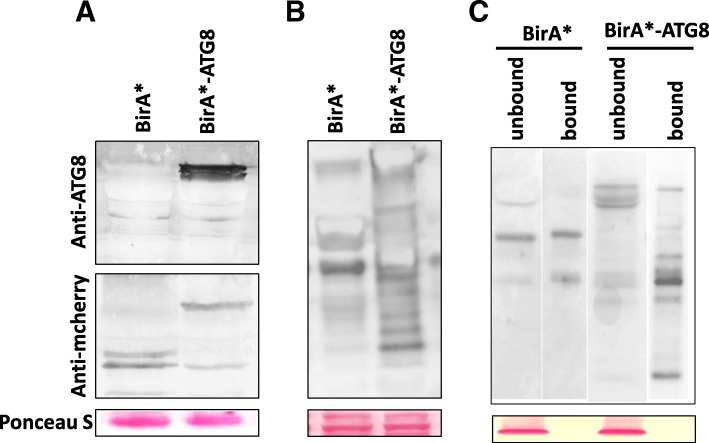
Autophagy is a conserved, highly-regulated catabolic process that plays important roles in growth, development and innate immunity in plants. In this study, we compared the rate of autophagy induction in Nicotiana benthamiana plants infected with Tobacco mosaic virus or the TMV 24A + UPD mutant variant, which replicates at a faster rate and induces more severe symptoms. Using a BirA* tag and proximity-dependent biotin identification (BioID) analysis, we identified host proteins that interact with the core autophagy protein, ATG8 in TMV 24A + UPD infected plants. By combining the use of a fast replicating TMV mutant and an in vivo protein-protein screening technique, we were able to gain functional insight into the role of autophagy in a compatible virus-host interaction.
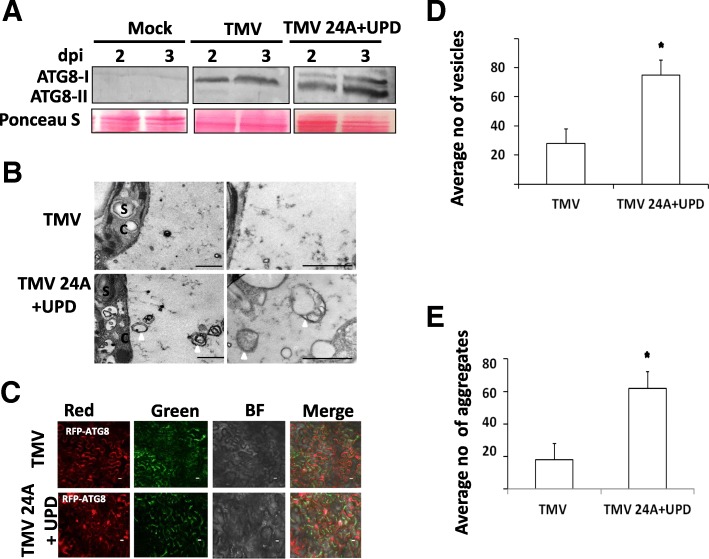
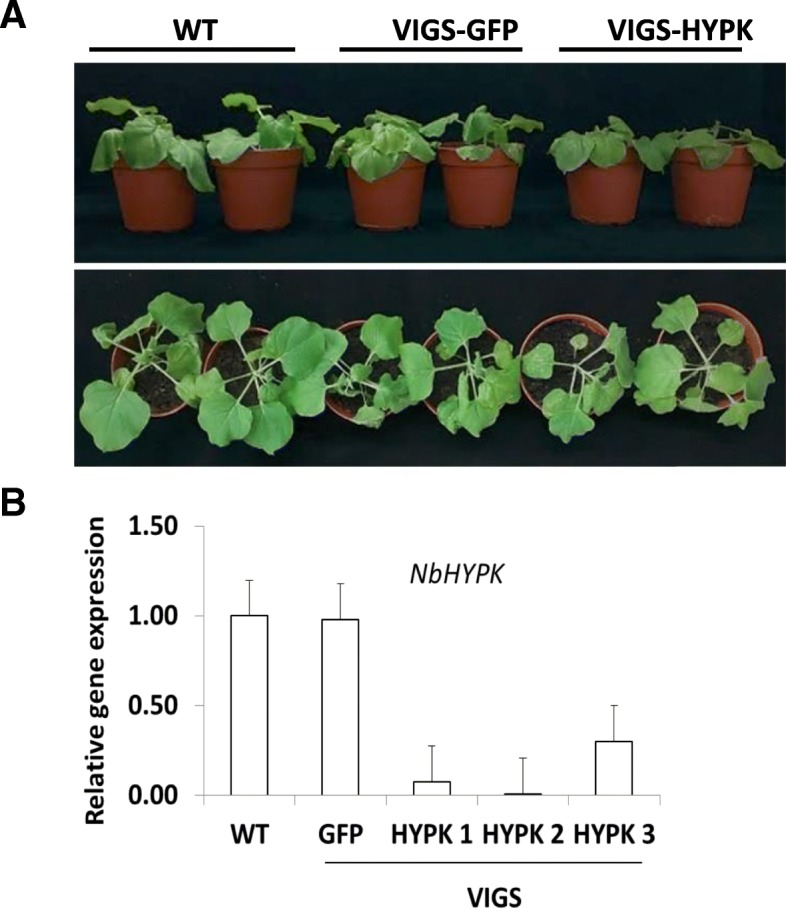
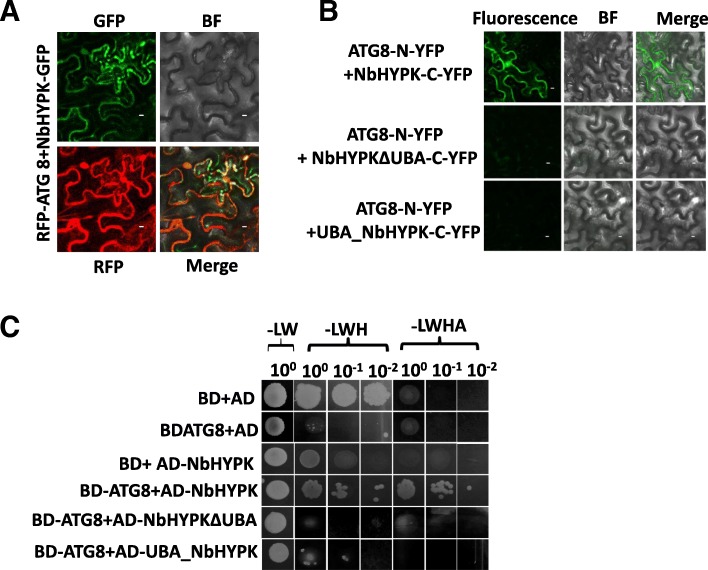
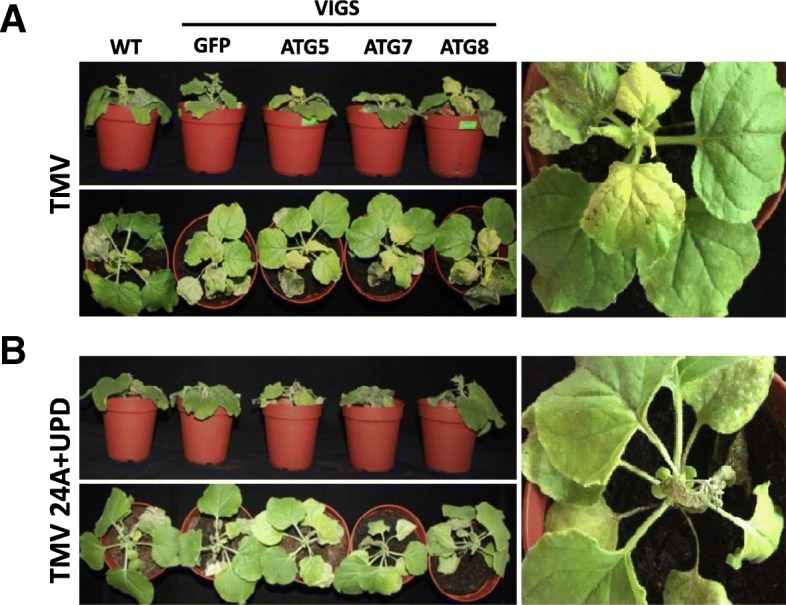
Our study revealed an increased autophagic flux induced by TMV 24A + UPD, as compared to TMV in N. benthamiana. Analysis of the functional proteome associated with ATG8 revealed a total of 67 proteins, 16 of which are known to interact with ATG8 or its orthologs in mammalian and yeast systems. The interacting proteins were categorized into four functional groups: immune system process, response to ROS, sulphur amino acid metabolism and calcium signalling. Due to the presence of an ubiquitin-associated (UBA) domain, which is demonstrated to interact with ATG8, the Huntingtin-interacting protein K-like (HYPK) was selected for validation of the physical interaction and function. We used yeast two hybrid (Y2H), bimolecular fluorescence complementation (BiFC) and subcellular localization to validate the ATG8-HYPK interaction. Subsequent down-regulation of ATG8 by virus-induced gene silencing (VIGS) showed enhanced TMV symptoms, suggesting a protective role for autophagy during TMV 24A + UPD infection.
This study presents the use of BioID as a suitable method for screening ATG8 interacting proteins in planta. We have identified many putative binding partners of ATG8 during TMV 24A + UPD infection in N. benthamiana plants. In addition, we have verified that NbHYPK is an interacting partner of ATG8. We infer that autophagy plays a protective role in TMV 24A + UPD infected plants.
自噬是一种保守的、高度调控的分解代谢过程,在植物的生长、发育和先天免疫中发挥着重要作用。在这项研究中,我们比较了感染烟草花叶病毒(TMV)或 TMV 24A+UPD 突变体的本氏烟植株中自噬诱导的速度,后者以更快的速度复制并引起更严重的症状。使用 BirA*标签和邻近依赖性生物素鉴定(BioID)分析,我们鉴定了与 TMV 24A+UPD 感染植物中的核心自噬蛋白 ATG8 相互作用的宿主蛋白。通过结合使用快速复制的 TMV 突变体和体内蛋白质-蛋白质筛选技术,我们能够深入了解自噬在兼容的病毒-宿主相互作用中的作用。
与 TMV 相比,我们的研究表明 TMV 24A+UPD 诱导的自噬通量增加。对与 ATG8 相关的功能蛋白质组的分析总共揭示了 67 种蛋白质,其中 16 种已知在哺乳动物和酵母系统中与 ATG8 或其同源物相互作用。相互作用的蛋白质分为四个功能组:免疫系统过程、对 ROS 的反应、含硫氨基酸代谢和钙信号转导。由于存在泛素相关(UBA)结构域,该结构域被证明与 ATG8 相互作用,因此选择亨廷顿相互作用蛋白 K 样(HYPK)来验证物理相互作用和功能。我们使用酵母双杂交(Y2H)、双分子荧光互补(BiFC)和亚细胞定位来验证 ATG8-HYPK 相互作用。随后通过病毒诱导的基因沉默(VIGS)下调 ATG8 显示增强的 TMV 症状,表明自噬在 TMV 24A+UPD 感染期间发挥保护作用。
本研究提出了使用 BioID 作为筛选植物体内 ATG8 相互作用蛋白的合适方法。我们已经在本氏烟植株感染 TMV 24A+UPD 期间鉴定了许多 ATG8 的假定结合伴侣。此外,我们已经验证了 NbHYPK 是 ATG8 的相互作用伴侣。我们推断自噬在 TMV 24A+UPD 感染的植物中发挥保护作用。