Laurita N J, Ron A, Shan Jun-Yi, Puggioni D, Koocher N Z, Yamaura K, Shi Y, Rondinelli J M, Hsieh D
Department of Physics, California Institute of Technology, Pasadena, CA, 91125, USA.
Institute for Quantum Information and Matter, California Institute of Technology, Pasadena, CA, 91125, USA.
Nat Commun. 2019 Jul 19;10(1):3217. doi: 10.1038/s41467-019-11172-2.
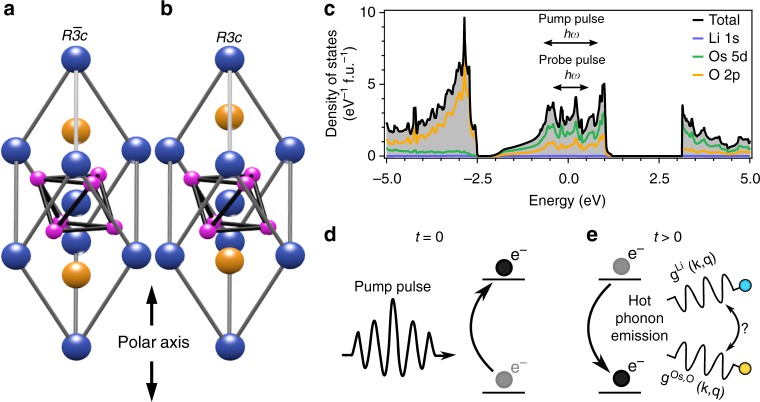
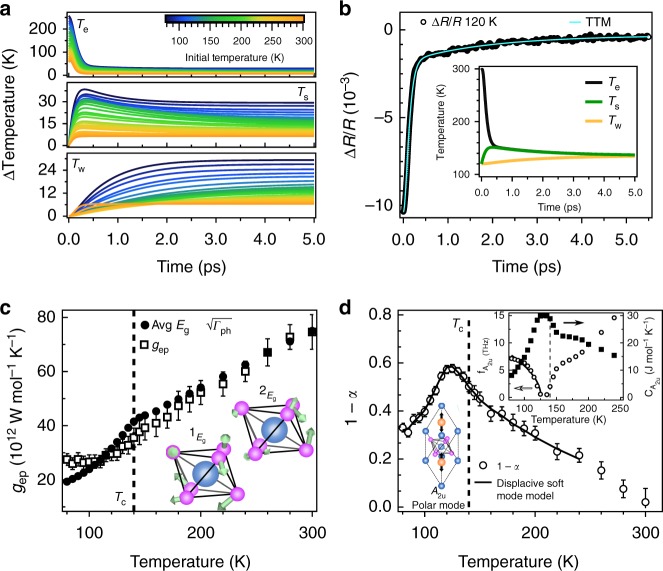
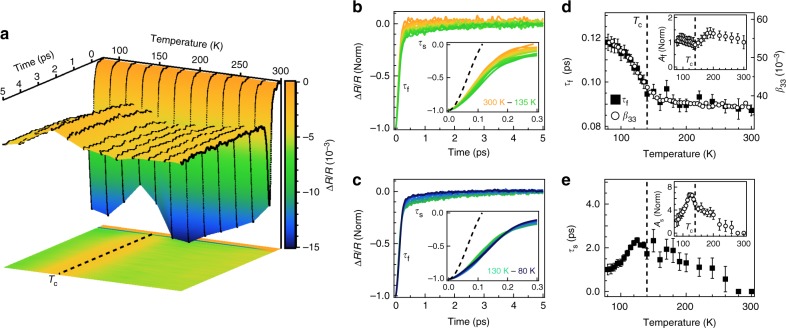
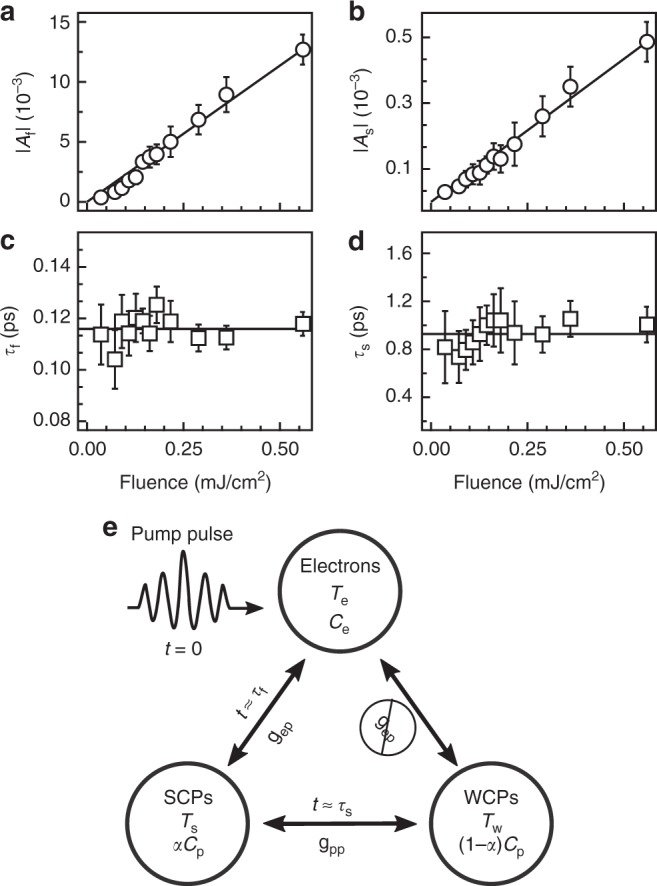
Over 50 years ago, Anderson and Blount proposed that ferroelectric-like structural phase transitions may occur in metals, despite the expected screening of the Coulomb interactions that often drive polar transitions. Recently, theoretical treatments have suggested that such transitions require the itinerant electrons be decoupled from the soft transverse optical phonons responsible for polar order. However, this decoupled electron mechanism (DEM) has yet to be experimentally observed. Here we utilize ultrafast spectroscopy to uncover evidence of the DEM in LiOsO the first known band metal to undergo a thermally driven polar phase transition (T ≈ 140 K). We demonstrate that intra-band photo-carriers relax by selectively coupling to only a subset of the phonon spectrum, leaving as much as 60% of the lattice heat capacity decoupled. This decoupled heat capacity is shown to be consistent with a previously undetected and partially displacive TO polar mode, indicating the DEM in LiOsO.
五十多年前,安德森和布朗特提出,尽管通常会屏蔽驱动极性转变的库仑相互作用,但金属中可能会发生类似铁电体的结构相变。最近,理论研究表明,这种转变要求巡游电子与负责极性有序的软横向光学声子解耦。然而,这种解耦电子机制(DEM)尚未得到实验观测。在此,我们利用超快光谱学在LiOsO中发现了DEM的证据,LiOsO是第一种已知的经历热驱动极性相变(T≈140K)的能带金属。我们证明,带内光载流子通过选择性地仅耦合到声子谱的一个子集来弛豫,使得高达60%的晶格热容量解耦。这种解耦的热容量与先前未检测到的部分位移型横向光学(TO)极性模式一致,表明LiOsO中存在DEM。