Department of Radiation Oncology, Sichuan Cancer Hospital & Institution, Sichuan Cancer Center, School of Medicine, University of Electronic Science and Technology of China, Radiation oncology Key Laboratory of Sichuan Province, Chengdu, 610041, China.
Department of Radiation Oncology, Fujian Cancer Hospital & Fujian Medical University Cancer Hospital, Fuzhou, 350014, China.
Sci Rep. 2019 Jul 19;9(1):10497. doi: 10.1038/s41598-019-46899-x.
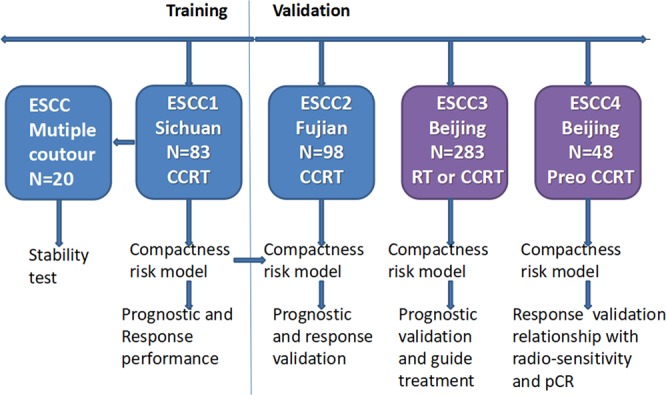
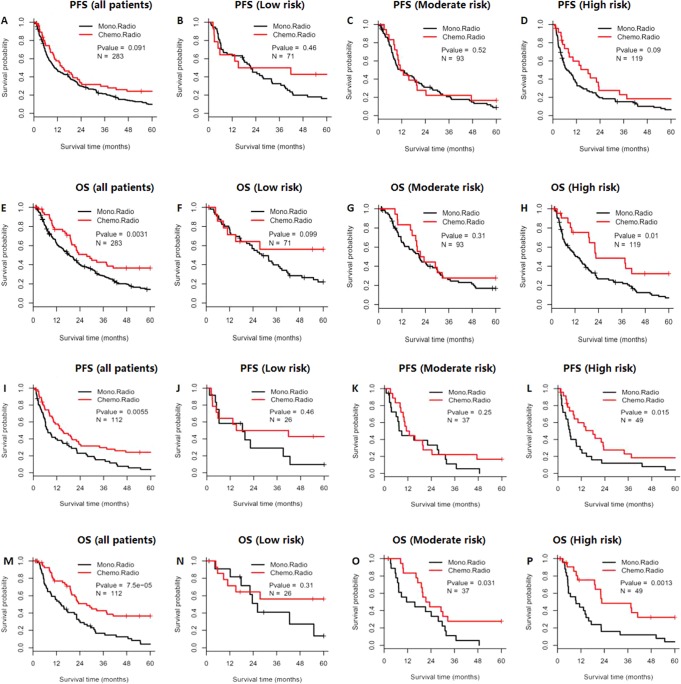
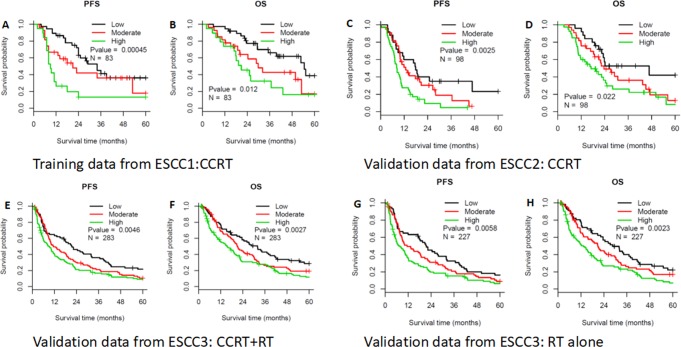
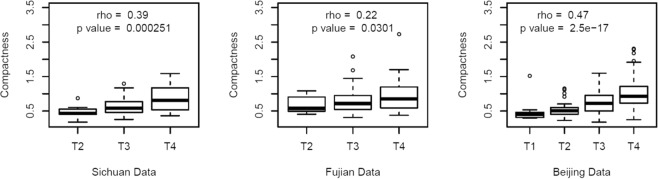
We aimed to establish a risk model using computed tomography-based compactness to predict overall survival (OS) and progression-free survival (PFS) after multimodal treatment for esophageal squamous cell carcinoma (ESCC). We extracted pre-treatment computed tomography-based tumor data (volume, surface area, and compactness) for 512 cases of ESCC that were treated at 3 centers. A risk model based on compactness was trained using Cox regression analyses of data from 83 cases, and then the model was validated using two independent cohorts (98 patients and 283 patients). The largest cohort (283 patients) was then evaluated using the risk model to predict response to radiotherapy with or without chemotherapy. In the three datasets, the pre-treatment compactness risk model provided good accuracy for predicting OS (P = 0.012, P = 0.022, and P = 0.003) and PFS (P < 0.001, P = 0.003, and P = 0.005). Patients in the low-risk group did not experience a significant OS benefit from concurrent chemoradiotherapy (P = 0.099). Furthermore, after preoperative concurrent chemoradiotherapy, the OS outcomes were similar among patients in the low-risk group who did and did not achieve a pathological complete response (P = 0.127). Tumor compactness was correlated with clinical T stage but was more accurate for predicting prognosis after treatment for ESCC, based on higher C-index values in all three datasets. The compactness-based risk model was effective for predicting OS and PFS after multimodal treatment for ESCC. Therefore, it may be useful for guiding personalized treatment.
我们旨在建立一个基于 CT 紧凑度的风险模型,以预测食管鳞癌(ESCC)经多模态治疗后的总生存期(OS)和无进展生存期(PFS)。我们从 3 个中心提取了 512 例 ESCC 患者的治疗前 CT 肿瘤数据(体积、表面积和紧凑度)。使用来自 83 例数据的 Cox 回归分析,基于紧凑度建立风险模型,然后使用两个独立队列(98 例患者和 283 例患者)验证模型。使用最大队列(283 例患者)评估风险模型,以预测放疗联合或不联合化疗的反应。在这三个数据集,治疗前的紧凑度风险模型对于预测 OS(P=0.012,P=0.022,P=0.003)和 PFS(P<0.001,P=0.003,P=0.005)具有良好的准确性。低风险组患者在同步放化疗中并未显著获益(P=0.099)。此外,在术前同步放化疗后,低风险组中达到和未达到病理完全缓解的患者的 OS 结果相似(P=0.127)。肿瘤紧凑度与临床 T 分期相关,但基于所有三个数据集更高的 C 指数值,对于预测 ESCC 治疗后预后更准确。基于 CT 紧凑度的风险模型可有效预测 ESCC 经多模态治疗后的 OS 和 PFS。因此,它可能有助于指导个性化治疗。