Robertson Institute of Biostatistics and Clinical Trials Unit, University of Glasgow, University Avenue, Glasgow, G12 8QQ, UK.
National Heart & Lung Institute and National Institute of Health Research Cardiovascular Biomedical Research Unit, Royal Brompton & Harefield Hospitals, Imperial College, London, UK.
Heart Fail Rev. 2020 Jan;25(1):147-159. doi: 10.1007/s10741-019-09829-7.
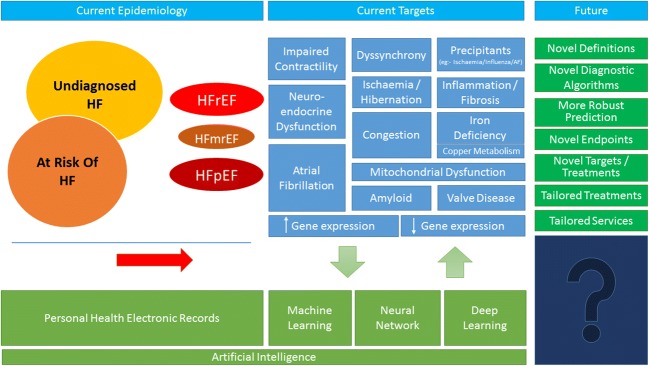
The management of heart failure has changed significantly over the last 30 years, leading to improvements in the quality of life and outcomes, at least for patients with a substantially reduced left ventricular ejection fraction (HFrEF). This has been made possible by the identification of various pathways leading to the development and progression of heart failure, which have been successfully targeted with effective therapies. Meanwhile, many other potential targets of treatment have been identified, and the list is constantly expanding. In this review, we summarise planned and ongoing trials exploring the potential benefit, or harm, of old and new pharmacological interventions that might offer further improvements in treatment for those with HFrEF and extend success to the treatment of patients with heart failure with preserved left ventricular ejection fraction (HFpEF) and other heart failure phenotypes.
在过去的 30 年中,心力衰竭的管理发生了重大变化,至少对左心室射血分数明显降低(HFrEF)的患者而言,提高了生活质量和治疗效果。这得益于对导致心力衰竭发生和发展的各种途径的识别,并通过有效的治疗成功靶向这些途径。同时,已经确定了许多其他潜在的治疗靶点,而且这个清单还在不断扩大。在这篇综述中,我们总结了正在计划和进行的试验,这些试验探讨了旧的和新的药理学干预措施的潜在益处或危害,这些干预措施可能会进一步改善 HFrEF 患者的治疗效果,并将成功扩展到治疗射血分数保留的心力衰竭(HFpEF)和其他心力衰竭表型的患者。