Park Sungsoo, Park Joong-Min, Kim Jin-Jo, Lee In-Seob, Han Sang-Uk, Seo Kyung Won, Kwon Jin Won
Department of Surgery, Korea University College of Medicine, Seoul, Korea.
Department of Surgery, Chung-Ang University College of Medicine, Seoul, Korea.
J Neurogastroenterol Motil. 2019 Jul 1;25(3):394-402. doi: 10.5056/jnm19059.
BACKGROUNDS/AIMS: This multicenter study aims to evaluate the effect and feasibility of anti-reflux surgery compared with medical treatment for gastroesophageal reflux disease (GERD).
Patients with GERD who were undergoing medical treatment with proton pump inhibitors for more than 8 weeks and those who were scheduled to undergo anti-reflux surgery were enrolled. Efficacy of pre-operative medical treatment was evaluated retrospectively and effect of anti-reflux surgery was prospectively evaluated at 1 week and 3 months after surgery. Quality of life (QOL) was also investigated before and after surgery.
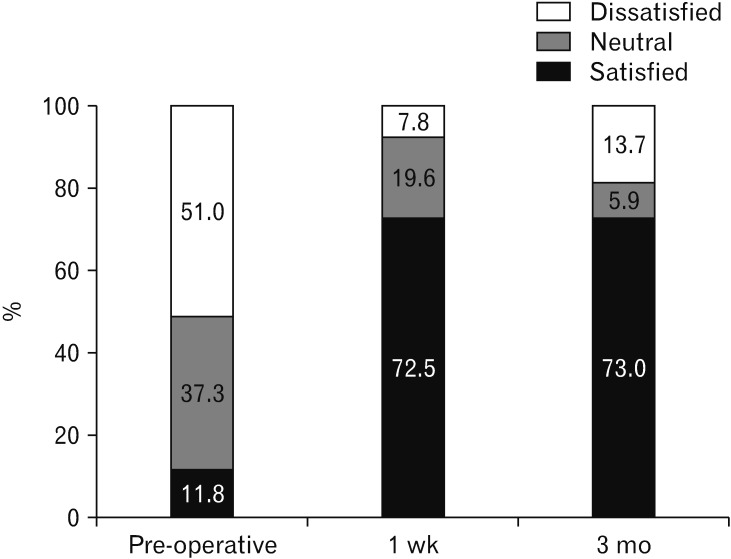
Between February and October 2018, 51 patients underwent laparoscopic Nissen fundoplication for treating GERD at 5 hospitals in Korea. Thirty-four patients (66.7%) showed poor proton pump inhibitor response. At 3 months after surgery, heartburn was completely resolved in 87.9% patients and partially improved in 9.1%. Acid regurgitation was completely resolved in 82.9% and partially improved in 11.4%. Atypical extraesophageal symptoms were completely controlled in 45.5% and partially controlled in 36.4%. GERD-related QOL scores at 1 week after surgery significantly improved compared with pre-operative scores. There was no difference in GERD-related QOL scores between 1 week and 3 months after surgery. General QOL measured with European QOL-5 dimensions and health-related QOL instrument with 8 items significantly improved after anti-reflux surgery. Satisfaction with treatment was significantly higher after surgery than before surgery (72.5% vs 11.8%, < 0.001).
Anti-reflux surgery improved GERD symptoms and QOL in patients. Anti-reflux surgery is an effective treatment option compared with medical treatment for GERD patients selected for surgical treatment.
背景/目的:本多中心研究旨在评估抗反流手术与药物治疗相比,对胃食管反流病(GERD)的疗效和可行性。
纳入正在接受质子泵抑制剂治疗超过8周的GERD患者以及计划接受抗反流手术的患者。回顾性评估术前药物治疗的疗效,并前瞻性评估术后1周和3个月时抗反流手术的效果。同时还调查了手术前后的生活质量(QOL)。
2018年2月至10月期间,韩国5家医院的51例患者接受了腹腔镜Nissen胃底折叠术治疗GERD。34例患者(66.7%)对质子泵抑制剂反应不佳。术后3个月时,87.9%的患者烧心症状完全缓解,9.1%部分改善。反酸症状完全缓解的患者占82.9%,部分改善的占11.4%。非典型食管外症状完全得到控制的患者占45.5%,部分得到控制的占36.4%。术后1周时GERD相关的QOL评分与术前相比显著改善。术后1周和3个月时GERD相关的QOL评分无差异。采用欧洲五维度健康量表和8项健康相关生活质量工具测量的总体QOL在抗反流手术后显著改善。患者对治疗的满意度术后明显高于术前(72.5%对11.8%,<0.001)。
抗反流手术改善了GERD患者的症状和生活质量。对于选择手术治疗的GERD患者,抗反流手术是一种比药物治疗更有效的治疗选择。